
Falkirk Wheel panorama
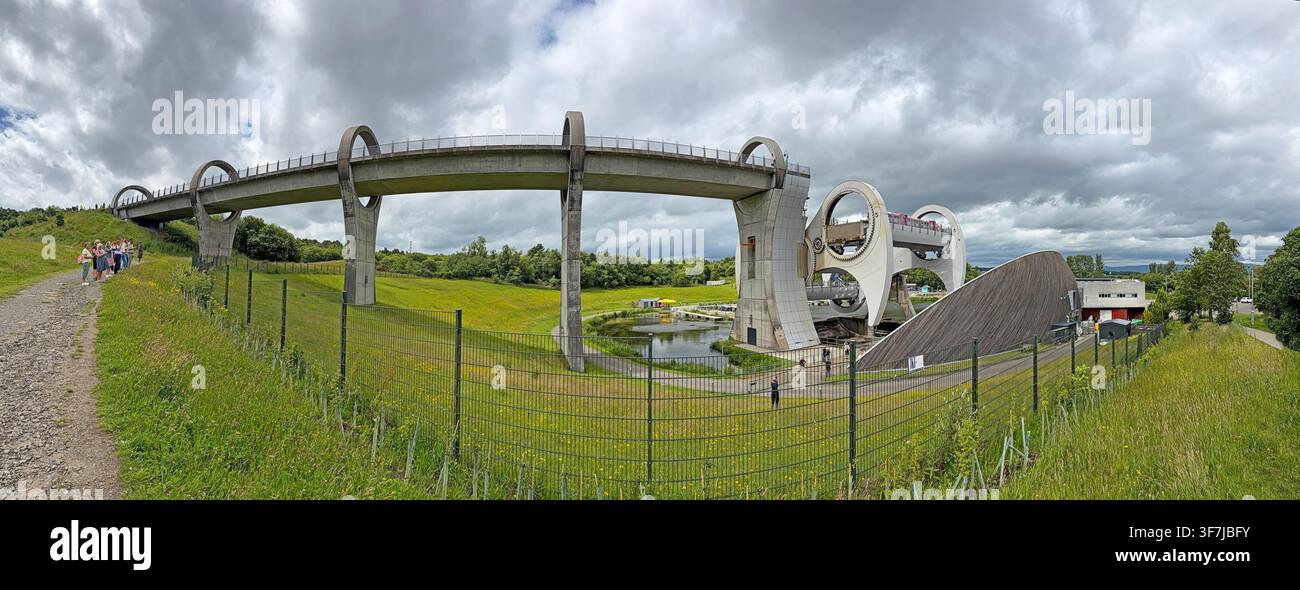
Image details
Contributor:
Tony SmithImage ID:
3F7JBFYFile size:
85 MB (4.7 MB Compressed download)Releases:
Model - no | Property - noDo I need a release?Dimensions:
8790 x 3381 px | 74.4 x 28.6 cm | 29.3 x 11.3 inches | 300dpiDate taken:
27 June 2026Location:
Falkirk, Scotland, UKMore information:
Wide panoramic view of the Falkirk Wheel at Falkirk, Scotland, the world's only rotating boat lift and one of the most distinctive modern engineering landmarks on the British canal network. The structure links the Forth & Clyde Canal with the Union Canal, replacing the historic flight of locks that once connected waterways at different levels. Opened in 2002 as a centrepiece of the Millennium Link restoration project, the Wheel raises and lowers boats between the lower basin and an aqueduct using two opposing water-filled gondolas balanced around a central axle. Its sculptural form has been compared with a pair of Celtic double-headed axes and has become an internationally recognisable symbol of Scottish engineering. A half rotation takes only a few minutes and uses relatively little energy because the two gondolas remain balanced according to Archimedes' principle, with a boat displacing its own weight in water. The surrounding visitor attraction includes canal walks, boat trips, cycling routes and views towards the landscaped central Scotland corridor. The panoramic format places the Wheel within its wider basin and landscape, illustrating both the scale of the structure and its role in reconnecting Scotland's east-west canal system. Since opening, it has become one of Falkirk's principal tourist attractions and an example of how modern engineering can revive historic transport infrastructure while creating a new cultural landmark. It also works for features on engineering education, STEM, Scottish family holidays and adaptive reuse of canals, showing how infrastructure originally built for freight can be reimagined for leisure, heritage, active travel and tourism. The Falkirk Wheel opened in 2002 as a rotating boat lift linking the Forth and Clyde Canal with the Union Canal, replacing the former flight of locks that once connected the waterways.

