
Cold War East German Stasi monitoring display in Berlin, showing a CRT screen, cassette tape recorders and MFS state surveillance technology.
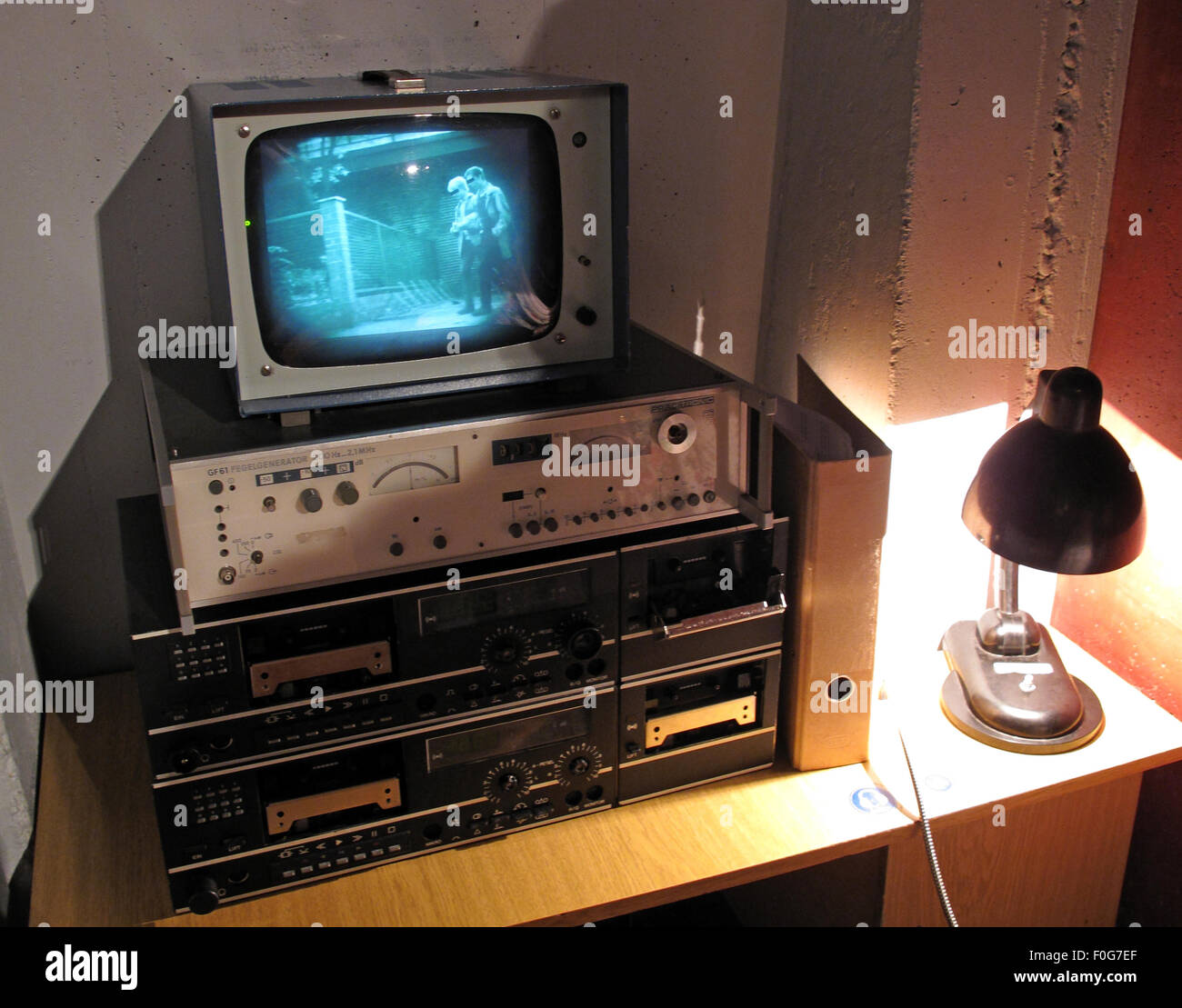
Image details
Contributor:
Tony SmithImage ID:
F0G7EFFile size:
25.9 MB (938.7 KB Compressed download)Releases:
Model - no | Property - noDo I need a release?Dimensions:
3396 x 2664 px | 28.8 x 22.6 cm | 11.3 x 8.9 inches | 300dpiDate taken:
8 August 2012Location:
Stasi Museum Berlin, Ruschestraße 103, Haus 1, 10365 Berlin, GermanyMore information:
DDR-era Stasi surveillance and monitoring equipment is shown on display in Berlin, with a small CRT security monitor above stacked analogue cassette tape recorders, control units, switches, dials and recording decks. The dimly lit interior, desk lamp and heavy electronic hardware evoke the practical machinery of Cold War spying, before digital surveillance replaced magnetic tape, cathode ray tube screens and manual monitoring rooms. The equipment is associated with the East German Ministry for State Security, known as the Stasi or MfS, which operated one of the most intrusive domestic intelligence systems in post-war Europe. In the German Democratic Republic, surveillance was used to monitor political opponents, dissidents, church groups, writers, artists, foreign visitors and ordinary citizens suspected of disloyalty to the ruling SED state. The Stasi Museum Berlin is located in House 1 of the former Stasi headquarters in Berlin-Lichtenberg and documents the organisation’s role in political repression, intelligence gathering and everyday state control. Displays at the museum include original technology such as bugs, hidden cameras and other surveillance devices, alongside the preserved office of Erich Mielke, the long-serving Minister for State Security. This photograph is useful for editorial themes including East German history, Cold War Berlin, state surveillance, civil liberties, dictatorship, intelligence services, analogue recording, spy technology, political policing, secret police archives, human rights and the legacy of communist rule in Europe. The screen’s blue-toned image and the banks of black and silver recording equipment create a strong visual shorthand for covert observation and monitored private life. The scene is indoors, with no weather visible, and appears to be a museum or historical exhibition rather than an operational setting. It records the physical tools of twentieth-century surveillance and the chilling administrative ordinariness of a s

