
Easter Rising 1916 Republican mural on Whiterock Road, Ballymurphy, West Belfast, showing the GPO and Irish tricolour.
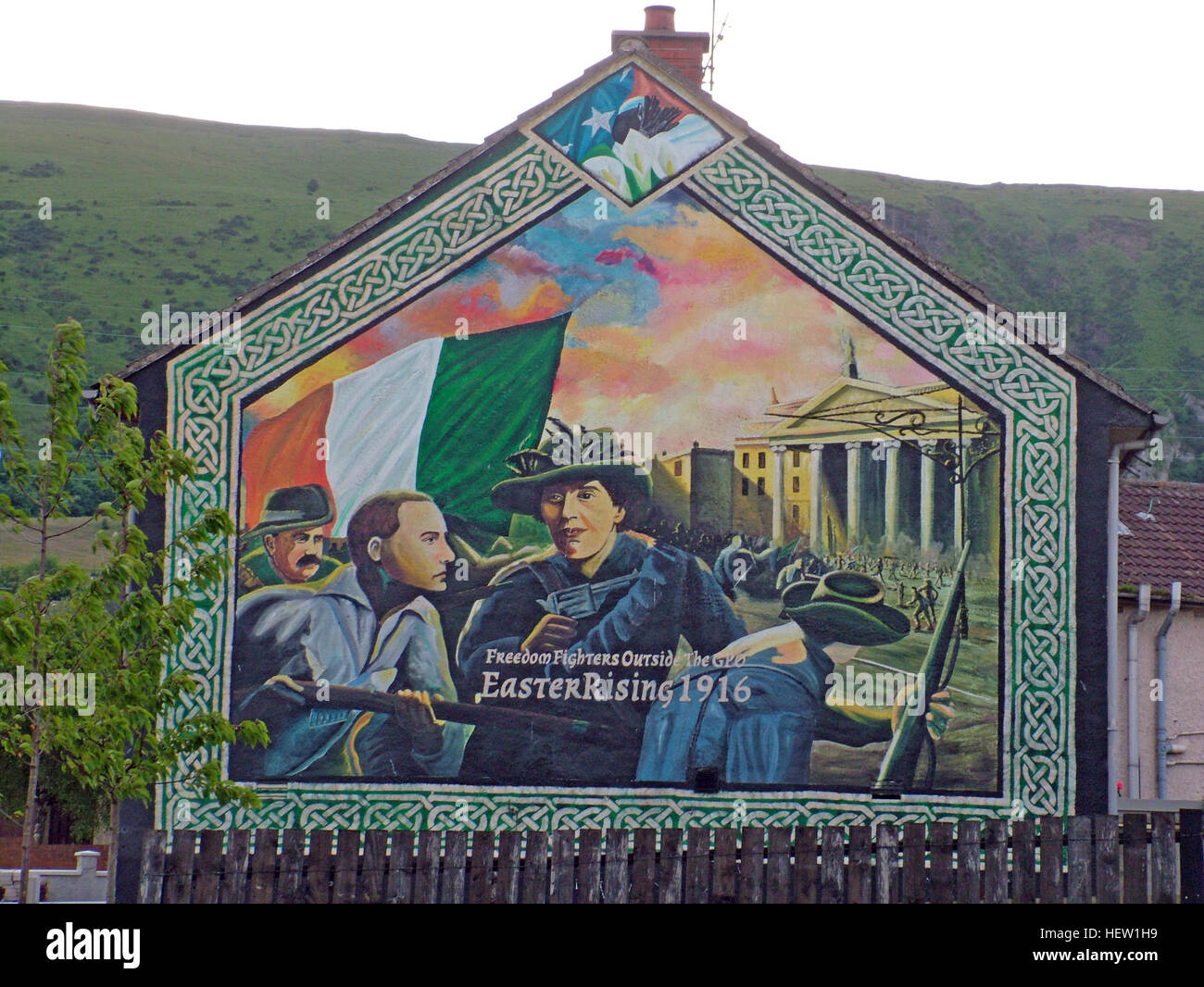
Image details
Contributor:
Tony SmithImage ID:
HEW1H9File size:
35.2 MB (1.7 MB Compressed download)Releases:
Model - no | Property - noDo I need a release?Dimensions:
4048 x 3040 px | 34.3 x 25.7 cm | 13.5 x 10.1 inches | 300dpiDate taken:
22 December 2016Location:
Whiterock Road, Ballymurphy, West Belfast, Northern Ireland, BT12.More information:
Gable-end Republican mural on Whiterock Road in Ballymurphy, West Belfast, depicting the 1916 Easter Rising with armed figures outside the General Post Office in Dublin, an Irish tricolour and Celtic border decoration. The mural is recorded by CAIN as a Nationalist and Republican mural with the wording “Freedom fighters outside the GPO. Easter Rising 1916”, showing Pearse, Connolly and Countess Markievicz leading the attack on the GPO below the Irish tricolour. Extramural Activity also identifies the scene as Countess Markievicz outside the Dublin GPO, accompanied by Connolly and Pearse, and places it on Whiterock Road, west Belfast. The photograph has strong editorial value for themes including Belfast murals, West Belfast, Ballymurphy, Irish Republican visual culture, the Easter Rising, political murals, public art, housing estate identity, conflict memory, Irish nationalism, post-conflict tourism and the use of gable walls as sites of historical storytelling. The hillside behind the houses, likely part of the Belfast Hills and Black Mountain backdrop, helps place the mural within the elevated west Belfast landscape rather than a flat city centre street. The overcast sky, timber fence, grass verge and residential setting show how political imagery is embedded in everyday neighbourhood space, where memorial, identity, heritage, tourism and contested history overlap. The mural connects Belfast’s Republican mural tradition with the wider story of the 1916 Rising in Dublin, when the GPO became one of the symbolic centres of the rebellion. Its painted references to the tricolour, volunteers and the neoclassical GPO make it useful for stock searches around Irish independence, commemoration, political identity and public memory. It suits articles on mural tours, Irish history, Northern Ireland politics, Troubles legacy, nationalist commemoration, documentary photography, community art, cultural memory and political symbolism.

