
Men to the left, because women are always right, sign on an old brick wall
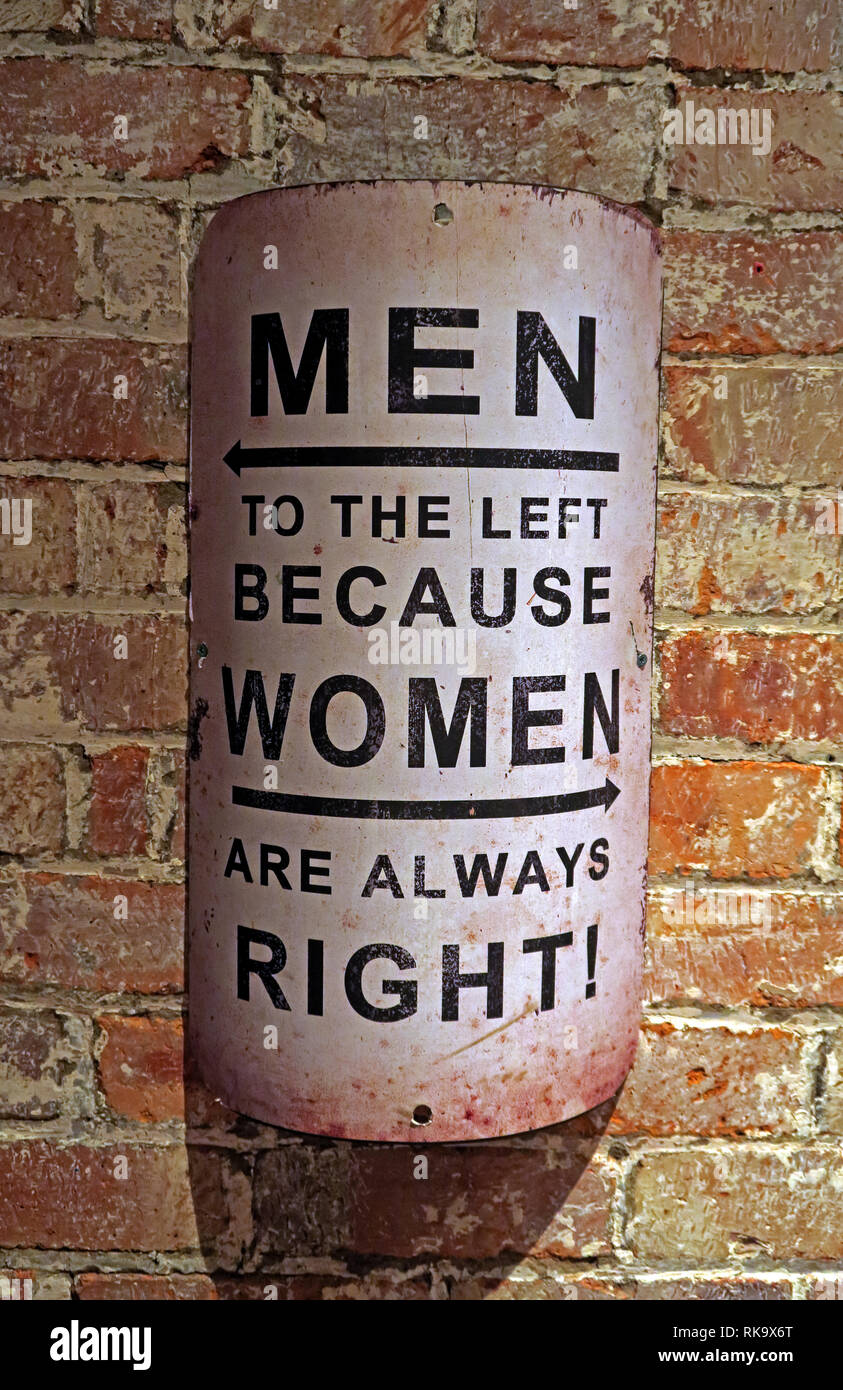
Image details
Contributor:
Tony SmithImage ID:
RK9X6TFile size:
55.6 MB (3.5 MB Compressed download)Releases:
Model - no | Property - noDo I need a release?Dimensions:
3552 x 5472 px | 30.1 x 46.3 cm | 11.8 x 18.2 inches | 300dpiDate taken:
28 January 2019Location:
Warrington, Cheshire, England, UK, WA4 1NNMore information:
. A close documentary record preserves the working environment around Warrington, Cheshire, England, UK, WA4 1NN, in a 2019 record. Within that setting the photograph concentrates on Men to the left, because women are always right, sign on an old brick wall. Further features of the subject include local identity, visual record, contemporary social history, modern history, cultural landscape, documentary photography, urban and rural change, regional identity, documentary record, changing Britain, public realm, and everyday infrastructure. In the mid-2020s, social history is increasingly discussed through business turnover and new technology, with attention turning to a clearer record of local change. The date and location give the photograph archival strength: future views of Warrington, Cheshire, England, UK, WA4 1NN may show different businesses, branding, services, architecture, traffic patterns or redevelopment, allowing clear before-and-after comparison. Beyond the immediate subject, the setting involves place-based history, everyday Britain, social context, local character, social landscape, community environment. Associated details include witty, wit, relationships, love, Men to the left because women are always right, signs. The scene also carries the language of community life, and place and memory. Current debate around community change often combines the passage of time, shifts in local identity and the practical challenge of preservation of everyday detail. As the location changes, the frame remains a reference for public access, architecture and streetscape, transport patterns, neighbourhood identity, and ownership or occupation as part of the area's longer social history. In historical comparison, the image can help trace regional identity, local business activity, public-realm details, the condition of buildings, and patterns of everyday use without relying on a generic or reconstructed view.

