
Maroon 1969 Rolls Royce Silver Shadow 7407 TU classic car parked in Stretton, Warrington, Cheshire, North West England, UK
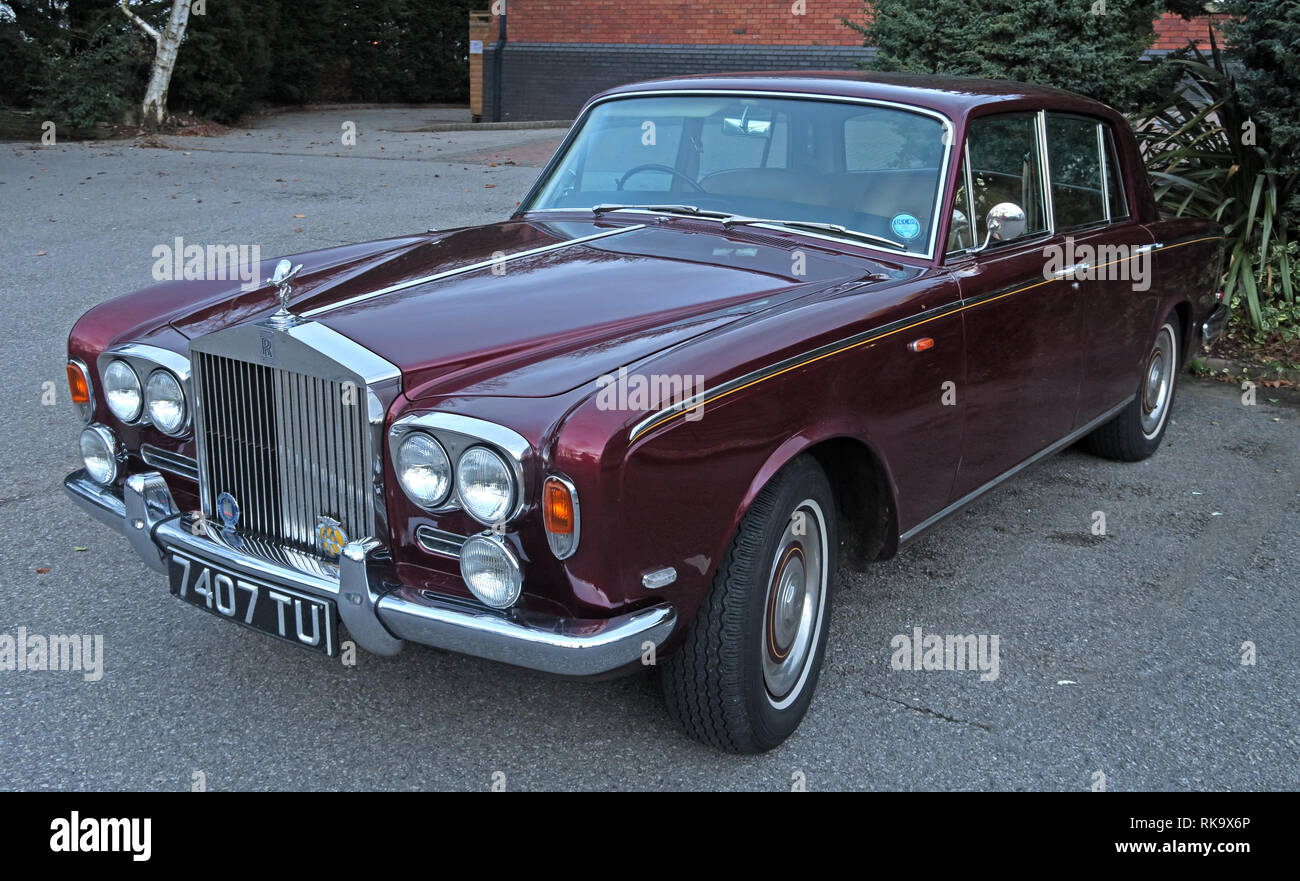
Image details
Contributor:
Tony SmithImage ID:
RK9X6PFile size:
49.7 MB (2.5 MB Compressed download)Releases:
Model - no | Property - noDo I need a release?Dimensions:
5340 x 3252 px | 45.2 x 27.5 cm | 17.8 x 10.8 inches | 300dpiDate taken:
27 January 2019Location:
Stretton, Warrington, Cheshire, North West England, UKMore information:
The Rolls-Royce Silver Shadow is a full-sized luxury car produced by British automaker Rolls-Royce in various forms from 1965 to 1980. It was the first of the marque to use unitary body and chassis construction. The Silver Shadow was produced from 1965 to 1976, and the Silver Shadow II from 1977 to 1980. To date, the combined model run of 30, 057 units manufactured is the largest production volume of any Rolls-Royce model A Bentley-badged version, the T-series, was produced from 1965 through 1980 in 2, 336 examples. The Silver Shadow was originally intended to be called Rolls-Royce Silver Mist, but was replaced with Silver Shadow at the last minute due to Mist meaning "manure" or "crap" in German. It was designed with several modernisations in response to concerns that the company was falling behind in automotive innovation, most notably in its unitary construction. Other new features included disc brakes replacing drums, and independent rear suspension instead of the outdated live rear axle design of previous Rolls-Royce models. The standard wheelbase Silver Shadow measured 203.5 inches (5, 170 mm), 4, 700 lb (2, 100 kg) and had a book price of £6, 557 in the first year of production. The Shadow featured a 172 hp (128 kW) 6.2 L V8 from 1965 to 1969, and a 189 hp (141 kW) 6.75 L V8 from 1970 to 1980. Left-hand-drive models were coupled to the recently introduced Turbo-Hydramatic 400 automatic gearbox sourced from General Motors (GM). Pre-1970, right-hand-drive (RHD) models used a highly modified, aluminum-cased version of the original cast-iron 4-speed Hydra-Matic gearbox that had been built in Crewe under license from GM since 1953. From 1968, export RHD cars gained the Turbo-Hydramatic 400, and by 1970, the 4-speed unit had been completely phased out even in the home market

