
Traffic cone crowns Glasgow’s Duke of Wellington statue in Royal Exchange Square, continuing a decades-old Scottish urban tradition much repeated
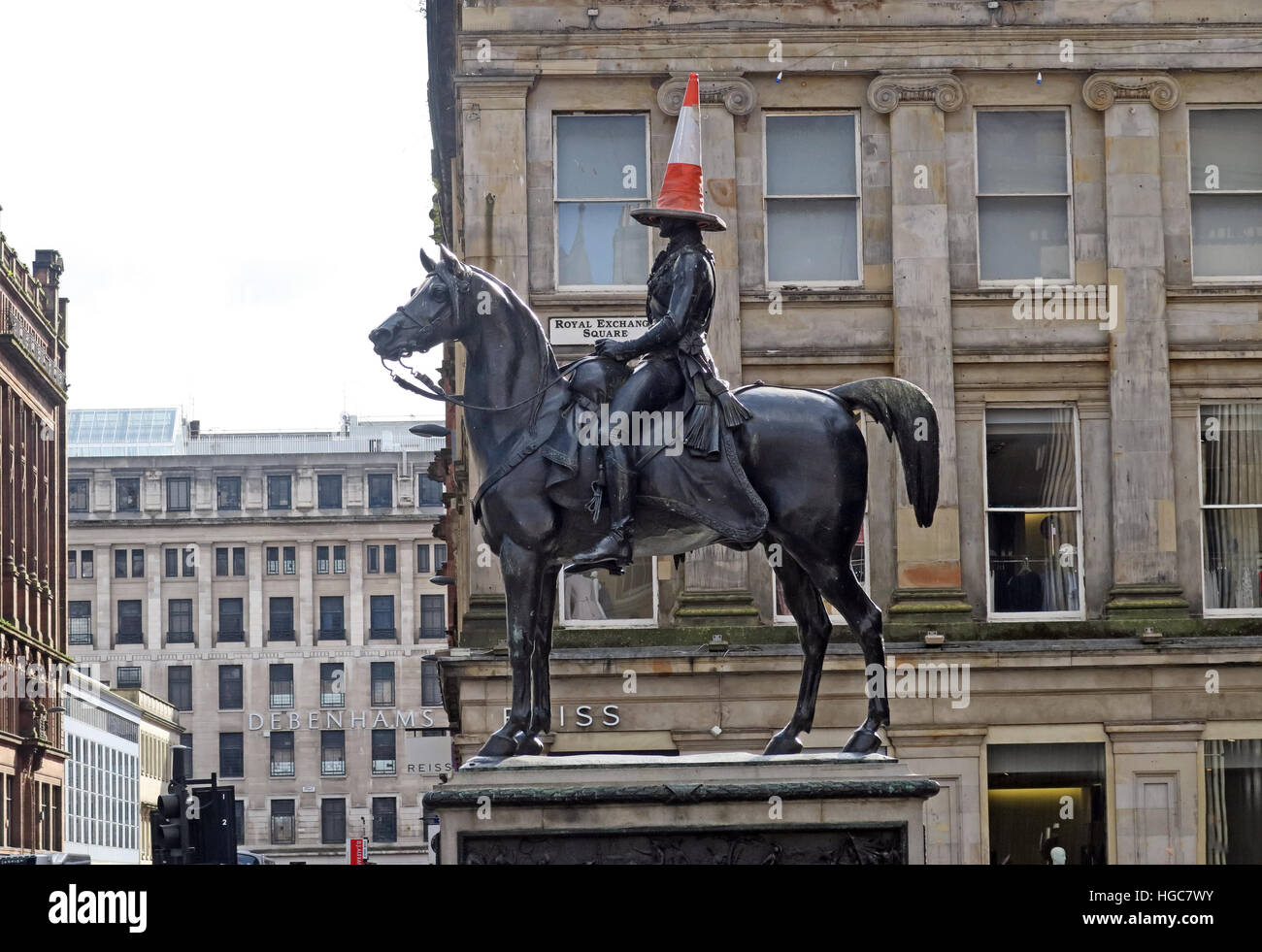
Image details
Contributor:
Tony SmithImage ID:
HGC7WYFile size:
35.2 MB (1.5 MB Compressed download)Releases:
Model - no | Property - noDo I need a release?Dimensions:
4236 x 2904 px | 35.9 x 24.6 cm | 14.1 x 9.7 inches | 300dpiDate taken:
22 September 2016Location:
Royal Exchange Square, Queen Street at Ingram Street, Glasgow, Scotland, UKMore information:
Famous equestrian statue of the Duke of Wellington in Glasgow city centre wears an orange traffic cone, continuing one of Scotland’s best-known examples of irreverent urban humour. Sculpted by Italian-born Carlo Marochetti and erected in 1844, the bronze monument depicts Arthur Wellesley, 1st Duke of Wellington, mounted on his horse Copenhagen and stands outside Glasgow’s Gallery of Modern Art at Royal Exchange Square. The statue is now Category A listed, but since at least the early 1980s members of the public, frequently associated in popular accounts with students, revellers and Glasgow nightlife, have repeatedly climbed the monument and placed a road cone on Wellington’s head. The exact first coning is difficult to prove, so claims that one particular student invented the tradition should be treated cautiously. What began as a prank developed into an unofficial Glasgow institution, celebrated as an expression of the city’s cheeky, anti-pomp and distinctly Glaswegian sense of humour. Council staff and police repeatedly removed cones, only for replacements to appear, sometimes within hours. The repeated cycle became expensive and increasingly futile. In 2013 Glasgow City Council proposed spending about £65, 000 altering and raising the plinth to make the statue harder to climb, arguing that regular cone removal cost around £100 each time and risked damage to the historic monument. The attempt backfired spectacularly. More than 10, 000 people signed an online petition opposing the scheme, while a Save the Cone campaign attracted tens of thousands of supporters. Faced with the public reaction, the council withdrew the proposal. The cone consequently survived official attempts to suppress it and evolved from supposed vandalism into an internationally recognised Glasgow emblem. Banksy later cited the permanently coned Wellington as a reason for choosing GoMA for his 2023 exhibition, while Glasgow Life now describes the self-perpetuating cone as an iconic part of the city

