
Derelict working class Belfast terrace beside a loyalist Troubles memorial mural near Shankill Road, showing poverty and conflict legacy.
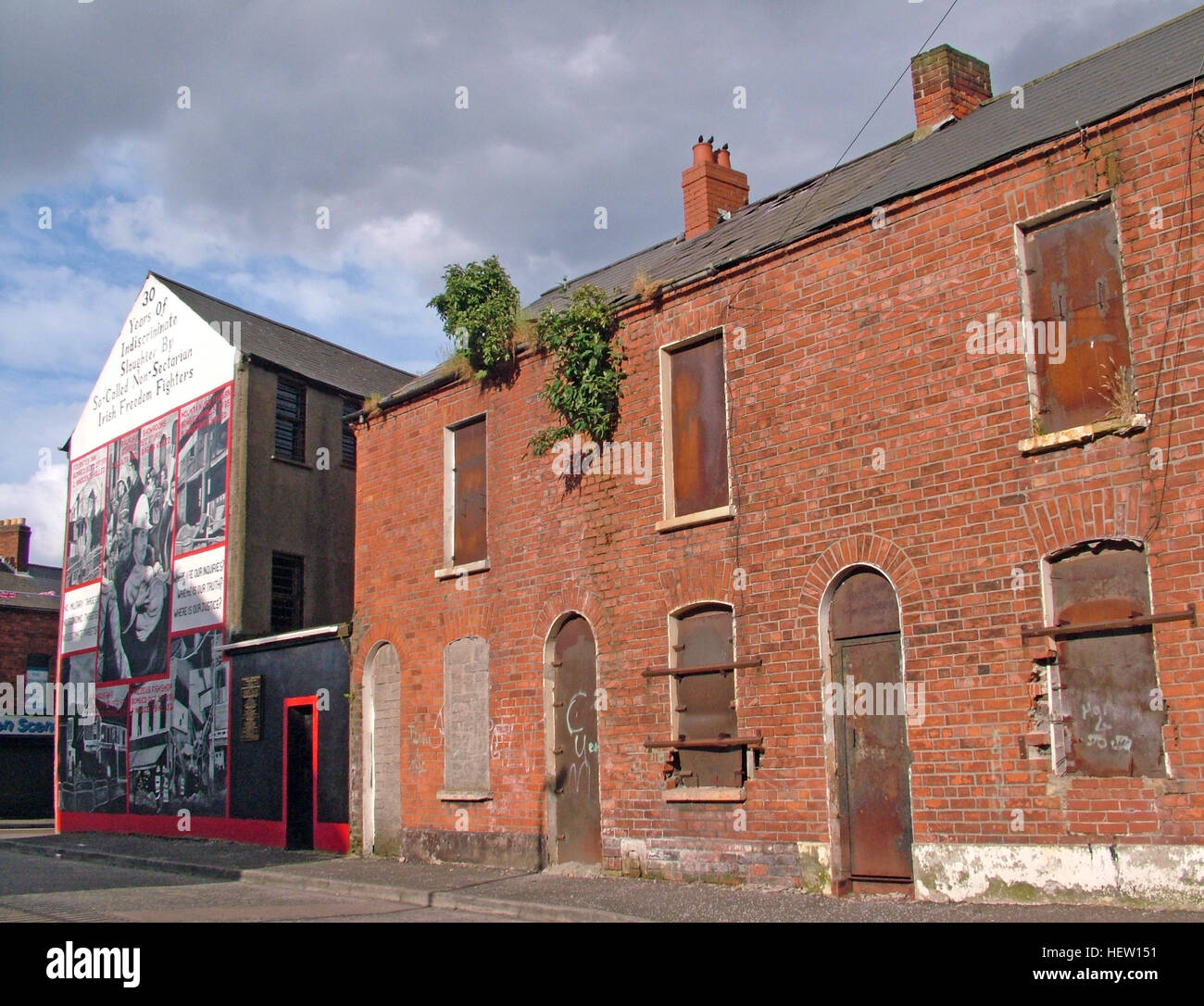
Image details
Contributor:
Tony SmithImage ID:
HEW151File size:
30.8 MB (1.5 MB Compressed download)Releases:
Model - no | Property - noDo I need a release?Dimensions:
3748 x 2872 px | 31.7 x 24.3 cm | 12.5 x 9.6 inches | 300dpiDate taken:
22 December 2016Location:
Bellevue Street in West Belfast, UK, BT13 2BTMore information:
A row of small red brick two up, two down terraced houses stands boarded and partly derelict beside the “30 Years of Slaughter” loyalist mural off the Shankill Road in West Belfast, Northern Ireland. The image combines poor working class housing, urban decay and the visual politics of the Troubles in one street scene. The houses have sealed doors, covered windows, damaged brickwork, weeds growing from the roofline and a general sense of abandonment, making the photograph useful for editorial stories about housing poverty, inner city decline, dereliction, regeneration, poor urban conditions and the long social shadow of conflict. The adjoining mural refers to “30 years of indiscriminate slaughter” and is associated with loyalist and Protestant, Unionist, Loyalist community memory around attacks including the Four Step Inn, Balmoral Showrooms, Mountainview Tavern, Bayardo Bar and Frizzell’s Fish Shop. It is a highly charged example of Belfast political mural culture, using public wall space to express grief, anger, identity and contested historical memory. The contrast between the memorial mural and the modest brick terrace is especially strong for themes around everyday life beside political symbolism, the overlap of poverty and sectarian history, and the way ordinary streets became carriers of public memory during and after the Northern Ireland Troubles. The photograph can illustrate Belfast mural tours, conflict tourism, dark tourism, post conflict urban landscapes, Shankill Road history, loyalist murals, social housing history, urban renewal, neglected housing stock, community identity and documentary street photography. The scene appears to be photographed in daylight under mixed blue sky and cloud, with direct sun catching the red brickwork while grey cloud adds a sombre mood. The image has strong commercial and editorial relevance for Northern Ireland politics, British and Irish history, architecture, housing deprivation, urban regeneration, working class

