
Illuminated Union Jack neon artwork in red, white and blue
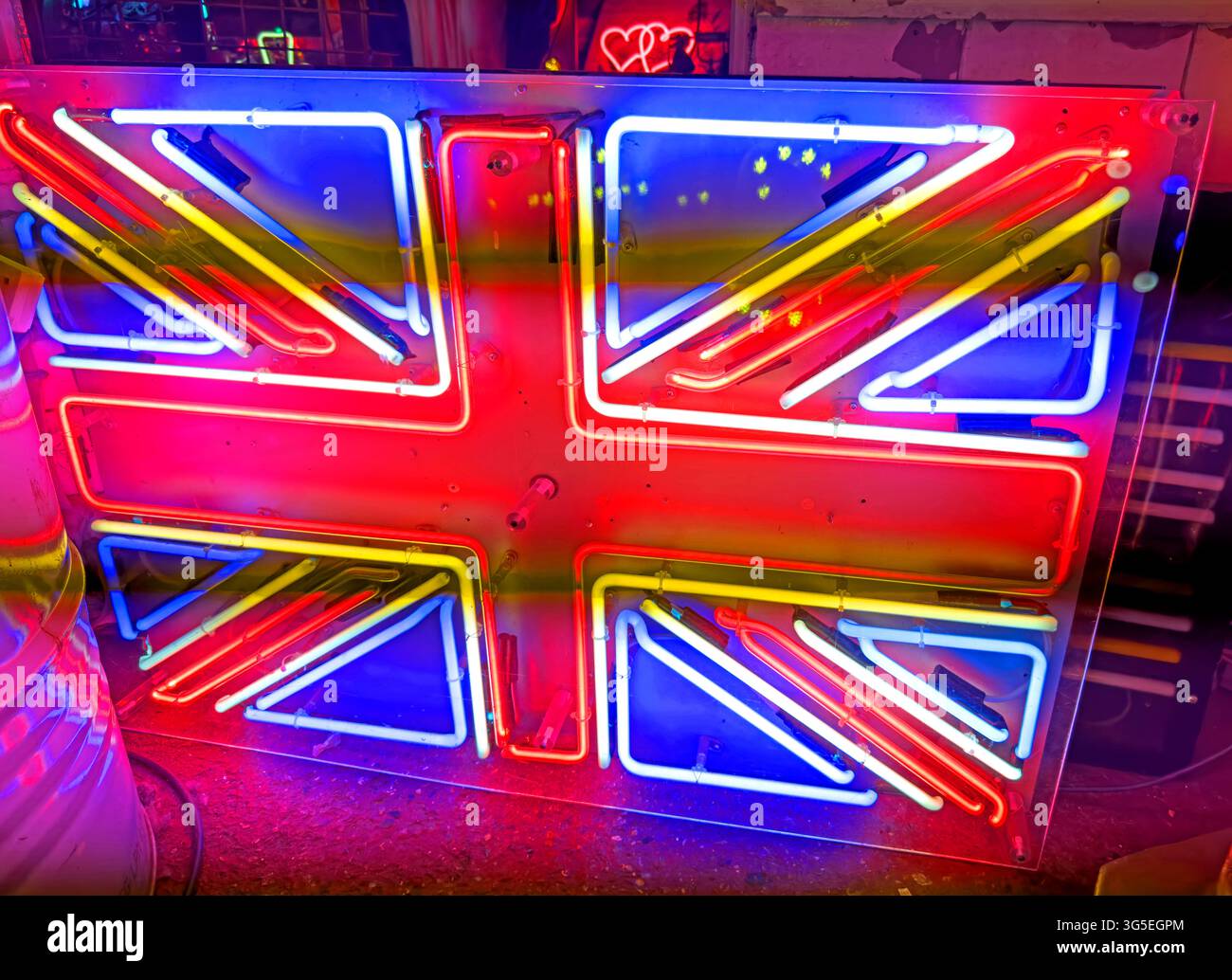
Image details
Contributor:
Tony SmithImage ID:
3G5EGPMFile size:
86.9 MB (2.3 MB Compressed download)Releases:
Model - no | Property - noDo I need a release?Dimensions:
6464 x 4697 px | 54.7 x 39.8 cm | 21.5 x 15.7 inches | 300dpiDate taken:
21 May 2023Location:
UKMore information:
. Bright illuminated tubes form the intersecting crosses of the Union flag against a dark reflective background. Red and blue dominate the rectangular design, with pale illuminated lines defining the diagonals and central cross. Reflections create additional colour around the edges of the installation. The photograph concentrates on the graphic construction of the national symbol as decorative lighting. The Union flag combines the crosses of St George, St Andrew and St Patrick, representing the historical unions that formed the United Kingdom. The present design dates from 1801, following the union with Ireland. Its distinctive diagonal arrangement is reproduced here with coloured illuminated tubing, translating a fabric flag design into a fixed graphic object. The flag is used across civic, commercial and cultural settings as an emblem of national identity. Its decorative presentation is also associated with British-themed interiors, souvenirs and popular design. Wales is represented historically through its union with England. In a traditional luminous discharge tube an electrical current excites gas sealed within shaped glass; neon itself emits an orange-red light, while other gases and coatings produce additional colours. Georges Claude demonstrated neon lighting publicly in Paris in 1910, preceding its widespread adoption for commercial signs. The first combined flag was proclaimed in 1606 for maritime use, three years after the English and Scottish crowns came under one monarch. A later proclamation in 1634 reserved it for royal warships. The Flag Institute has campaigned since 2008 for wider adoption of the original three-to-five proportions; the familiar naval version is normally twice as long as it is high. The offset diagonals also provide a means of checking the orientation of a flag on a pole.

