
Stanley Street Liverpool Pride Quarter street sign with rainbow flag.
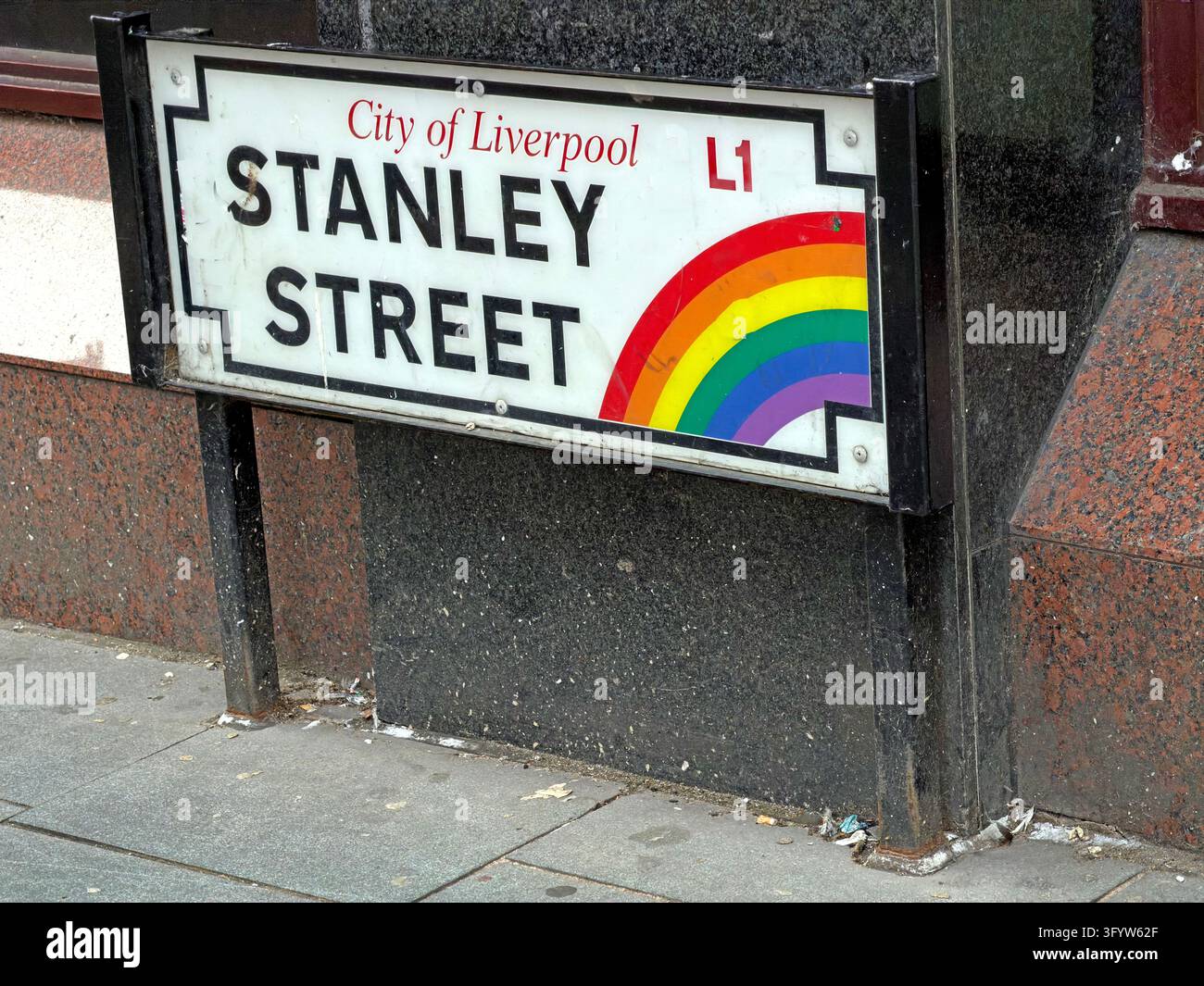
Image details
Contributor:
Tony SmithImage ID:
3FYW62FFile size:
98.2 MB (5.9 MB Compressed download)Releases:
Model - no | Property - noDo I need a release?Dimensions:
6764 x 5073 px | 57.3 x 43 cm | 22.5 x 16.9 inches | 300dpiDate taken:
19 September 2026Location:
Stanley Street, Liverpool, L1More information:
. A white street sign reading STANLEY STREET is fixed to a dark stone wall in Liverpool, accompanied by CITY OF LIVERPOOL L1 lettering and a rainbow graphic. Stanley Street lies within Liverpool’s Pride Quarter, a district associated with LGBTQ+ venues and community life. The rainbow element gives the otherwise traditional street-name plate a clear contemporary identity. The image closely documents a recognisable piece of public wayfinding and the representation of sexual and gender diversity within the city-centre streetscape. The white street-name plate reads City of Liverpool L1 and STANLEY STREET in large black characters, with a rainbow stripe curving around the right-hand side. It is fixed to a dark surface at a street corner and shows the council's street naming format combined with Pride colours. Stanley Street is closely associated with Liverpool's LGBTQ nightlife and is a central location in the city's Pride Quarter. Rainbow imagery is widely used as a symbol of LGBTQ communities and events, and its inclusion on street furniture connects local place identity with visible public recognition. Liverpool has a network of bars, clubs and organisations serving diverse communities, with the area around Stanley Street developing a distinctive cultural association. The image is deliberately close-framed so that the wording and coloured stripes dominate, with prominent lettering and rainbow markings. The rectangular sign has a narrow black border, angled left edge and bold sans-serif lettering legible to people travelling along the street. The council's wording gives the sign an official appearance, while the rainbow graphic marks a particular local cultural identity. The postcode district L1 appears in the top right, an additional geographic clue for the city-centre position. The photograph brings together wayfinding, public signage, equality symbolism and the social geography of Liverpool's established nightlife area.

