
Greenpeace Big Gas campaign posters on a Liverpool wall.
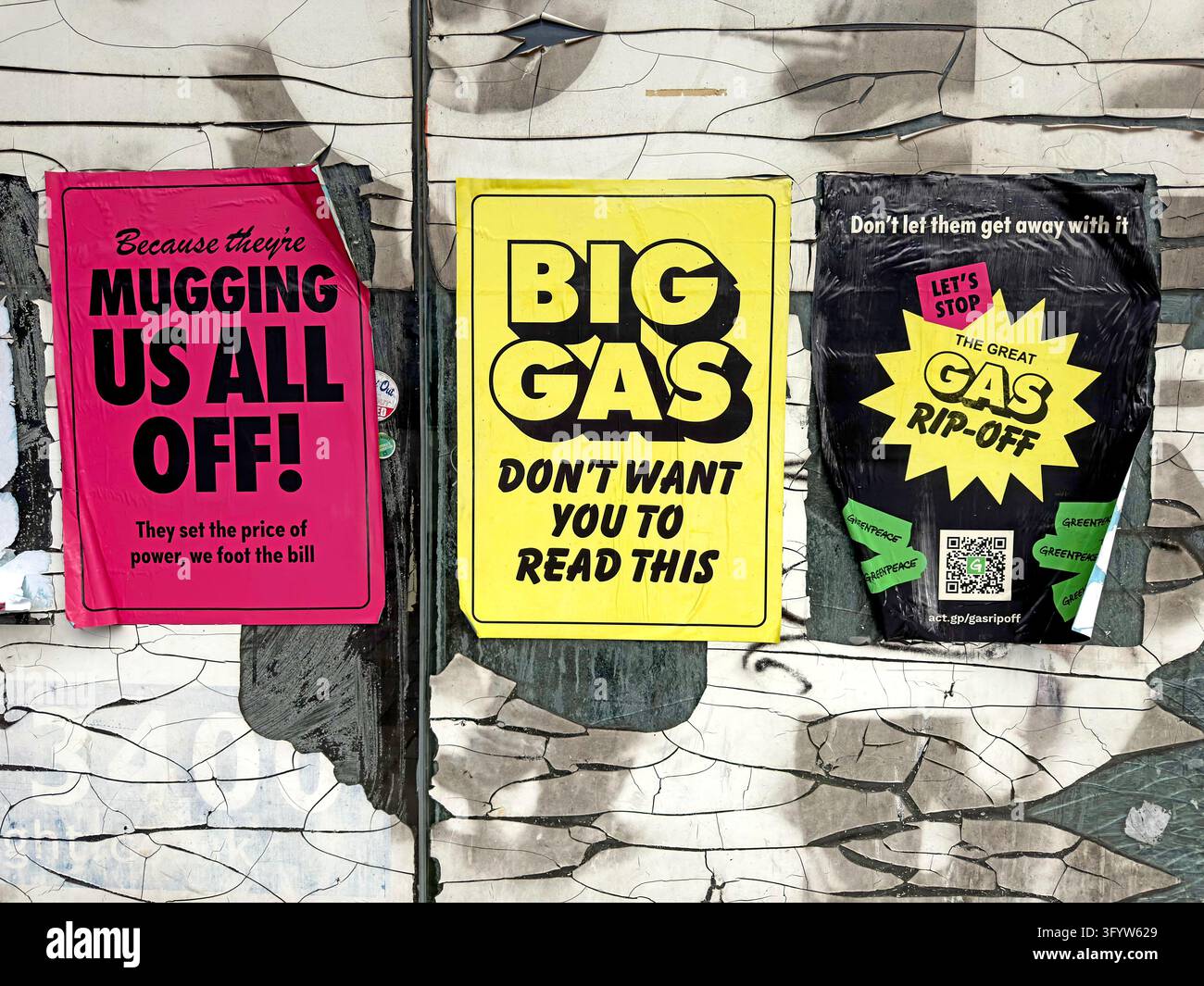
Image details
Contributor:
Tony SmithImage ID:
3FYW629File size:
78.9 MB (3.6 MB Compressed download)Releases:
Model - no | Property - noDo I need a release?Dimensions:
6064 x 4548 px | 51.3 x 38.5 cm | 20.2 x 15.2 inches | 300dpiDate taken:
19 September 2026Location:
Liverpool city centreMore information:
. Three bold activist posters are fixed side by side on a worn wall in Liverpool, including a yellow BIG GAS slogan and a pink message stating MUGGING US ALL OFF! The posters use high-contrast black lettering, bright colours and deliberately forceful language. Their content concerns energy prices and the role of the gas industry, while the physical presentation evokes temporary street-level political advertising. Peeling paint, marks on the masonry and overlapping edges of printed paper underline the urban setting of the campaign material. Three protest-style posters have been pasted across a rough urban wall. The middle is yellow with the large words BIG GAS and DON’T WANT YOU TO READ THIS, while the poster to the right is mostly black with a bright yellow badge and further wording about gas. The design uses the visual language of tabloid headlines and street advertising to challenge perceived conduct by energy companies. Greenpeace is an environmental campaigning organisation known for work on climate change, fossil fuels, marine protection and other issues. The phrase Big Gas is an advocacy expression referring collectively to powerful interests in the gas industry, as a political slogan in the advertising artwork. Three adjacent posters use contrasting campaign slogans, with the yellow BIG GAS panel between a pink MUGGING US ALL! poster and a black-and-yellow gas-bill design. Torn and uneven paper edges and the texture of the underlying wall add to the direct, unofficial appearance of the intervention. Pink, yellow and black are repeated in alternating blocks so the slogans are visible even in a quick glance. This is a close study of environmental political communication through wheat-pasted street posters, with a clear emphasis on typography, campaigning language and gas as an energy-policy issue. Creased paper edges reveal the pasted posters against the brickwork.

