
Votes for Women and Deeds Not Words placards at Pankhurst Centre
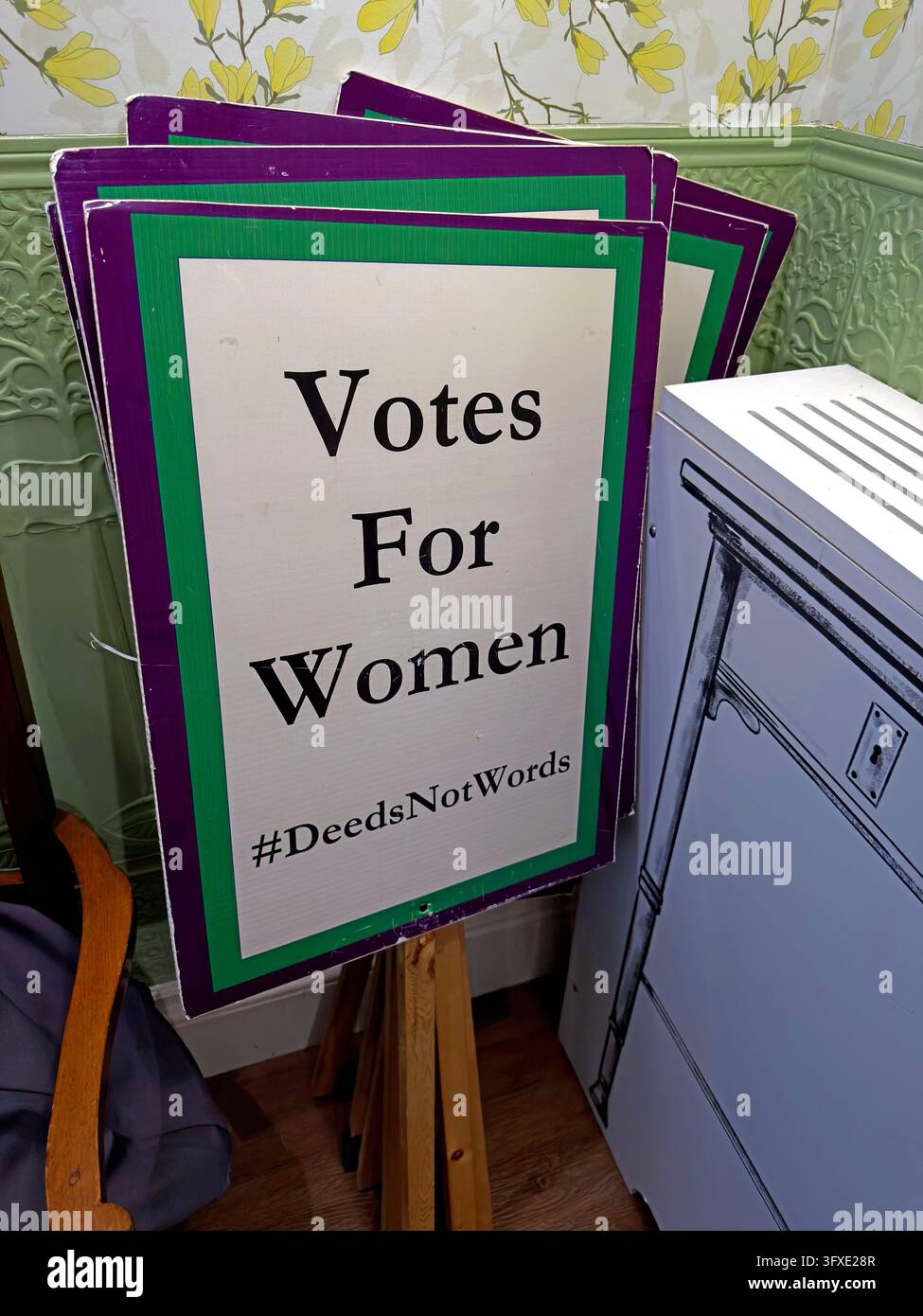
Image details
Contributor:
Tony SmithImage ID:
3FXE28RFile size:
81.5 MB (2.9 MB Compressed download)Releases:
Model - no | Property - noDo I need a release?Dimensions:
4623 x 6164 px | 39.1 x 52.2 cm | 15.4 x 20.5 inches | 300dpiDate taken:
18 October 2026Location:
60-62 Nelson Street, Manchester M13 9WP, UKMore information:
Votes for Women and Deeds Not Words placards at Pankhurst Centre. Printed Votes For Women placard stands in front of a set of green and purple campaign-style cards. The words Deeds Not Words refer to a famous suffragette movement slogan at the Pankhurst Museum. The foreground display features a white placard with black VOTES FOR WOMEN lettering bordered by purple and green material. A second visible slogan, Deeds Not Words, connects the exhibition to the militant suffragette movement and its campaign for parliamentary votes for women. The tightly framed composition emphasises the printed words and museum presentation. Emmeline Pankhurst and the Women's Social and Political Union are central to the historical setting at the Pankhurst Centre in Manchester. The combination of historically associated slogans and physical display materials is useful for stories about women's suffrage, voting rights, campaigns and public history. Purple and green are historically associated with the campaign for women's suffrage in Britain, making the border colours meaningful to the exhibit. The placards overlap in a compact display, and the main Votes For Women sheet is set at a slight angle so the lettering dominates the centre. The museum context connects the printed demands to the Pankhurst family's Manchester history. Emmeline Pankhurst founded the Women's Social and Political Union in Manchester in 1903, with Deeds Not Words becoming closely associated with the movement. The photograph is particularly relevant to historical anniversaries, schools teaching suffrage, museum exhibitions and the representation of women's political participation. The objects and their lettering allow the past campaign to be illustrated directly through surviving or reproduced publicity materials. The display reproduces the terse language of campaigning, with a demand for political rights condensed into a few bold words. The purple and green border is an important historic colour reference.

