
Historic Knotty Ash train station nameboard from the former Knotty Ash and Stanley railway station in Liverpool.
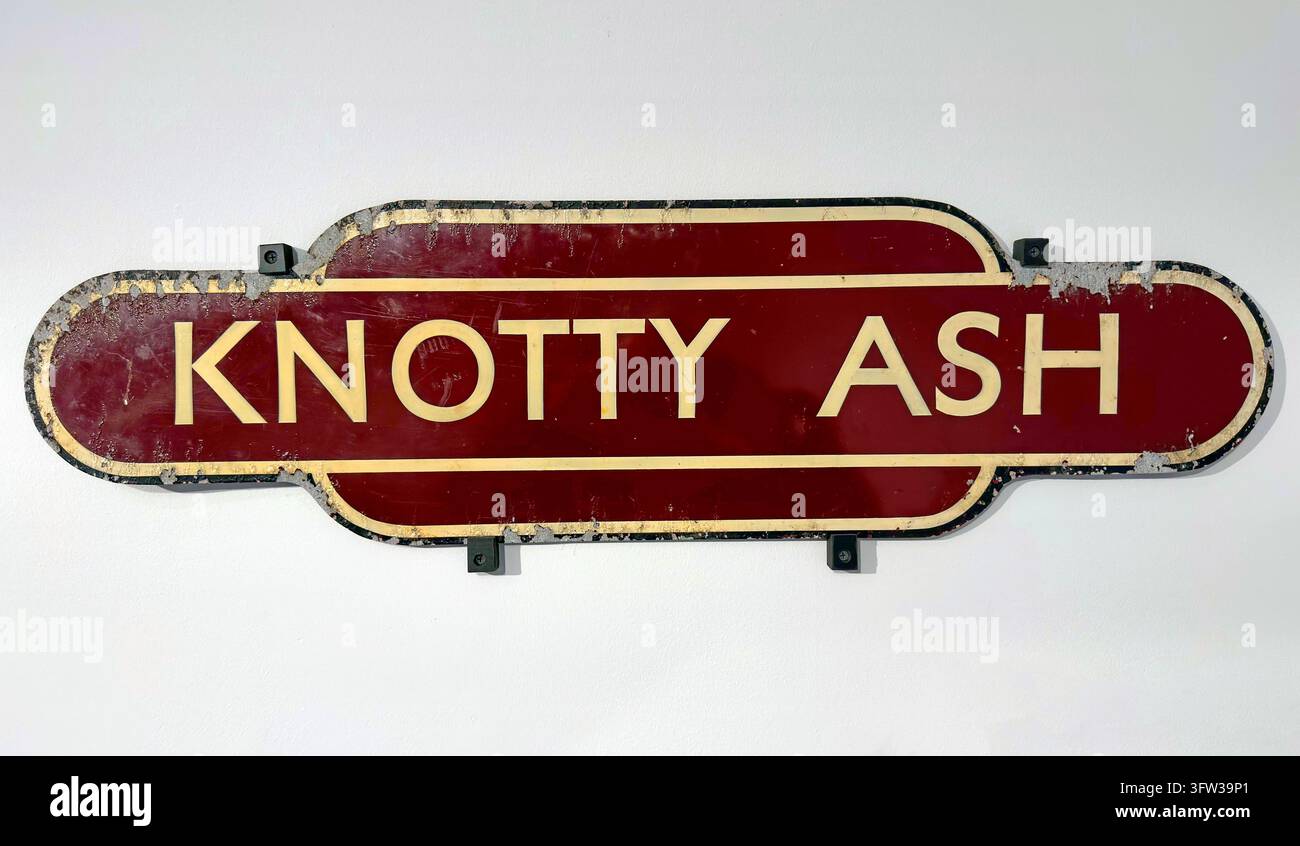
Image details
Contributor:
Tony SmithImage ID:
3FW39P1File size:
71.7 MB (2.2 MB Compressed download)Releases:
Model - no | Property - noDo I need a release?Dimensions:
6564 x 3819 px | 55.6 x 32.3 cm | 21.9 x 12.7 inches | 300dpiDate taken:
17 October 2026Location:
Knotty Ash, Liverpool, Merseyside, England, UKMore information:
A long maroon-red railway-style nameboard bearing the words KNOTTY ASH is displayed against a plain light background. The lettering is large, pale and capitalised, with a narrow cream-coloured border following the sign's distinctive curved ends. Dark metal fittings or mounting points project around the edges; abrasions, small paint chips and surface marks interrupt the finish. The object is photographed directly from the front, filling the frame without a platform, building or landscape in view. Knotty Ash is a district of Liverpool and was served by a railway station on the Cheshire Lines Committee's North Liverpool Extension Line. The station opened to passengers on 1 December 1879 under the name Old Swan & Knotty Ash, and was renamed Knotty Ash & Stanley on 1 November 1888. Contemporary station nameboards are recorded as using the simpler words Knotty Ash, matching the inscription shown here. Passenger services ceased on 7 November 1960; goods traffic continued afterwards, with final station closure recorded in 1972. The North Liverpool Extension Line formed a link across districts to the north and east of Liverpool and supported both passenger journeys and freight movement. The name Knotty Ash also became nationally familiar through comedian Ken Dodd, whose performances and fictional Diddy Men drew heavily on the Liverpool locality. Those associations help explain why the short place-name remains recognisable independently of the former railway station. The photograph presents the painted sign as a separate object, with visible fastenings and age-related wear providing details of its construction and finish. Its provenance, age and original installation are not established by the image; the documented station history refers to the railway location rather than to an authenticated origin for this particular object. The mounting points are visible above and below the narrow outer border.

