
Rear alley behind Victorian red-brick terraces in Warrington, with wheelie bins, yard walls and chimney stacks.
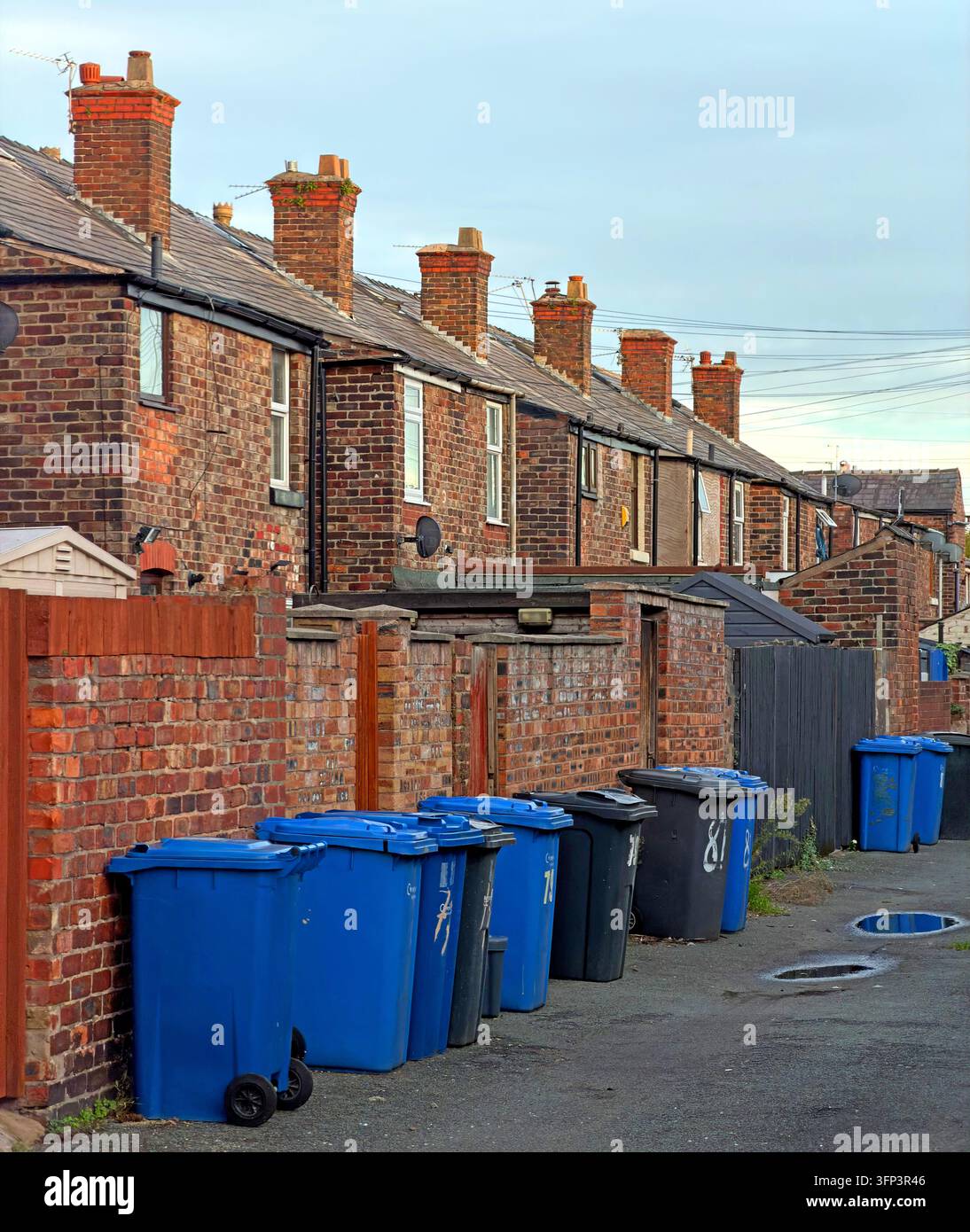
Image details
Contributor:
Tony SmithImage ID:
3FP3R46File size:
98.2 MB (4.3 MB Compressed download)Releases:
Model - no | Property - noDo I need a release?Dimensions:
5375 x 6384 px | 45.5 x 54.1 cm | 17.9 x 21.3 inches | 300dpiDate taken:
4 October 2026Location:
Warrington, Cheshire, England, UKMore information:
. A rear service lane runs past closely spaced red-brick Victorian terraced houses, chimney stacks, yard walls and a row of blue and dark household wheelie bins. Terraced stock illustrates older northern housing, limited rear access, domestic refuse storage and the interaction between residents, councils and waste collections. The blue bins are placed along the alleyway rather than the main frontages. Rear service alleys of this kind occur across late nineteenth-century industrial towns, where narrow plots and brick boundary walls leave limited space for modern refuse containers. The repeating roofs and chimneys show how closely these homes were arranged before widespread car ownership and larger domestic gardens. Rows of houses with individual chimneys and modest walled yards show the density of late nineteenth-century urban development. The contrasting blue and dark bins are positioned along the service passage rather than a front street. Repeated chimney stacks show the original provision of individual fireplaces, while the high rear walls separate each yard from communal access. The scene has uses in coverage of collection logistics, limited storage space and maintaining older terraced neighbourhoods. These rear elevations reveal how small private yards and shared passageways organise daily life in nineteenth-century terraces. Chimneys mark individual former coal-fire flues, while wall divisions identify separate plots behind houses that share a continuous street frontage. Bins consume scarce manoeuvring space where residents and collection crews both need access. The built pattern is associated with the rapid expansion of industrial towns and remains important to discussions about improving established homes rather than replacing them. Wet weather, wheelie-bin collection routines, access for tradespeople and litter management create practical constraints in narrow back lanes.

