
Reform UK and Nigel Farage badges with Bitcoin token, illustrating political funding and crypto-donation scrutiny.
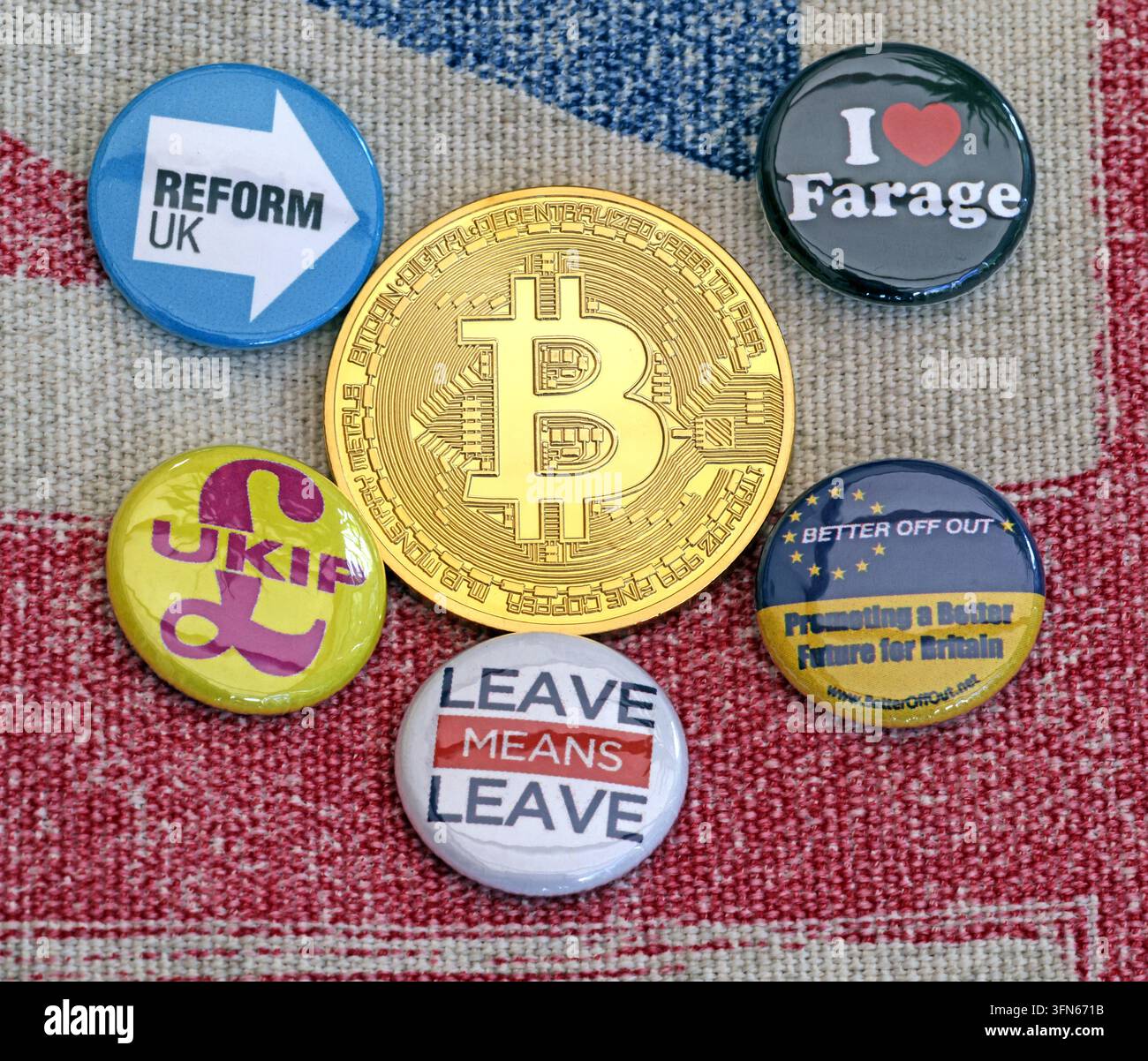
Image details
Contributor:
Tony SmithImage ID:
3FN671BFile size:
79.1 MB (3.6 MB Compressed download)Releases:
Model - no | Property - noDo I need a release?Dimensions:
5685 x 4864 px | 48.1 x 41.2 cm | 19 x 16.2 inches | 300dpiDate taken:
1 October 2026Location:
United KingdomMore information:
. A gold-coloured Bitcoin token is surrounded by Reform UK, Nigel Farage, UKIP and Brexit-related badges, creating a still-life about political identity, money and digital assets. In 2026 political finance has become a sharper UK news issue because government reforms are tightening controls on overseas money, company donations and cryptoassets. A government moratorium announced on 25 March 2026 halted political donations made directly through cryptoassets while Parliament considers permanent rules. The Rycroft Review and a parliamentary national security committee both highlighted the difficulty of tracing some crypto transactions and the risk of foreign or illicit influence. Electoral law requires regulated parties and campaigners to identify donors, check whether they are permissible and report qualifying donations to the Electoral Commission. Bitcoin is a decentralised digital asset recorded on a blockchain, making it visually useful for illustrating debate about new forms of political funding and transparency. Questions about donor identity, beneficial ownership, overseas electors, shell companies and the source of funds now sit at the centre of proposed political-finance safeguards. The photograph therefore connects the physical imagery of campaign loyalty with a rapidly changing regulatory debate over money, influence and accountability in British politics. Public concern is not limited to the value of a donation: scrutiny also covers who ultimately controls the money, whether intermediaries obscure its origin and whether reporting rules can keep pace with new payment technologies. Because political finance is regulated separately from ordinary consumer payments, a transaction that is technically possible can still raise distinct questions under election law and parliamentary standards. The symbols are arranged as an editorial concept, not evidence of an actual transaction.

