
Historic Boodle & Dunthorne projecting street clock on Lord Street in Liverpool city centre, recalling Liverpool’s long watch and jewellery trade.
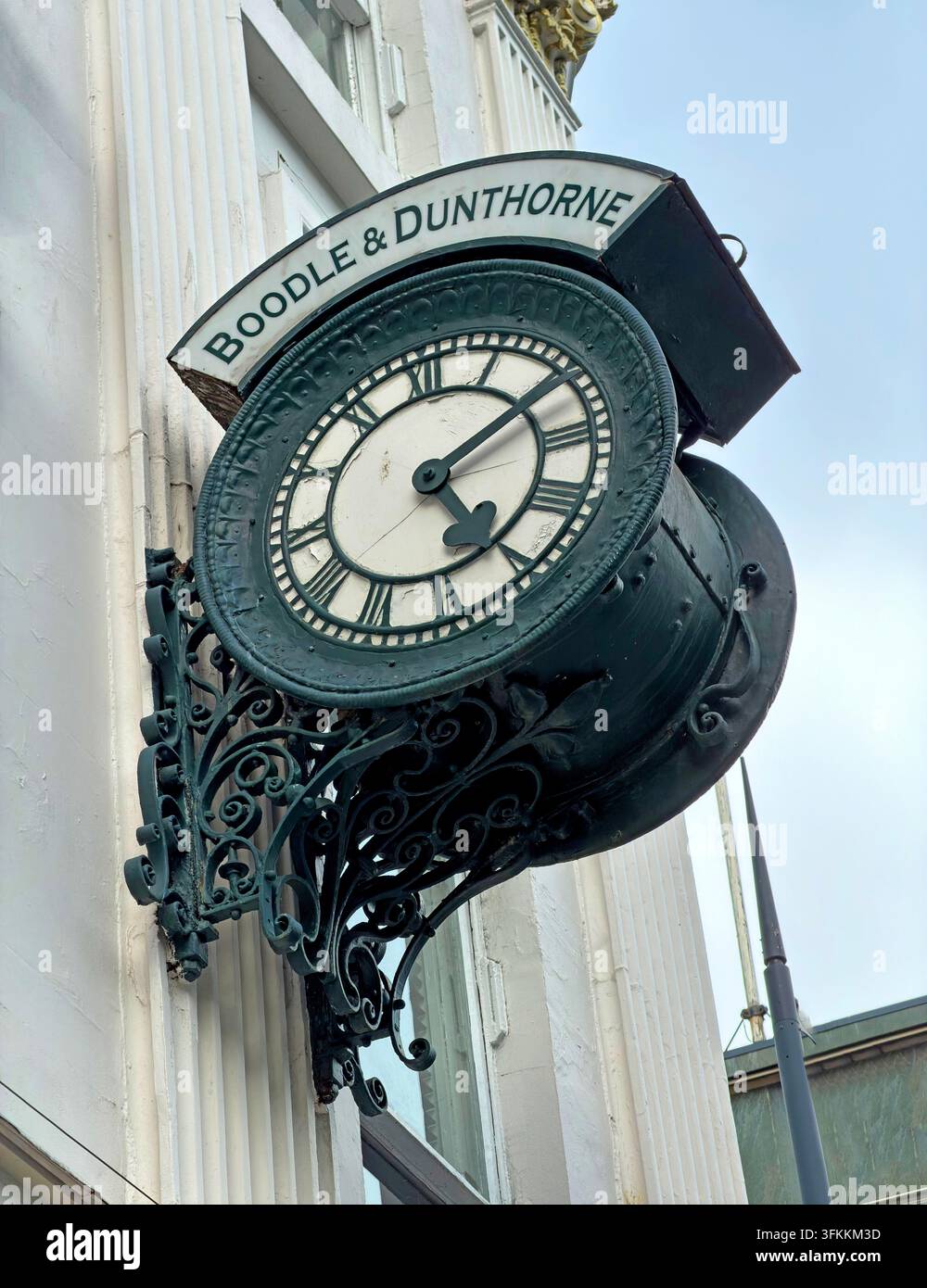
Image details
Contributor:
Tony SmithImage ID:
3FKKM3DFile size:
97.6 MB (3.3 MB Compressed download)Releases:
Model - no | Property - noDo I need a release?Dimensions:
5124 x 6656 px | 43.4 x 56.4 cm | 17.1 x 22.2 inches | 300dpiDate taken:
19 September 2026Location:
Lord Street, Liverpool, Merseyside, England, United KingdomMore information:
Historic Boodle & Dunthorne projecting street clock mounted outside Boodles House on Lord Street in Liverpool city centre, with Roman numerals, ornate dark metal casing and elaborate decorative bracket. The clock forms part of the visual identity of one of Liverpool’s oldest jewellery businesses and reflects the city’s long association with watchmaking, goldsmithing, silverware and luxury retail. Boodles traces its heritage to a jewellery business established in 1798, while the Boodle & Dunthorne name became part of the Wainwright family business after Herbert and Harold Wainwright acquired the firm in 1910. Boodles records that the family opened Boodles House on the prominent corner of Lord Street and North John Street in 1921, and the building remains the company’s Liverpool head office. The business historically specialised in jewellery, silver, objets d’art, watches, special timepieces and gold pocket watches, making the projecting clock particularly appropriate as both practical timepiece and commercial landmark. During the nineteenth and early twentieth centuries, large projecting clocks were a familiar advertising feature of jewellers, watchmakers, banks and other prestigious retailers, helping shops stand out above busy pedestrian streets. This example retains the historic Boodle & Dunthorne name rather than the shortened modern Boodles brand, preserving an earlier layer of Liverpool’s retail identity. The photograph can illustrate horology, jewellery heritage, historic shop signage, decorative metalwork, traditional retailing, family businesses, Liverpool commercial history, Lord Street shopping, urban heritage and the survival of distinctive architectural details within a modern city centre. The clock also connects present-day luxury retail with the era when Liverpool’s international trade and wealthy merchant economy supported specialist jewellers, watchmakers and craftsmen serving local and visiting customers.

