
North West Ambulance Service vehicles lined up outside A&E at the Royal Liverpool University Hospital on Prescot Street, Liverpool.
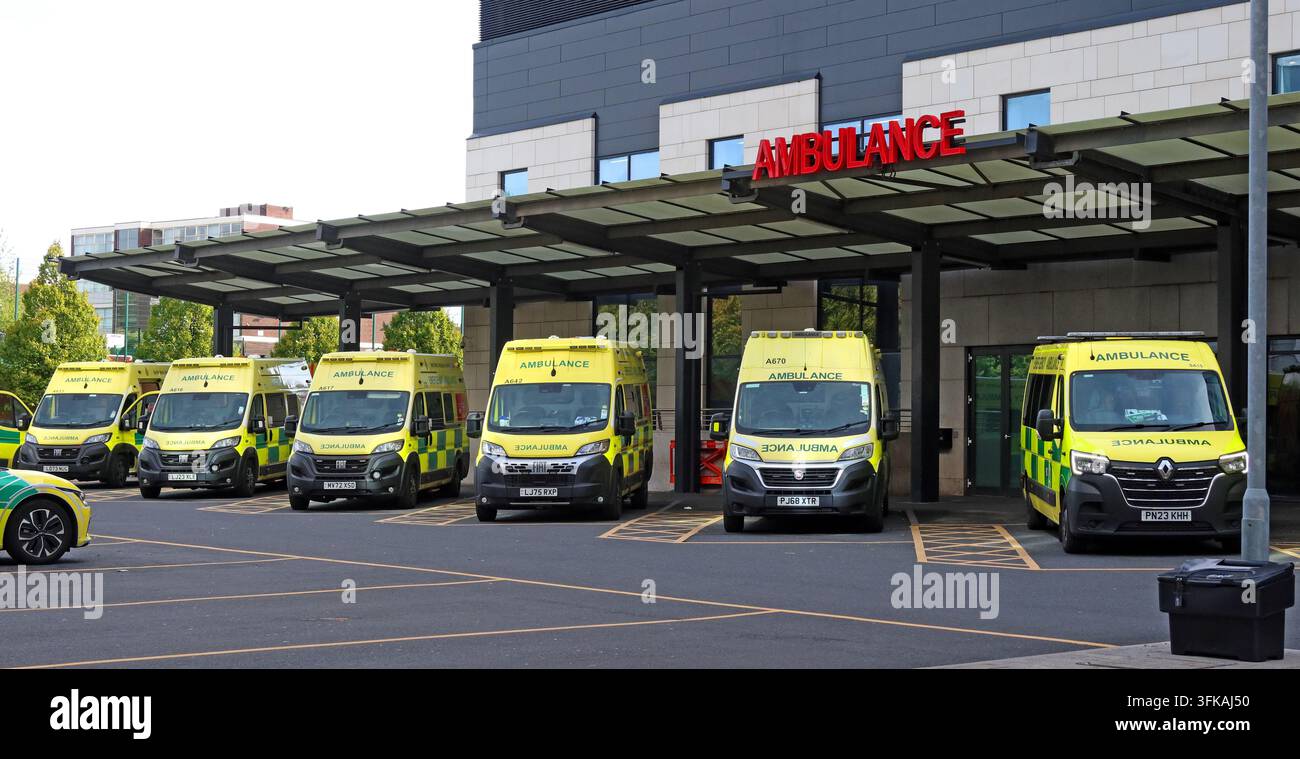
Image details
Contributor:
Tony SmithImage ID:
3FKAJ50File size:
44.1 MB (1.7 MB Compressed download)Releases:
Model - no | Property - noDo I need a release?Dimensions:
5472 x 2816 px | 46.3 x 23.8 cm | 18.2 x 9.4 inches | 300dpiDate taken:
19 September 2026Location:
Royal Liverpool University Hospital, Prescot Street, Liverpool, Merseyside, L7 8XPMore information:
A line of North West Ambulance Service emergency vehicles occupies designated bays beside the accident and emergency department at the Royal Liverpool University Hospital on Prescot Street, Liverpool. Beneath the hospital’s emergency entrance canopy, the high-visibility yellow and green NHS ambulances show the everyday operational connection between frontline ambulance crews and one of Merseyside’s major acute hospitals. North West Ambulance Service NHS Trust provides urgent and emergency 999 response services across North West England, alongside NHS 111 and patient transport services. Patients who need hospital assessment or treatment can be brought by ambulance to emergency departments such as the Royal Liverpool, where their clinical care is then handed over to hospital teams. This transfer is an important part of ambulance operations because crews and vehicles must subsequently become available for further emergency calls. When emergency departments are under pressure and patient transfers take longer, ambulance turnaround and wider 999 capacity can also be affected. In its 2025/26 annual report, NWAS said demand across the regional health and care system remained high while work continued with hospital partners to improve response times and return ambulances to frontline duties more quickly through better handover arrangements. The Royal Liverpool University Hospital serves Liverpool and the wider Merseyside population, delivering major emergency, acute and specialist services from its modern city-centre site. The photograph documents the routine infrastructure of NHS emergency healthcare: multiple ambulances, designated bays, crews, hospital access and the movement of patients between pre-hospital treatment and acute care. It does not show a particular incident, but instead records emergency service capacity, patient transfer and the practical interface between ambulance provision and hospital treatment within England’s publicly funded National Health Service.

