
Queen Elizabeth II Law Courts in Liverpool, a major court complex housing Crown, County and Magistrates’ Court functions.
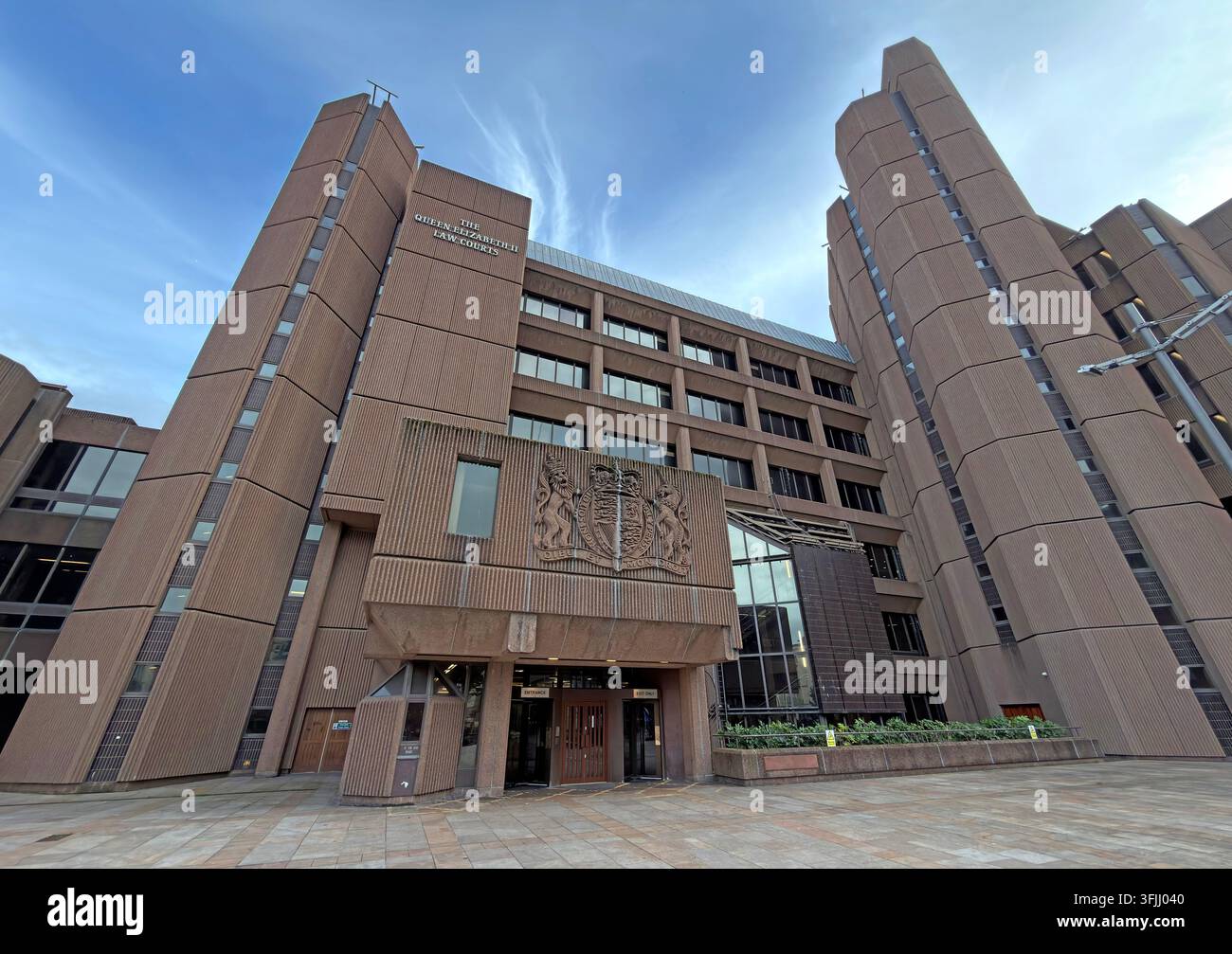
Image details
Contributor:
Tony SmithImage ID:
3FJJ040File size:
100.7 MB (3.6 MB Compressed download)Releases:
Model - no | Property - noDo I need a release?Dimensions:
7064 x 4983 px | 59.8 x 42.2 cm | 23.5 x 16.6 inches | 300dpiDate taken:
19 September 2026Location:
Queen Elizabeth II Law Courts, Derby Square, Liverpool, Merseyside, L2 1XAMore information:
Queen Elizabeth II Law Courts dominate Derby Square in Liverpool city centre, a substantial late twentieth-century courthouse complex serving several important parts of the criminal justice system in Merseyside. Completed and opened in 1984, the building was designed by architects Farmer and Dark and is a striking example of British brutalist civic architecture, with tall angular towers, deeply modelled elevations and vertically ribbed precast concrete panels in dark reddish-brown tones. The complex currently houses Liverpool Crown Court, Liverpool & Knowsley Magistrates’ Court, Liverpool Youth Court and Liverpool District Probate Registry. Crown Court cases include serious criminal proceedings, trials before judge and jury and sentencing, while magistrates deal with a wide range of criminal matters and preliminary hearings. Youth Court proceedings involving younger defendants and probate registry services are also based within the complex. Liverpool’s County Court and Civil and Family Court functions are now located separately at 35 Vernon Street. Before the Queen Elizabeth II Law Courts opened, Liverpool Crown Court cases were heard in the historic St George’s Hall. The new Derby Square building was commissioned as a modern purpose-built courthouse and contains numerous courtrooms arranged within its large central mass. Its severe concrete architecture was intended to convey institutional authority, permanence and civic importance, characteristics associated with many major government buildings of the post-war period. The site is also historically significant because Derby Square occupies part of the area once associated with medieval Liverpool Castle. Seen from the broad paved public space outside, the building’s imposing scale, strong vertical forms, Royal Arms and recessed entrance create a distinctive visual expression of the administration of justice. The photograph documents an important Liverpool civic institution, combining themes of criminal law, courts,

