
Liverpool Metropolitan Cathedral on Mount Pleasant, the modern Roman Catholic cathedral popularly nicknamed Paddy’s Wigwam or The Mersey Funnel.
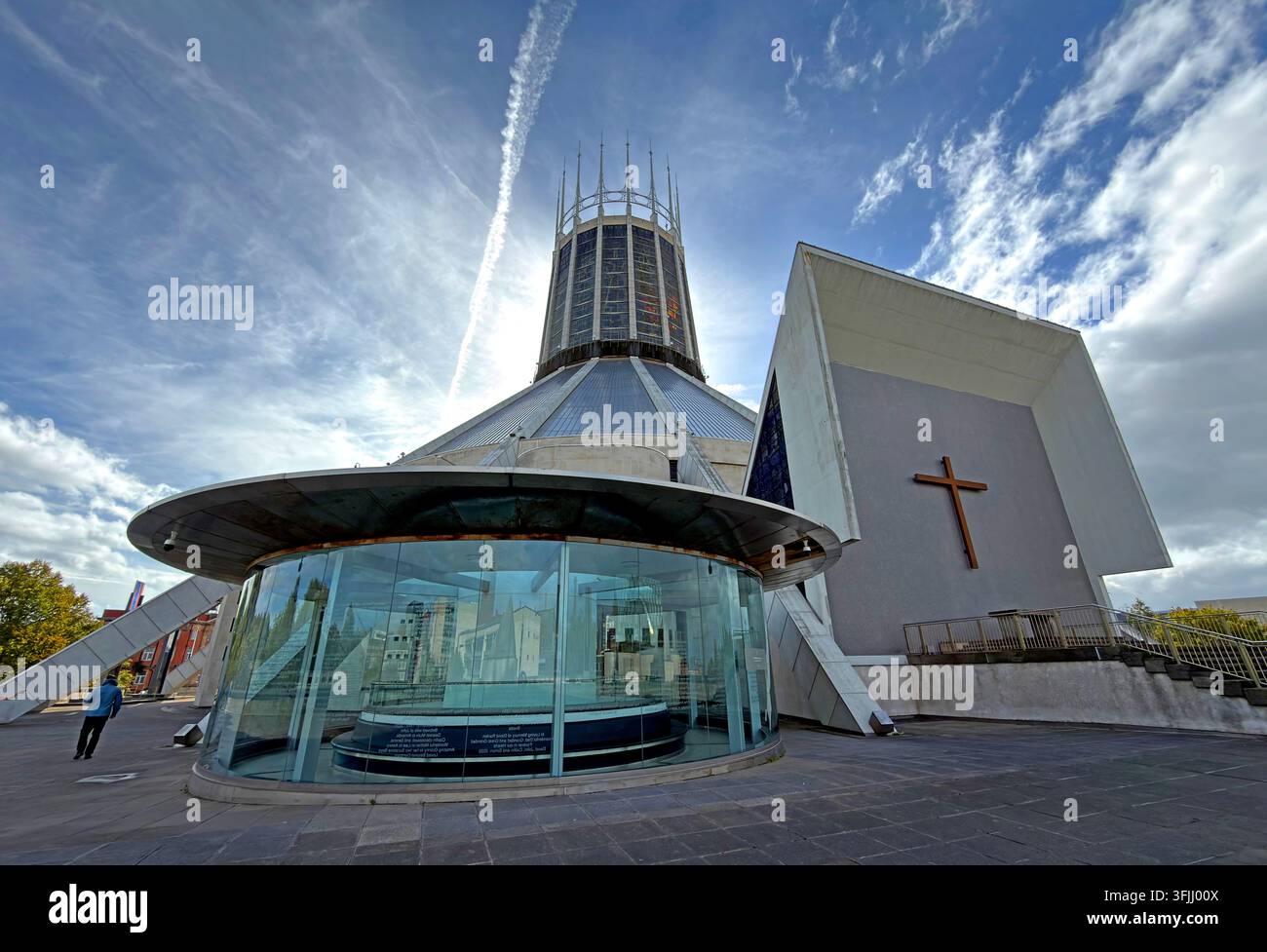
Image details
Contributor:
Tony SmithImage ID:
3FJJ00XFile size:
97.5 MB (2.4 MB Compressed download)Releases:
Model - no | Property - noDo I need a release?Dimensions:
7064 x 4825 px | 59.8 x 40.9 cm | 23.5 x 16.1 inches | 300dpiDate taken:
19 September 2026Location:
Liverpool Metropolitan Cathedral, Mount Pleasant, Liverpool, Merseyside, L3 5TQMore information:
Dramatic low-angle view of Liverpool Metropolitan Cathedral of Christ the King on Mount Pleasant, its circular glass entrance, concrete geometry, Christian cross and distinctive lantern tower rising into a blue sky crossed by cloud and an aircraft contrail. Designed by architect Frederick Gibberd and consecrated in 1967, the Roman Catholic cathedral became one of the most recognisable works of postwar British ecclesiastical architecture. Its radical circular plan placed the congregation around the central altar, reflecting changing ideas about Catholic worship associated with the Second Vatican Council. The building’s extraordinary silhouette, crowned by a tall central lantern or corona, has inspired the affectionate Liverpool nickname Paddy’s Wigwam and gives the cathedral a futuristic, almost spaceship-like appearance particularly evident from this dramatic wide-angle viewpoint. Its combination of concrete, glass, geometric forms and monumental scale makes it an important example of 1960s modernism and Space Age architectural confidence. The cathedral was upgraded to Grade I listed status, recognising its exceptional architectural and historic significance. Its interior is celebrated for coloured glass created by John Piper and Patrick Reyntiens, while artists associated with the building also include William Mitchell and Elizabeth Frink. Approaching its Diamond Jubilee and 60th anniversary in 2027, the cathedral remains both an active place of Catholic worship and a major Liverpool landmark and visitor attraction. During 2026 it has continued to provide a setting for religious, civic and social themes including hope, ecumenism, social justice and awareness of modern slavery. The photograph concentrates on the building itself rather than those events, capturing the striking exterior architecture and the visual tension between traditional Christian symbolism and a design unmistakably rooted in twentieth-century modernism. Against the expansive sky, its space age.

