
Trapped, a quilted textile artwork by Jan Aldersey at Weaver Hall Museum, reflecting confinement and the history of the workhouse.
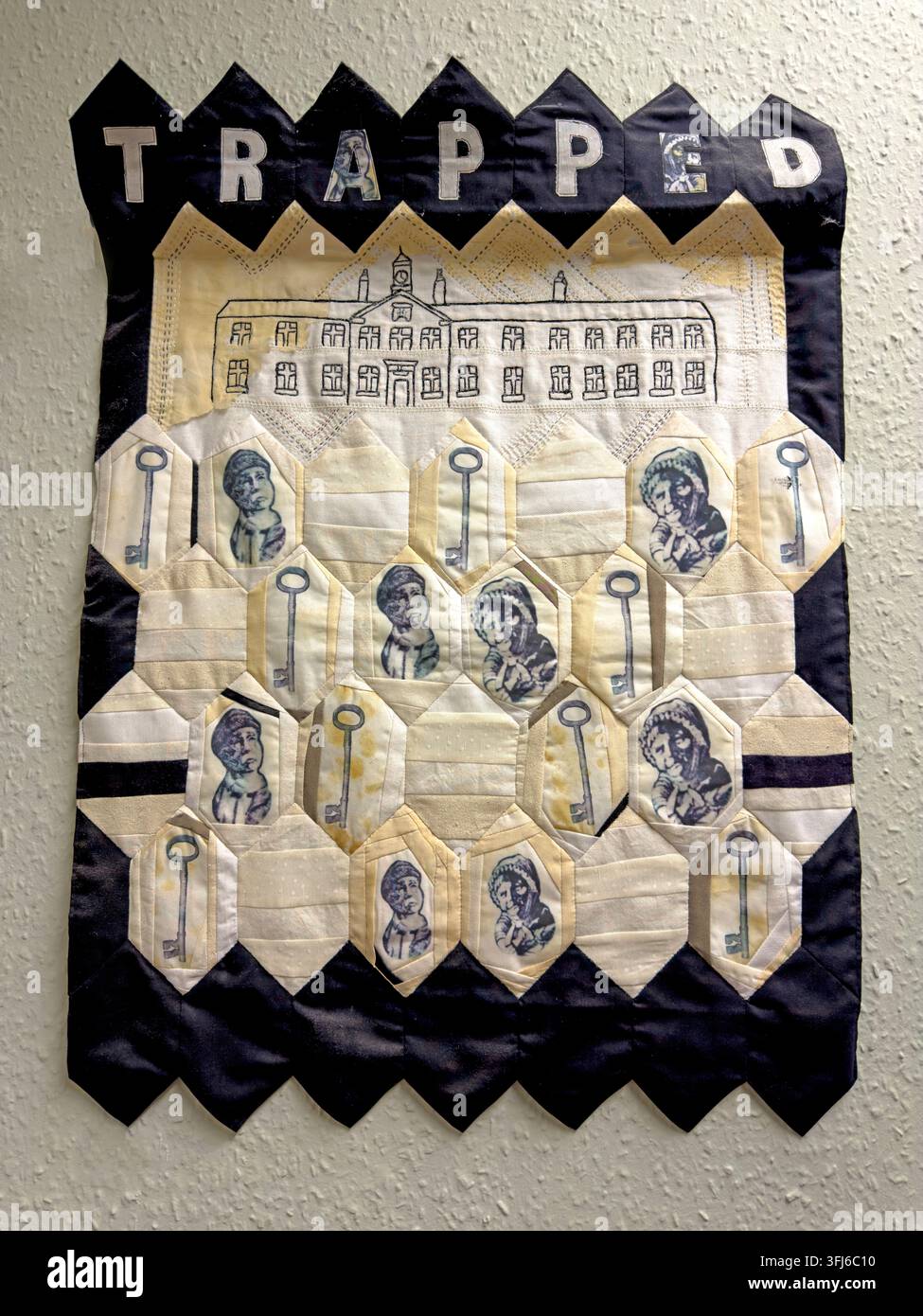
Image details
Contributor:
Tony SmithImage ID:
3FJ6C10File size:
92.5 MB (4.4 MB Compressed download)Releases:
Model - no | Property - noDo I need a release?Dimensions:
4923 x 6564 px | 41.7 x 55.6 cm | 16.4 x 21.9 inches | 300dpiDate taken:
23 August 2026Location:
Weaver Hall Museum & Workhouse, 162 London Road, Northwich, Cheshire, CW9 8ABMore information:
. Trapped, a quilted textile artwork by Jan Aldersey, displayed at Weaver Hall Museum and Workhouse in Northwich. The piece uses layered fabric, stitched imagery and a dark enclosing border to evoke themes of confinement and institutional life, making a contemporary artistic response to the history represented by the former workhouse building. Weaver Hall occupies the old Northwich Union Workhouse and interprets the lives of people who entered the Poor Law system as well as the industrial and social history of West Cheshire. Textile art can communicate this history differently from documents or machinery, using texture, symbolism and handwork to suggest emotion, restriction and memory. The title Trapped reinforces the association with people whose choices were severely limited by poverty and institutional rules. The photograph is relevant to museum interpretation, textile art, social history, Victorian poverty and the legacy of the workhouse system. It also shows how contemporary makers can respond to difficult heritage without attempting to recreate an original object. For editorial use, the artwork offers a visually distinctive entry point into subjects such as the Poor Law, welfare history, women’s craft, quilting, community memory and the use of art within local museums. The technique also matters because quilting has long associations with domestic labour, community making and storytelling. Using it to interpret a workhouse adds another layer of meaning: soft fabric and painstaking handwork are set against a history of institutional discipline and hardship. The artwork can therefore be discussed in relation to feminist craft histories and the elevation of textile practices within contemporary art, as well as the specific social history of Northwich. For researchers and picture buyers, it also provides a dated reference for historic interpretation, museum display, poverty, Victorian Britain and local history.

