
Historic John Holt Best British Salt 40 lb sack from Cheshire, illustrating branded packaging from the region’s salt industry.
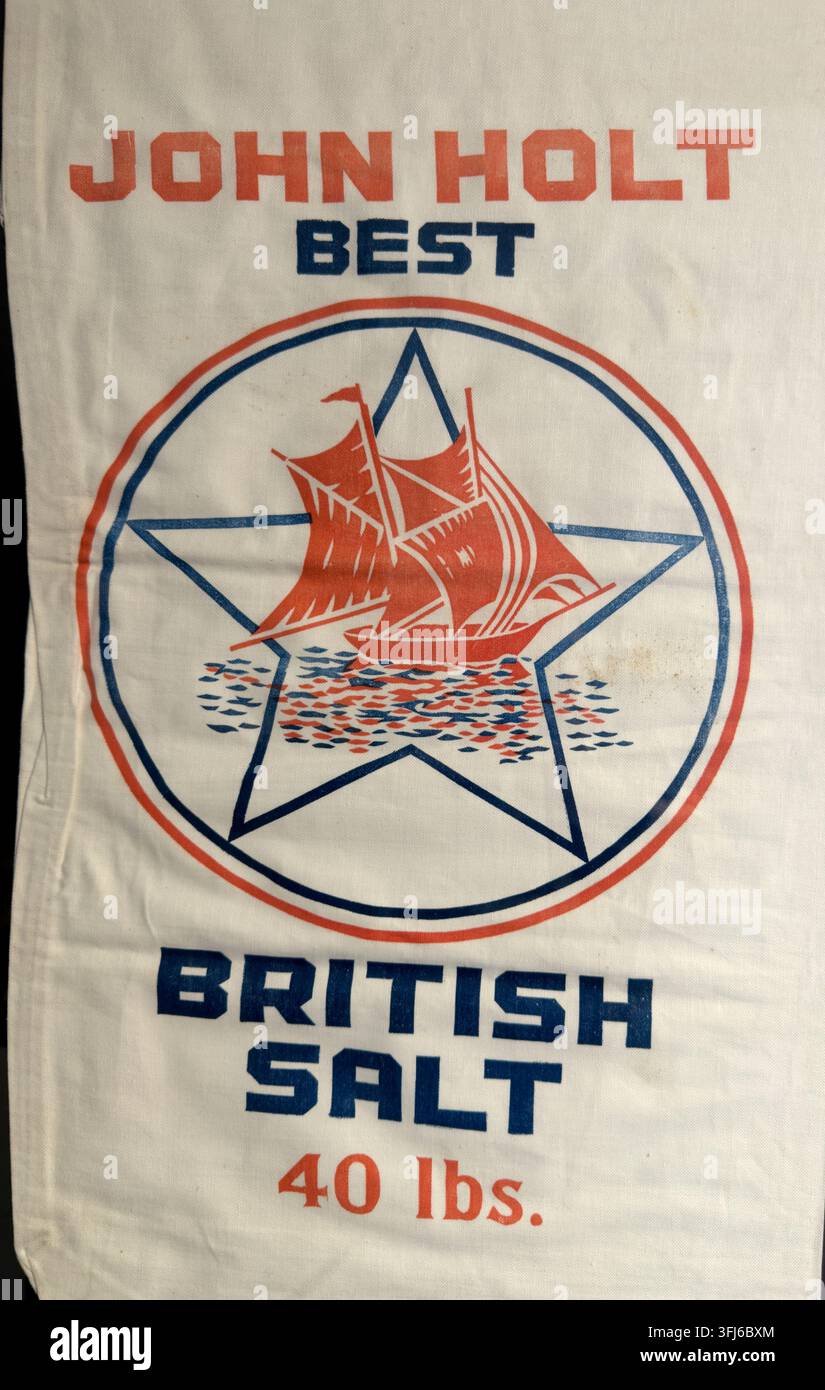
Image details
Contributor:
Tony SmithImage ID:
3FJ6BXMFile size:
75.9 MB (2.9 MB Compressed download)Releases:
Model - no | Property - noDo I need a release?Dimensions:
4104 x 6464 px | 34.7 x 54.7 cm | 13.7 x 21.5 inches | 300dpiDate taken:
23 August 2026Location:
Weaver Hall Museum & Workhouse, 162 London Road, Northwich, Cheshire, CW9 8ABMore information:
. A historic cloth sack printed John Holt Best British Salt, 40 lbs, displayed as part of the industrial-history collections associated with Northwich and the Cheshire salt field. The simple red and blue branding, sailing-ship emblem and bold weight marking show how a basic bulk commodity was packaged and marketed before modern plastic sacks and automated logistics. Cheshire has been one of Britain’s most important salt-producing areas because underground deposits around Northwich, Winsford and Middlewich could be mined or dissolved to create brine. Salt supported food preservation, household use and major chemical industries, while companies developed distinctive brands for domestic and export markets. Heavy reusable or disposable sacks were central to distribution because salt had to move efficiently from works to merchants, factories and customers. The object is relevant to industrial heritage, historic branding, commodity trade and the everyday material culture of manufacturing. It also provides evidence of how producers promoted British origin and quality in markets where salt itself was otherwise difficult to differentiate. The museum setting connects the bag with a wider story of brine pumping, subsidence, chemical production, canals and railways that shaped Northwich and the surrounding Cheshire landscape. Printed packaging can also reveal assumptions about quality and origin. The phrase Best British Salt turns geography into a marketing claim, while the ship emblem suggests trade and distribution beyond the immediate production area. In a museum collection, those design choices become evidence of how industrial firms presented themselves to wholesalers and consumers. The bag can therefore accompany features on branding history, commodity nationalism and the commercial identity of Cheshire’s salt producers. It also records historic branding, trade and the Cheshire salt industry.

