
Historic Whitelock's First City Luncheon Bar door and painted glass lettering in Turk's Head Yard, Leeds.
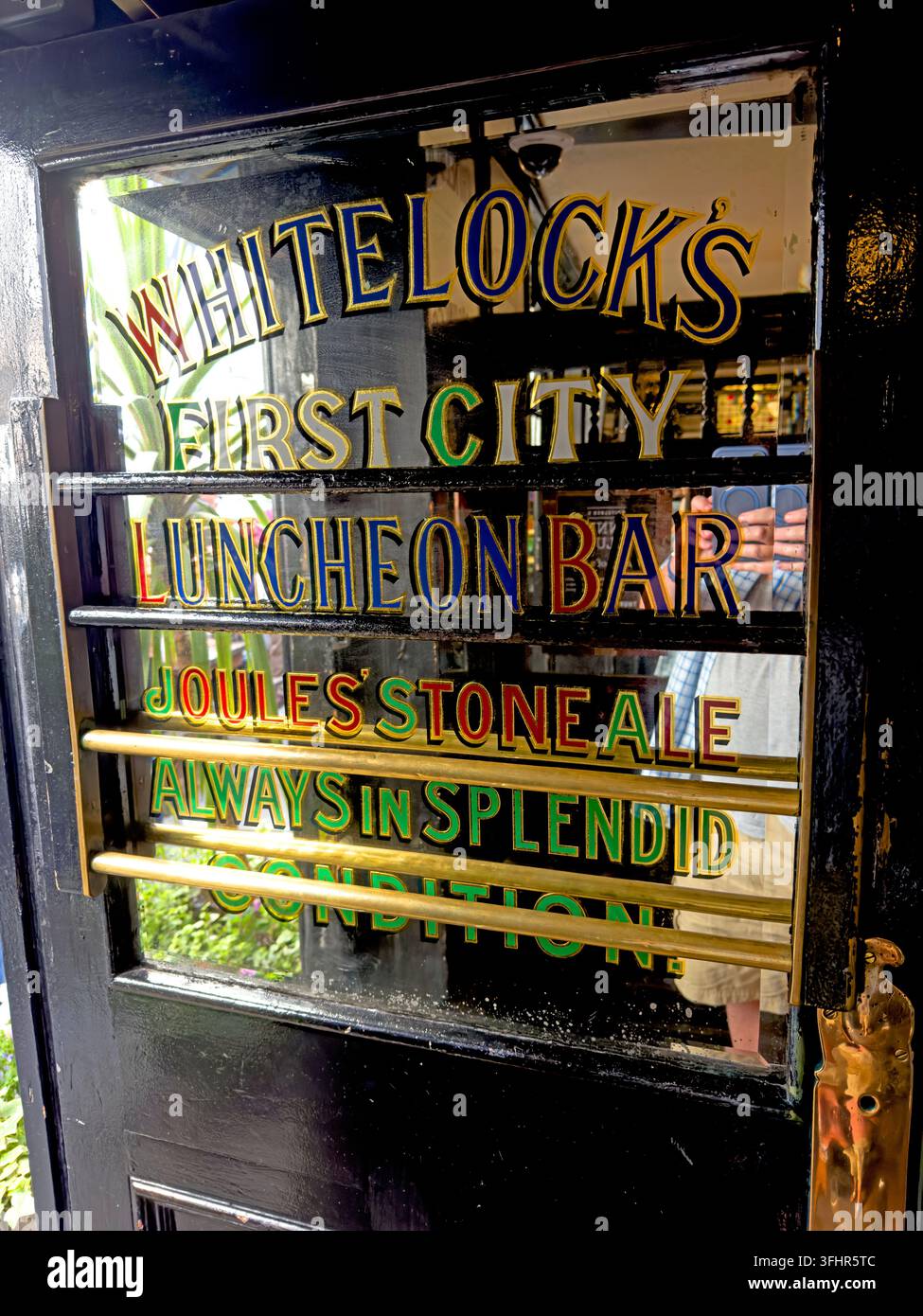
Image details
Contributor:
Tony SmithImage ID:
3FHR5TCFile size:
92.5 MB (3.4 MB Compressed download)Releases:
Model - no | Property - noDo I need a release?Dimensions:
4923 x 6564 px | 41.7 x 55.6 cm | 16.4 x 21.9 inches | 300dpiDate taken:
18 July 2026Location:
Whitelock's Ale House, 1-8 Turk's Head Yard, Leeds, West Yorkshire, LS1 6HBMore information:
. Detail of a door at Whitelock's in Turk's Head Yard, Leeds, carrying historic 'First City Luncheon Bar' lettering that preserves the pub's late-Victorian identity. Whitelock's occupies a narrow historic yard off Briggate and is one of Leeds' most celebrated surviving traditional public houses. The eastern part of the building was licensed as the Turk's Head in 1715, while John Lupton Whitelock became landlord in 1867 and the Whitelock family subsequently transformed the premises. A major remodelling in 1895 created much of the richly decorated interior that survives today, including mirrors, stained glass, decorative metalwork and a rare tiled bar counter. The building is Grade II* listed, recognising both its architectural quality and the exceptional survival of its historic pub fittings. The phrase 'First City Luncheon Bar' recalls a time when city-centre pubs promoted themselves as respectable places for meals and business lunches as well as beer. Whitelock's later became closely associated with Leeds cultural life and was frequented by musicians, artists, writers, journalists and performers. The painted door lettering is therefore more than decorative branding: it is a surviving layer of commercial history embedded in the fabric of the pub. Turk's Head Yard itself reflects the medieval burgage-plot pattern of central Leeds, with long narrow premises extending back from the principal shopping street. The tight photograph focuses attention on typography, glass, timber and patina, details that communicate age and continuity more effectively than a wide exterior view. The image documents British pub heritage, Victorian commercial design and the survival of a nationally important historic interior within a working twenty-first-century city-centre business. Historic England describes Whitelock's as a rare surviving late-nineteenth-century luncheon bar, making details such as this door lettering part of a nationally significant interior.

