
Traditional red British telephone box in Warrington with a notice stating it is protected for future generations.
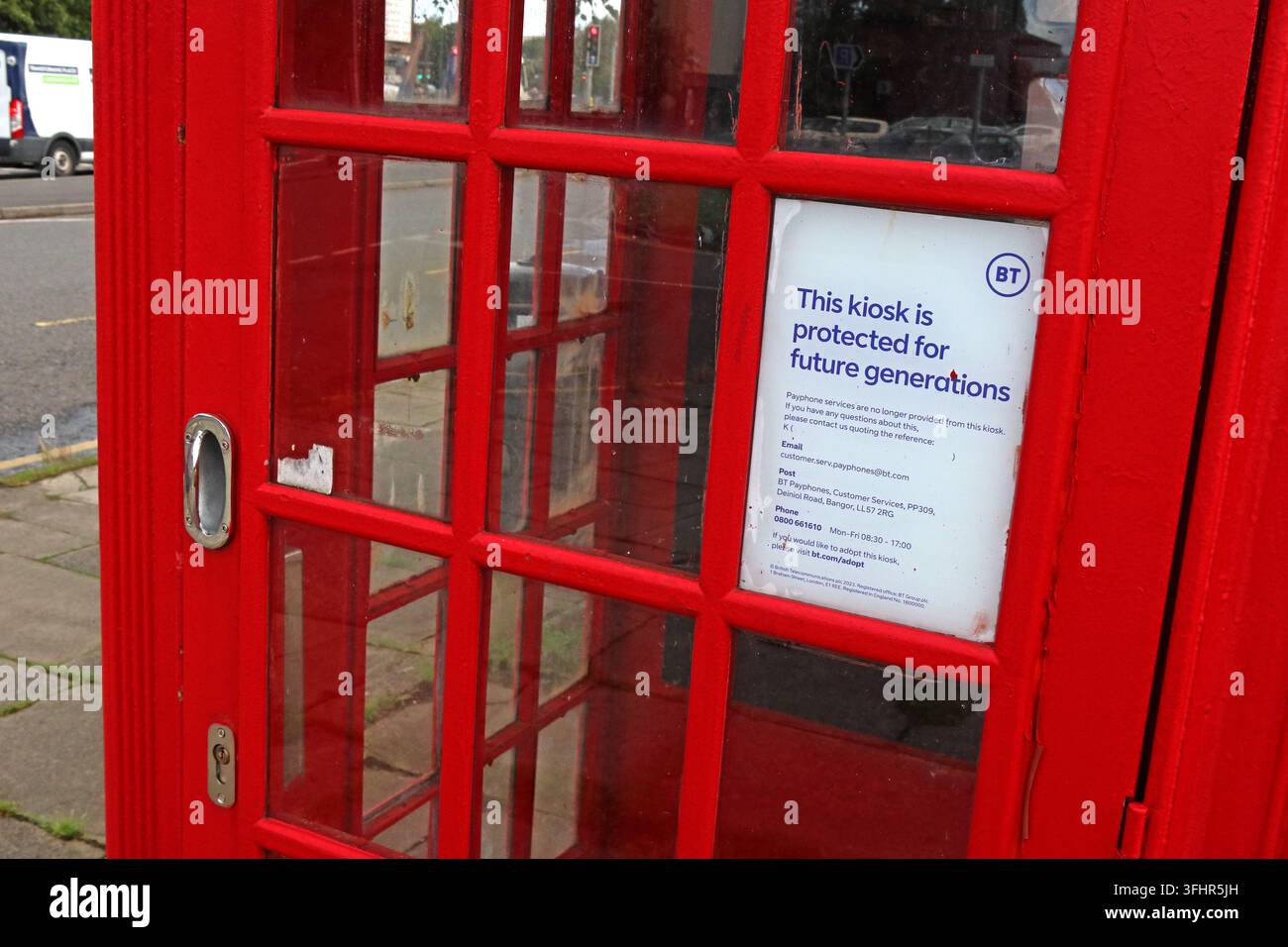
Image details
Contributor:
Tony SmithImage ID:
3FHR5JHFile size:
57.1 MB (1.8 MB Compressed download)Releases:
Model - no | Property - noDo I need a release?Dimensions:
5472 x 3648 px | 46.3 x 30.9 cm | 18.2 x 12.2 inches | 300dpiDate taken:
16 September 2026Location:
Outside Mr Smiths, Bridge Foot, Warrington, Cheshire, England, WA1 1PRMore information:
. Traditional red British telephone box in Warrington carries a notice stating that the kiosk is protected for future generations, turning former communications infrastructure into an explicitly preserved heritage object. Red telephone kiosks became a familiar symbol of twentieth-century Britain, standing in village centres, shopping streets and transport locations long before mobile phones made public call boxes largely redundant. Many surviving examples follow the classic K6 design introduced in the 1930s, with a domed roof, glazed panels and vivid red paint intended to make the kiosk easy to find. For decades a public telephone could be essential for emergency calls, business, arranging lifts or contacting family while away from home. The rapid spread of personal mobile phones removed much of that everyday need, leaving operators and communities to decide whether obsolete kiosks should be removed, retained or converted. Across Britain former phone boxes have been reused as miniature libraries, defibrillator cabinets and information points, while others are retained simply for historic or architectural reasons. The wording visible on this Warrington example makes the heritage intention unusually explicit and creates a strong editorial theme around conservation and technological change. The bright red timber-and-glass form contrasts with the ordinary street environment, demonstrating why the kiosk remains visually powerful even when its original function has diminished. The photograph can illustrate British identity, communications history, conservation and nostalgia for pre-digital public infrastructure. It also records a moment when society is preserving physical reminders of communication systems that many younger people have barely needed to use. This image therefore connects local Warrington heritage with a nationally recognised piece of industrial design and the wider shift from shared public telephones to personal digital communication.

