
Passengers queue on the apron to board an easyJet Airbus A320 at Lyon Airport, France.
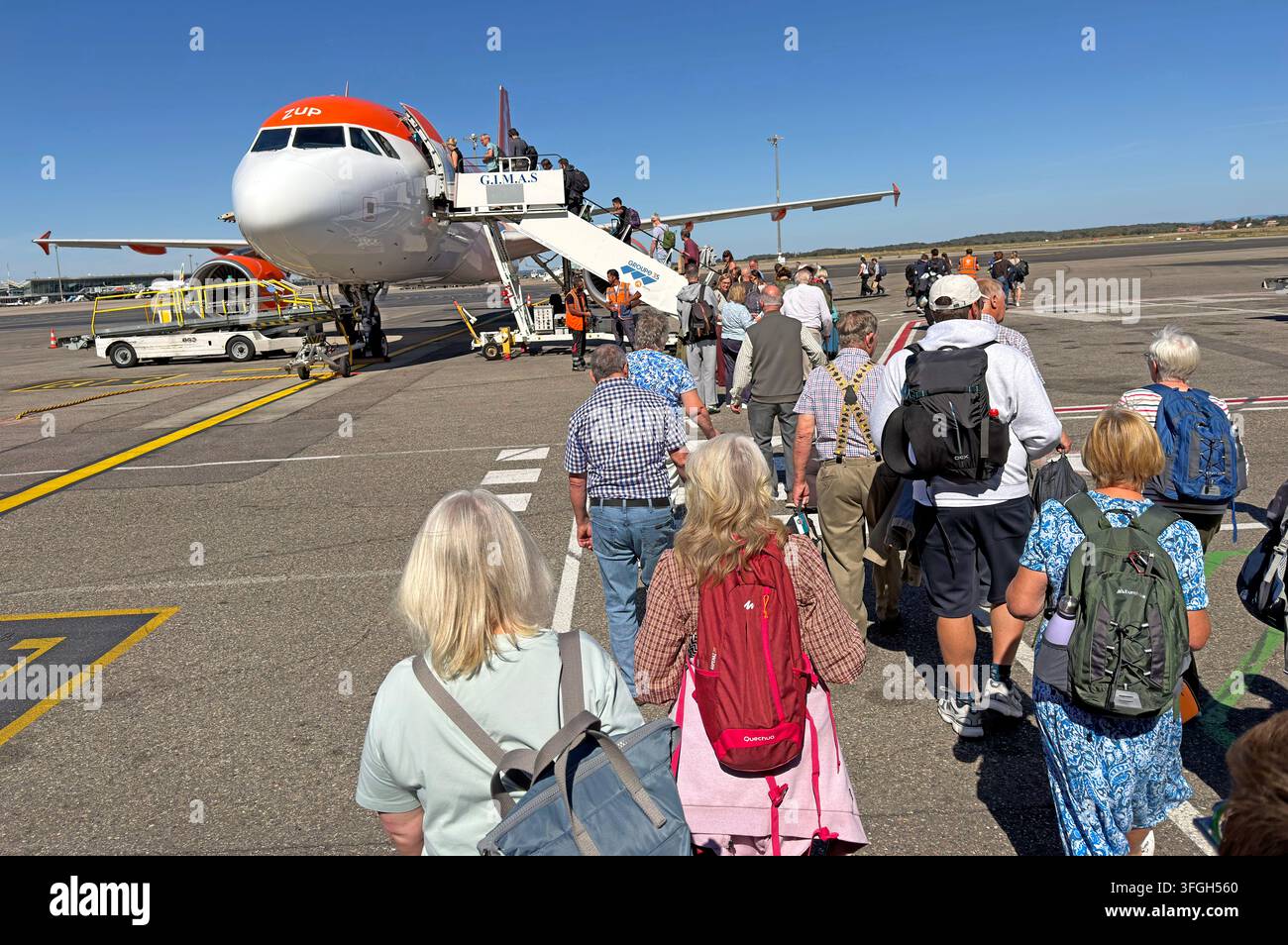
Image details
Contributor:
Tony SmithImage ID:
3FGH560File size:
90.5 MB (4.4 MB Compressed download)Releases:
Model - no | Property - noDo I need a release?Dimensions:
6896 x 4585 px | 58.4 x 38.8 cm | 23 x 15.3 inches | 300dpiDate taken:
12 September 2026Location:
Lyon Saint-Exupéry Airport, Colombier-Saugnieu, Rhône, FranceMore information:
. A long line of passengers crosses the airport apron towards an easyJet Airbus A320-family aircraft at Lyon Saint-Exupéry Airport. Travellers with backpacks and cabin bags wait to board by mobile stairs, while the aircraft nose and orange engine nacelles are visible ahead. The scene captures a familiar low-cost-airline boarding process in which passengers leave the terminal and walk to an aircraft on a remote stand. Airlines use tightly managed boarding groups, cabin-baggage rules and rapid turnarounds to keep aircraft utilisation high. Lyon is a major regional French airport with domestic and international services, and easyJet is a prominent European low-cost carrier. The queue includes travellers of different ages carrying backpacks and small cases, a typical mix for leisure-oriented European flying. The aircraft is parked away from a pier, so passengers are channelled across marked apron routes rather than through an enclosed bridge. This exposes the operational choreography of boarding: buses or gates release a group, staff control the line, and both aircraft doors can be used to shorten the time before pushback. Peak holiday periods can expose the difference between normal terminal capacity and sudden surges when several flights are processed at once, creating queues at check-in, security or the gate. Wayfinding has to work for people who may not speak the local language, so pictograms, bilingual wording, colour and repeated signs are central to airport design. The growth of low-cost aviation has made frequent European air travel more accessible while also intensifying debate about congestion, consumer rights, airport expansion and aviation emissions. Airlines favour fast turnarounds because an aircraft earns nothing while standing on the ground, so boarding, baggage loading, fuelling and cabin preparation are tightly timed around departure slots. The setting remains clearly identifiable.

