
Historic Victorian projecting clock beneath the train-shed roof at York railway station, decorated with the City of York coat of arms
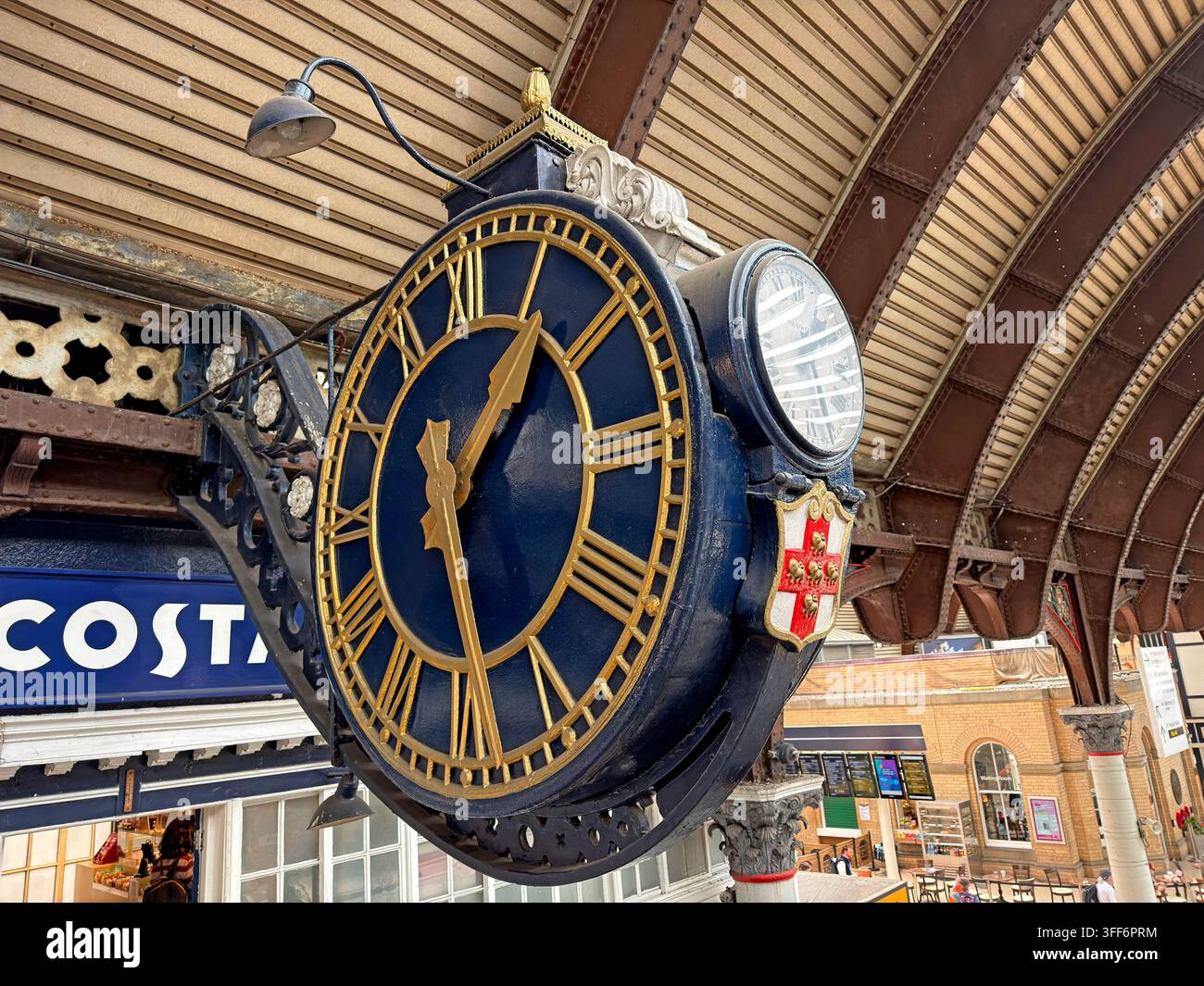
Image details
Contributor:
Tony SmithImage ID:
3FF6PRMFile size:
89.7 MB (4.2 MB Compressed download)Releases:
Model - no | Property - noDo I need a release?Dimensions:
6464 x 4848 px | 54.7 x 41 cm | 21.5 x 16.2 inches | 300dpiDate taken:
5 September 2026Location:
York railway station, Station Road, York, North Yorkshire, YO24 1AB, England, UKMore information:
Historic projecting clock beneath the Victorian train-shed roof at York railway station, a distinctive surviving architectural detail at this major North Yorkshire transport landmark. The dark-blue clock face has gold Roman numerals and hands and is carried on elaborate openwork metalwork, combining railway timekeeping with Victorian decorative design. York's present station was built between 1872 and 1877 for the North Eastern Railway and designed by Thomas Prosser, Benjamin Burley and William Peachey. When it opened in 1877 it was among the largest railway stations in the world. Its curved train shed, iron structure, brickwork, heraldry and historic fittings are now protected as part of the Grade II* listed station. Historic England records a massive clock on the platform side, projecting above the footbridge on an openwork S-shaped bracket decorated with foliage, white roses and the City of York arms. A conservation study dates York station's two cantilevered double-sided clocks to around the 1880s and identifies them as historically, communally and aesthetically significant, although their original mechanisms no longer survive. The shield visible on the clock should not simply be described as an English St George flag. It represents the arms of the City of York: a red St George's cross carrying five gold lions on a white field, civic heraldry incorporated into the railway architecture. White roses and other heraldic decoration elsewhere in the station reinforce the connection between railway identity, York and Yorkshire. The photograph can illustrate Victorian railway engineering, historic public clocks, railway timekeeping, North Eastern Railway heritage, station conservation, architectural ironwork, civic heraldry and the importance of accurate time to nineteenth-century rail travel. It forms part of York station's visual identity and survives as a decorated reminder of the city's status as one of Britain's great historic railway centres.

