
Three free-to-use UK cash machines installed together outside a supermarket, England, UK.
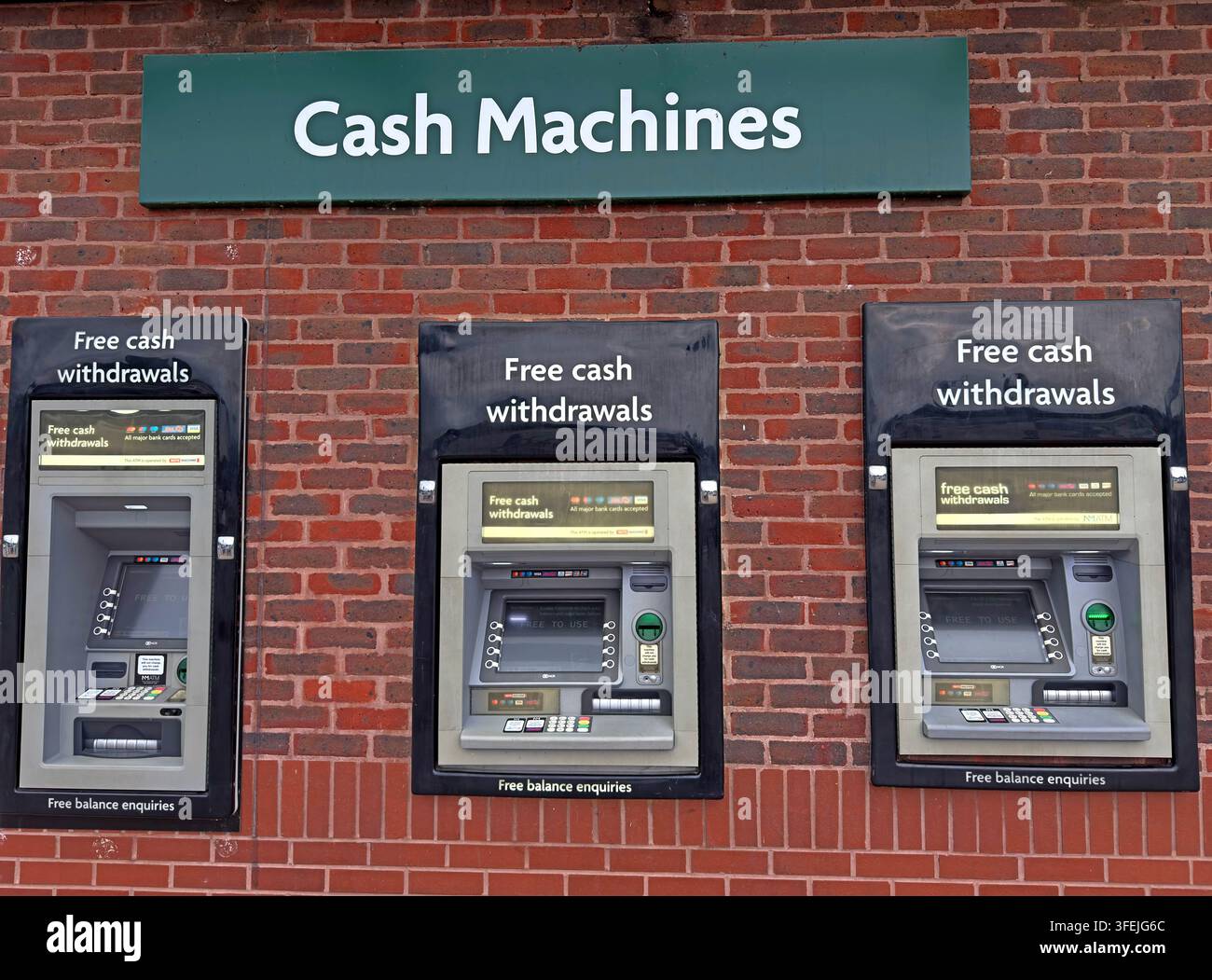
Image details
Contributor:
Tony SmithImage ID:
3FEJG6CFile size:
87.6 MB (3.1 MB Compressed download)Releases:
Model - no | Property - noDo I need a release?Dimensions:
6436 x 4760 px | 54.5 x 40.3 cm | 21.5 x 15.9 inches | 300dpiDate taken:
28 August 2026Location:
England, UKMore information:
. Three ATMs stand side by side beneath a Cash Machines sign, each advertising free cash withdrawals and illustrating the continuing role of physical cash access alongside card and digital payments. Cash machines became a routine part of British banking after the first UK cash dispenser was installed by Barclays in Enfield in 1967. The network expanded rapidly through the 1980s and 1990s, but the long-term decline in cash use, bank-branch closures and rising card and phone payments have since made free access to cash a public-policy issue. Three side-by-side ATMs labelled for free withdrawals show both the convenience of shared cash infrastructure and the continuing demand for notes despite digital banking. They are particularly relevant to debate about cash-dependent consumers, small businesses, budgeting, banking deserts and the obligation to preserve reasonable access to cash as individual branches and machines disappear. The three machines also demonstrate network diversity: cash access is often provided by different banks or independent operators in the same location, so withdrawal availability can survive even when a particular branch closes. Britain's cash infrastructure is changing unevenly rather than disappearing in a straight line. Contactless cards and mobile wallets have reduced routine withdrawals for many people, while branch closures have removed traditional counters from numerous towns. At the same time, cash remains important to some older customers, people budgeting tightly, market traders and small businesses, and it can provide resilience when electronic systems fail. Multiple ATMs in one location make that transition visible: different operators can coexist even as nearby bank branches contract. Fees, free withdrawals, machine ownership and availability all matter to users, while regulators and industry bodies treat geographic access to notes and coins as an inclusion issue rather than simply a commercial banking decision.

