
Mind charity shop in Stockton Heath asking for donated stock, Warrington, Cheshire.
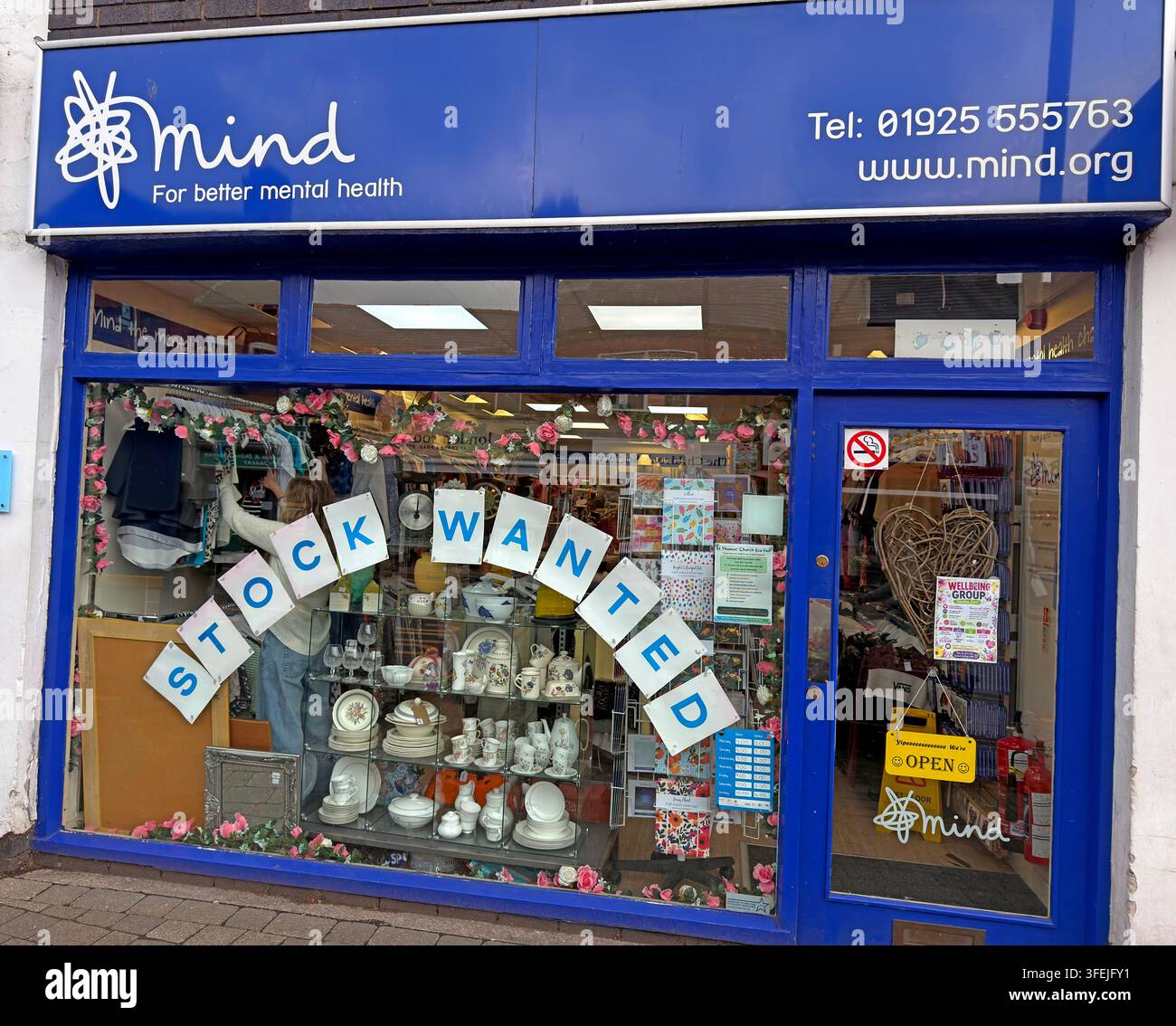
Image details
Contributor:
Tony SmithImage ID:
3FEJFY1File size:
92 MB (3.2 MB Compressed download)Releases:
Model - no | Property - noDo I need a release?Dimensions:
6324 x 5083 px | 53.5 x 43 cm | 21.1 x 16.9 inches | 300dpiDate taken:
28 August 2026Location:
28A London Road, Stockton Heath, Warrington WA4 6HN, Cheshire, England, UKMore information:
. The blue Mind shopfront in Stockton Heath displays a Stock Wanted message, illustrating how charity retail depends on public donations of reusable goods to raise funds for mental health work. Mind operates charity shops in more than 160 communities across England and Wales, selling mainly donated clothing, books and household goods to help fund its mental-health work. In 2024-25 Mind reported £26 million of retail sales and £4.1 million profit from shops and other retail income after operating costs. The Stockton Heath branch sits on London Road in a busy village centre, and a 'stock wanted' display makes the dependence of the charity-shop model on public donations especially clear. Beyond fundraising, Mind describes volunteering in its shops as a route to skills, social contact and sometimes a stepping stone back into work, giving these retail premises a role that extends beyond simply selling second-hand goods. A request for stock is operationally important because charity retailers cannot simply reorder identical donated inventory from a wholesaler; the quantity, season and quality of local donations directly shape what can be sold. Mind's charity shops turn donated clothing, books and household goods into unrestricted income that can support mental-health work, while also providing volunteering opportunities and low-cost second-hand goods. A 'stock wanted' display exposes the unusual supply chain behind that model: unlike a conventional retailer, the branch cannot order identical replacement stock when shelves run low. Stockton Heath is an affluent suburban village, making the quality and volume of donations potentially important to shop performance. The appeal also fits the circular-economy case for charity retail, extending the life of products that might otherwise be discarded. The frontage therefore links mental-health fundraising with reuse, volunteering and the practical economics of running a high-street charity shop.

