
Construction work during the refurbishment of historic Northwich Library, Cheshire, in 2026.
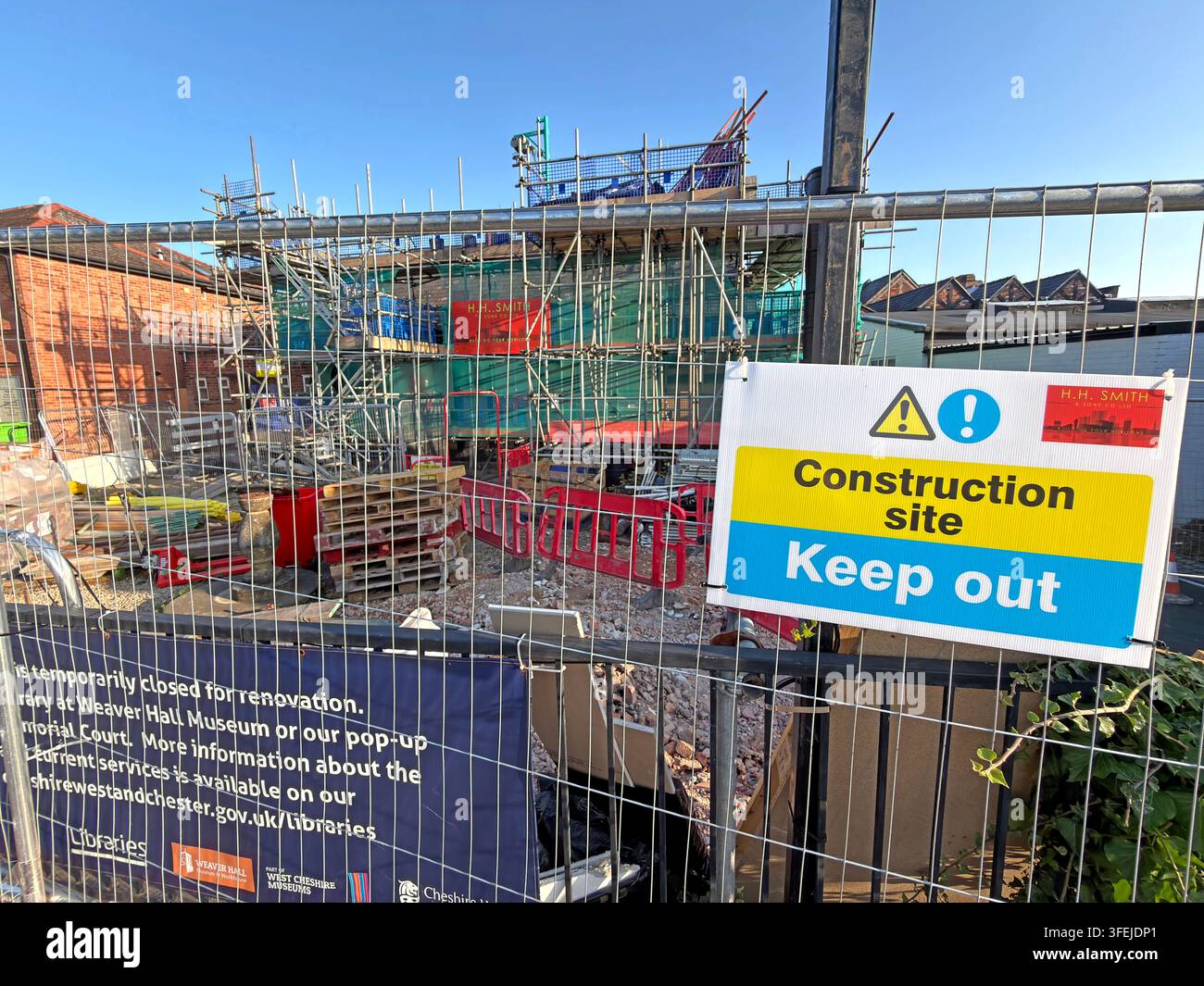
Image details
Contributor:
Tony SmithImage ID:
3FEJDP1File size:
101.1 MB (4 MB Compressed download)Releases:
Model - no | Property - noDo I need a release?Dimensions:
6864 x 5148 px | 58.1 x 43.6 cm | 22.9 x 17.2 inches | 300dpiDate taken:
23 August 2026Location:
Northwich Library, Witton Street, Northwich, Cheshire, England, UKMore information:
. Scaffolding and a construction safety sign mark work at the rear of Northwich Library. Northwich Library is an important heritage building in the town and has undergone a complex programme of repair and refurbishment. Cheshire West and Chester Council appointed H.H. Smith & Sons for the final phase, with work beginning in June 2026 and reopening planned for spring 2027. The council described the project as both repair of a difficult historic structure and creation of a modern library and learning space. Scaffolding, temporary works and a construction exclusion sign at the rear record the building during this transition, when specialist contractors were securing the fabric while adapting it for contemporary community use. The scheme combines conservation with public-service investment while the familiar civic building is temporarily inaccessible to normal users. The project has involved an extended procurement and specialist investigation because heritage buildings often contain hidden structural and fabric problems that cannot be priced reliably from a simple visual survey. Northwich Library occupies a prominent historic building whose repair has proved more complicated than a routine fit-out. Older public buildings can combine decorative masonry, timber, roofs and services installed at different periods, with defects becoming apparent only after access or opening-up works begin. The refurbishment is therefore relevant not just to library provision but to the cost of keeping civic heritage in active use. Libraries themselves have also expanded beyond book lending into digital access, study space, events, children's activities and help for residents who may lack devices or internet access at home. The 2026 works capture the difficult public-sector balance between conserving an inherited building and adapting it for contemporary community use rather than abandoning it for a simpler new-build solution.

