
Princess Diana children's memorial stone in Eccles, Salford, Greater Manchester, England, UK.
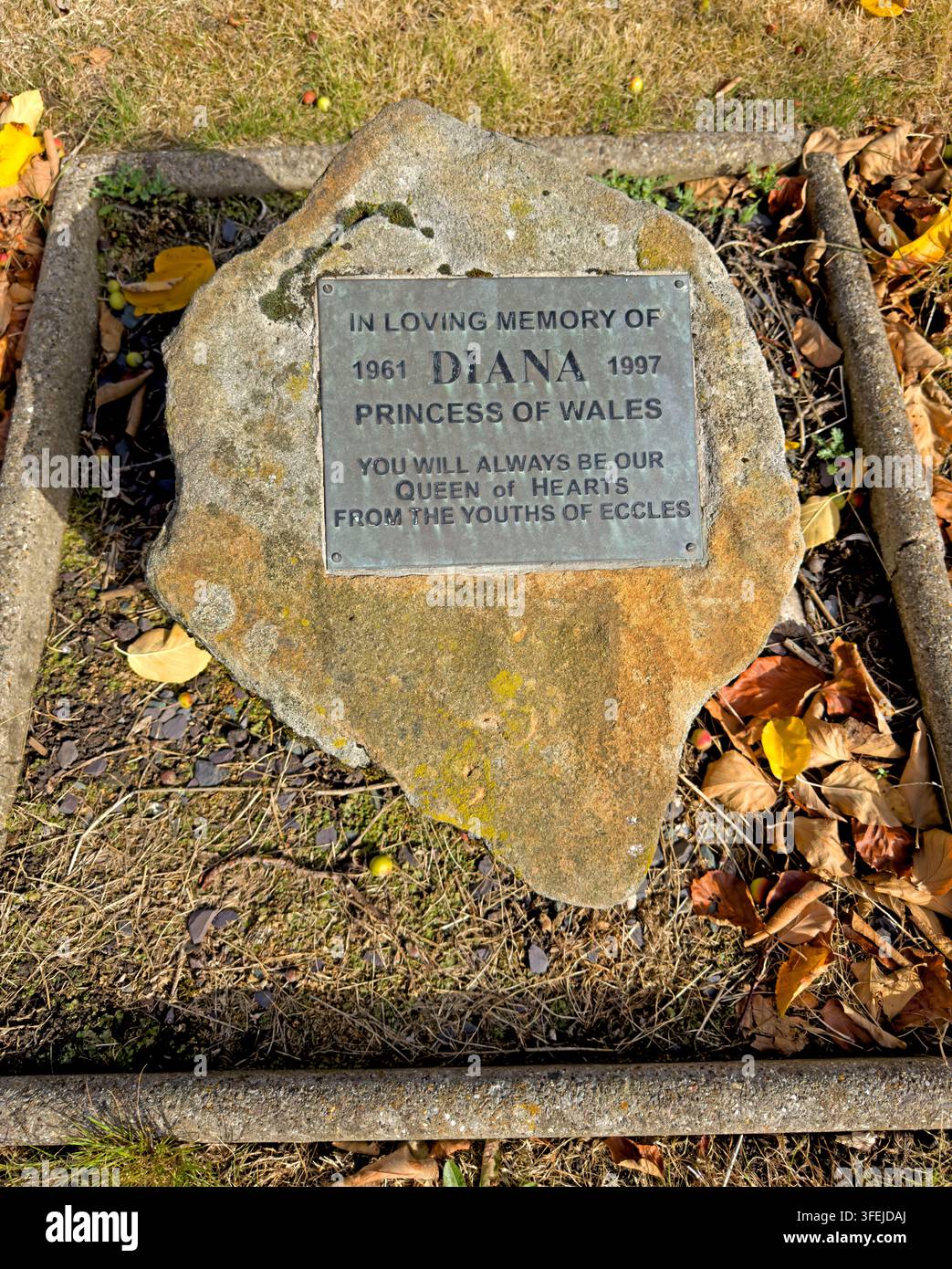
Image details
Contributor:
Tony SmithImage ID:
3FEJDAJFile size:
89.3 MB (5.7 MB Compressed download)Releases:
Model - no | Property - noDo I need a release?Dimensions:
5005 x 6236 px | 42.4 x 52.8 cm | 16.7 x 20.8 inches | 300dpiDate taken:
19 August 2026Location:
Eccles, Salford, Greater Manchester, England, UKMore information:
. A small memorial stone dedicated to Diana, Princess of Wales, sits among leaves in Eccles, a local expression of the extraordinary public mourning that followed her death in 1997. The memorial to Diana, Princess of Wales in Eccles reflects the extraordinary wave of public commemoration that followed her death in Paris on 31 August 1997. Diana, born in 1961, was widely described as the 'Queen of Hearts' and became associated with charitable causes, including homelessness, HIV/AIDS and the campaign against landmines. Across Britain, unofficial memorials, plaques, gardens and locally funded monuments appeared alongside the much larger national tributes in London. A modest neighbourhood memorial has a different historical value from an official royal monument: it records how popular grief and affection were expressed at local level and how those improvised or community-created sites survived into later decades. The stone's modest scale and setting among trees are typical of community memorials that were funded or maintained locally, far removed from the heavily visited official Diana memorial sites in London. Public mourning after Diana, Princess of Wales died in Paris on 31 August 1997 produced thousands of informal memorials across Britain, many created by residents rather than official bodies. Flowers, cards and handwritten messages were initially temporary, but some communities later installed plaques, gardens or stones to preserve the local response. A children's or youth memorial in Eccles belongs to that grassroots tradition and shows how the phrase 'Queen of Hearts' entered popular commemoration outside royal ceremony. Such small memorials receive far less national attention than Kensington Palace or the formal Diana memorials in London, yet they reveal how strongly her death was felt in ordinary neighbourhoods. Their survival decades later also raises questions about maintenance, collective memory and the persistence of spontaneous public grief.

