
Sainsbury's SmartShop handheld scanners ready for customers inside a UK supermarket.
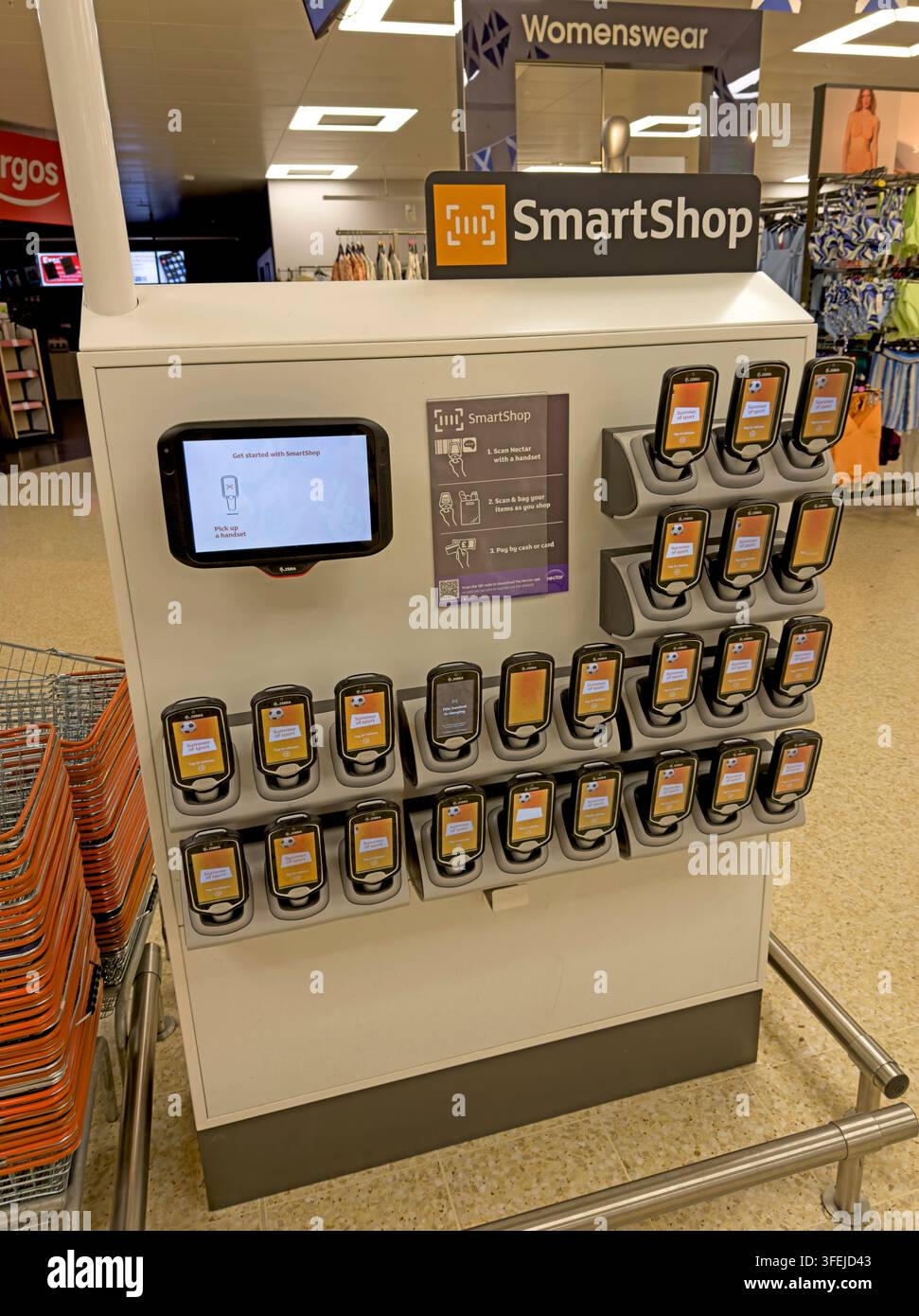
Image details
Contributor:
Tony SmithImage ID:
3FEJD43File size:
90.1 MB (2.2 MB Compressed download)Releases:
Model - no | Property - noDo I need a release?Dimensions:
4852 x 6492 px | 41.1 x 55 cm | 16.2 x 21.6 inches | 300dpiDate taken:
26 June 2026Location:
Sainsbury's supermarket, England, UKMore information:
. A bank of Sainsbury's SmartShop handheld scanners allows shoppers to scan goods as they move around the store, part of the shift toward self-service, app-assisted and friction-reducing supermarket checkout technology. Sainsbury's SmartShop allows customers to scan products as they move around a store using a handset or phone, keep a running total and then complete payment at a dedicated checkout. Scan-as-you-shop systems shift part of the checkout process to the customer and are one stage in the wider automation of supermarket retail, alongside self-checkouts, apps, digital loyalty schemes and electronic shelf labels. For shoppers they can reduce unloading and re-packing; for retailers they can change staffing patterns and generate more detailed data about the shopping journey. A bank of handheld scanners is therefore a clear record of the move away from the conventional staffed till that dominated British supermarkets for most of the 20th century. The scanner rack itself is transitional technology: some supermarkets have already shifted similar functions onto customers' own smartphones, so dedicated handsets may eventually become another short-lived stage in retail automation. Sainsbury's SmartShop handsets were introduced to let customers scan products as they moved around the store, pack directly into bags and pay with less unloading at a conventional checkout. Dedicated handset racks are therefore a visible stage in the automation of grocery retail, bridging traditional staffed checkouts and app-led shopping. They also show the trade-off retailers face: faster journeys and lower queue pressure on one side, but equipment costs, random rescan checks and theft risk on the other. As supermarkets continually redesign checkout areas, a bank of proprietary scanners can become a surprisingly date-specific record of how one chain expected customers to shop in the mid-2020s.

