
Panoramic view east across Tallinn Old Town rooftops towards the modern city skyline, Estonia.
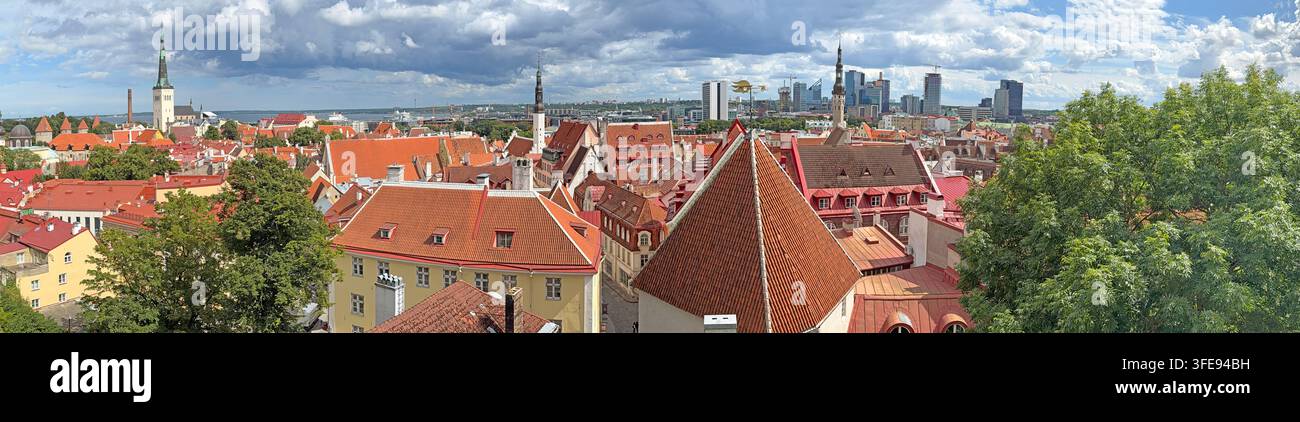
Image details
Contributor:
Tony SmithImage ID:
3FE94BHFile size:
119.7 MB (6.9 MB Compressed download)Releases:
Model - no | Property - noDo I need a release?Dimensions:
12788 x 3271 px | 108.3 x 27.7 cm | 42.6 x 10.9 inches | 300dpiDate taken:
3 August 2026Location:
Tallinn Old Town, Tallinn, EstoniaMore information:
. Red tiled roofs, church spires and medieval streets fill the foreground of this elevated panorama across Tallinn Old Town, with the modern Estonian capital spreading toward the horizon. Tallinn's Old Town is one of Europe's best-preserved medieval urban centres and has been on UNESCO's World Heritage List since 1997. The city developed as a major Hanseatic trading centre from the 13th to the 16th centuries, with the upper town of Toompea and the lower merchant town creating the layered skyline of walls, towers and church spires. The red roofs in the foreground retain much of the medieval street pattern, while modern Tallinn rises beyond them. That contrast is central to the city's identity: Estonia presents itself as a technologically advanced digital state while its capital also protects an unusually complete northern European medieval core. From elevated viewpoints the protected medieval roofscape is seen in direct relationship with newer high-rise districts, which is why UNESCO and Tallinn planners pay close attention to view corridors as well as individual old buildings. Tallinn's Old Town survived the upheavals of war and Soviet rule with an unusually complete medieval street plan, city walls, merchant houses and ecclesiastical skyline. Toompea rises above the lower town, reflecting an old division between administrative or aristocratic power and the mercantile settlement below. Beyond the red-tiled roofs, modern towers show the rapid development that followed Estonian independence and integration into European and global economies. That proximity creates a continuing planning challenge: new height can alter views that are part of the World Heritage setting even when construction lies outside the medieval core. An elevated panorama therefore brings several centuries into one frame, from Hanseatic trade and church spires to contemporary offices and apartments in a capital internationally associated with digital government and technology.

