
Birmingham city skyline viewed from above, showing the BT Tower among dense commercial, residential and historic city-centre development.
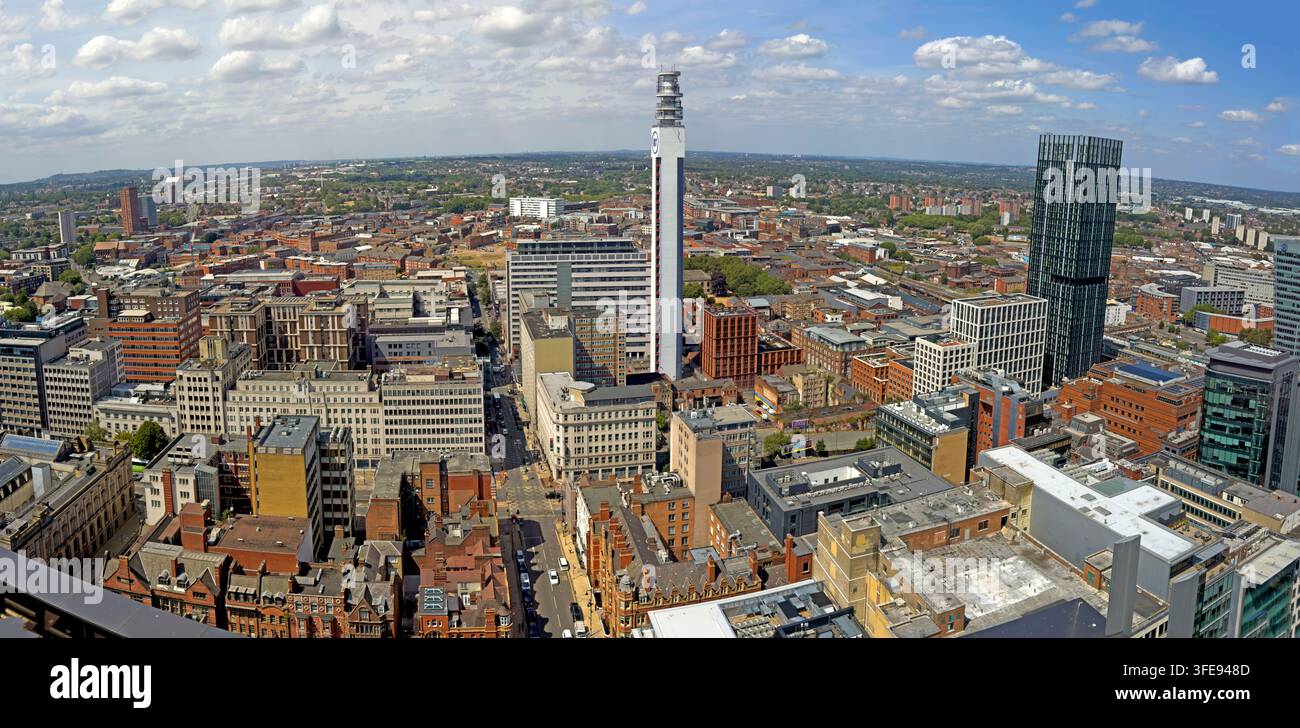
Image details
Contributor:
Tony SmithImage ID:
3FE948DFile size:
117.7 MB (5.2 MB Compressed download)Releases:
Model - no | Property - noDo I need a release?Dimensions:
9152 x 4494 px | 77.5 x 38 cm | 30.5 x 15 inches | 300dpiDate taken:
29 July 2026Location:
Birmingham city centre, West Midlands, England, UKMore information:
Elevated panoramic view looking north-east across Birmingham city centre, West Midlands, England, showing the dense urban skyline beneath a bright summer sky. The landmark BT Tower rises prominently near the centre of the view, surrounded by a mixture of historic brick buildings, post-war commercial blocks, offices, hotels and newer high-rise development. Birmingham’s skyline has changed dramatically during the twenty-first century as large residential, office and mixed-use schemes have reshaped the centre. The photograph records that transition, contrasting the telecommunications infrastructure and lower-rise commercial fabric of the established city with the growing number of modern towers. The dark-glazed high-rise to the right contributes to the increasingly vertical character of central Birmingham, while streets and rooftops below reveal the dense grain of Britain’s second-largest city. The BT Tower, formerly known as the Post Office Tower, was completed in the mid-1960s as part of Britain’s microwave telecommunications network and became one of Birmingham’s most recognisable landmarks. For decades it dominated the skyline, before a new generation of residential skyscrapers began exceeding its height. By 2026, One Eastside and Octagon had established a new scale for Birmingham, with One Eastside reaching about 155 metres and becoming the city’s tallest completed building. The image can illustrate Birmingham regeneration, city-centre redevelopment, urban growth, high-rise construction, telecommunications heritage, changing skylines, commercial property, residential development and the transformation of post-industrial British cities. It also provides a broad geographical overview of central Birmingham, useful for travel, tourism, planning, architecture, investment and regional-economy features, while documenting a skyline that continues to evolve as major development and infrastructure projects alter the city.

