
Historic plaque commemorating the 1899 Northwich Town Bridge over the River Weaver.
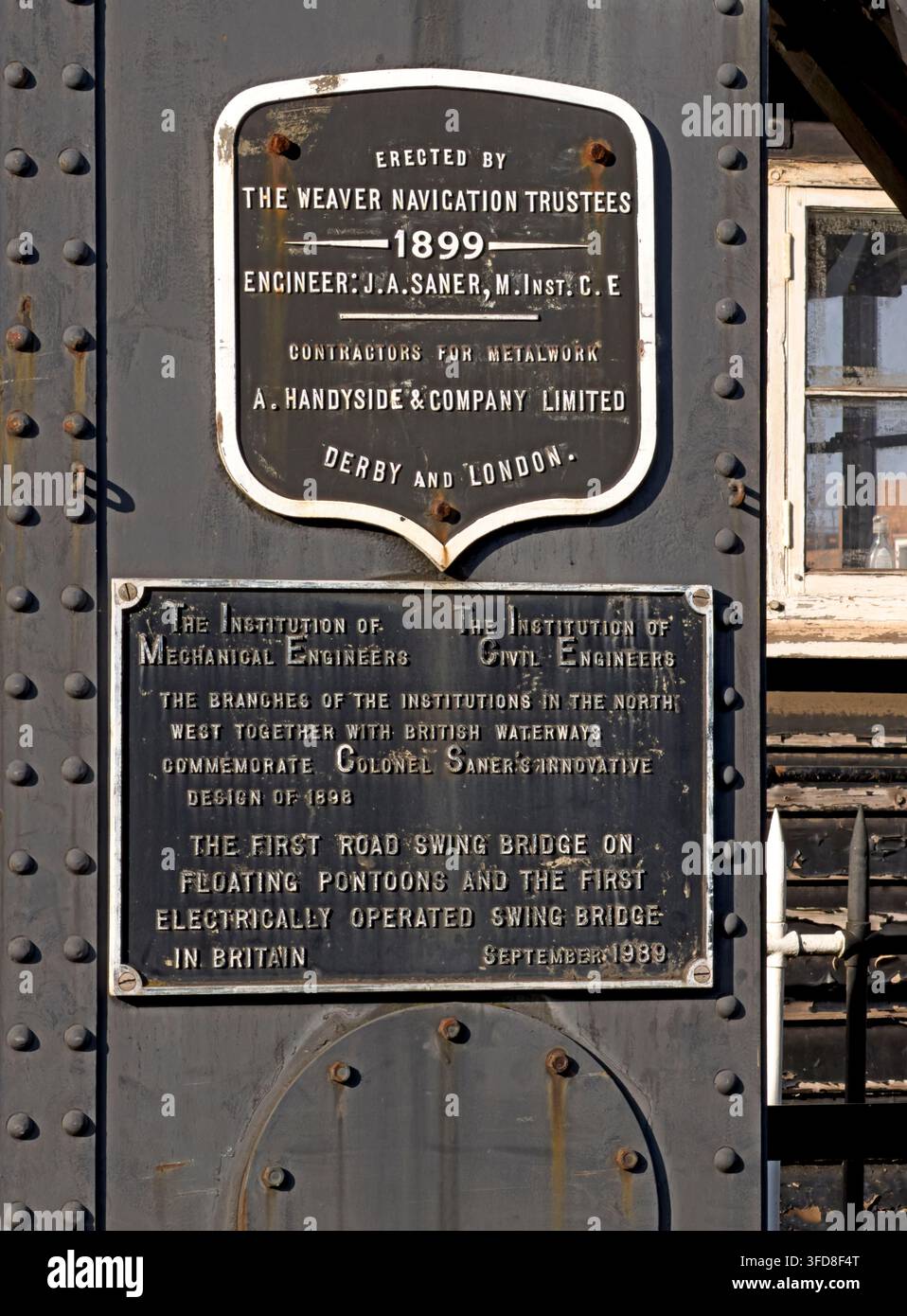
Image details
Contributor:
Tony SmithImage ID:
3FD8F4TFile size:
66.8 MB (1.9 MB Compressed download)Releases:
Model - no | Property - noDo I need a release?Dimensions:
4150 x 5629 px | 35.1 x 47.7 cm | 13.8 x 18.8 inches | 300dpiDate taken:
23 August 2026Location:
Town Bridge, Bull Ring, Northwich, Cheshire, CW9, EnglandMore information:
. Historic plaque commemorating the 1899 Northwich Town Bridge over the River Weaver. The metal plaque records the Weaver Navigation Trustees, the 1899 date and the engineers responsible for the bridge, turning a small detail into direct primary evidence of Northwich’s transport history. Northwich grew around the River Weaver and the salt trade, and its movable bridges are among the town’s most distinctive pieces of industrial infrastructure. Town Bridge and Hayhurst Bridge were built in 1899 for the Weaver Navigation Trustees to designs associated with engineer J. A. Saner and metalwork contractor A. Handyside & Co. Historic England records both as Grade II listed and notes that they are believed to be among the earliest electrically powered swing bridges in Britain. Their unusual engineering also reflects the problem of ground movement caused by historic salt extraction in Northwich. The location is Town Bridge, Bull Ring, Northwich, Cheshire, CW9, England. This geographical detail helps distinguish the subject from similar businesses, buildings or scenes elsewhere and gives the photograph stronger value for local, regional and comparative editorial use. For picture researchers, the combination of legible wording and clear environmental context broadens the potential use beyond a simple location shot, allowing the image to support business, heritage, lifestyle and public-policy coverage. There is also a strong sense of contemporary place: practical objects, signage and architecture are shown as they actually appear in use, without removing the clutter that makes a documentary photograph informative. The image therefore has value not only for current news features but also for retrospective comparisons of how streets, services, brands and public expectations evolve over time. This makes the photograph a useful piece of contemporary editorial documentation. The visible details also strengthen its usefulness as documentary stock photography.

