
Hayhurst swing bridge crossing the River Weaver Navigation at Northwich in summer.
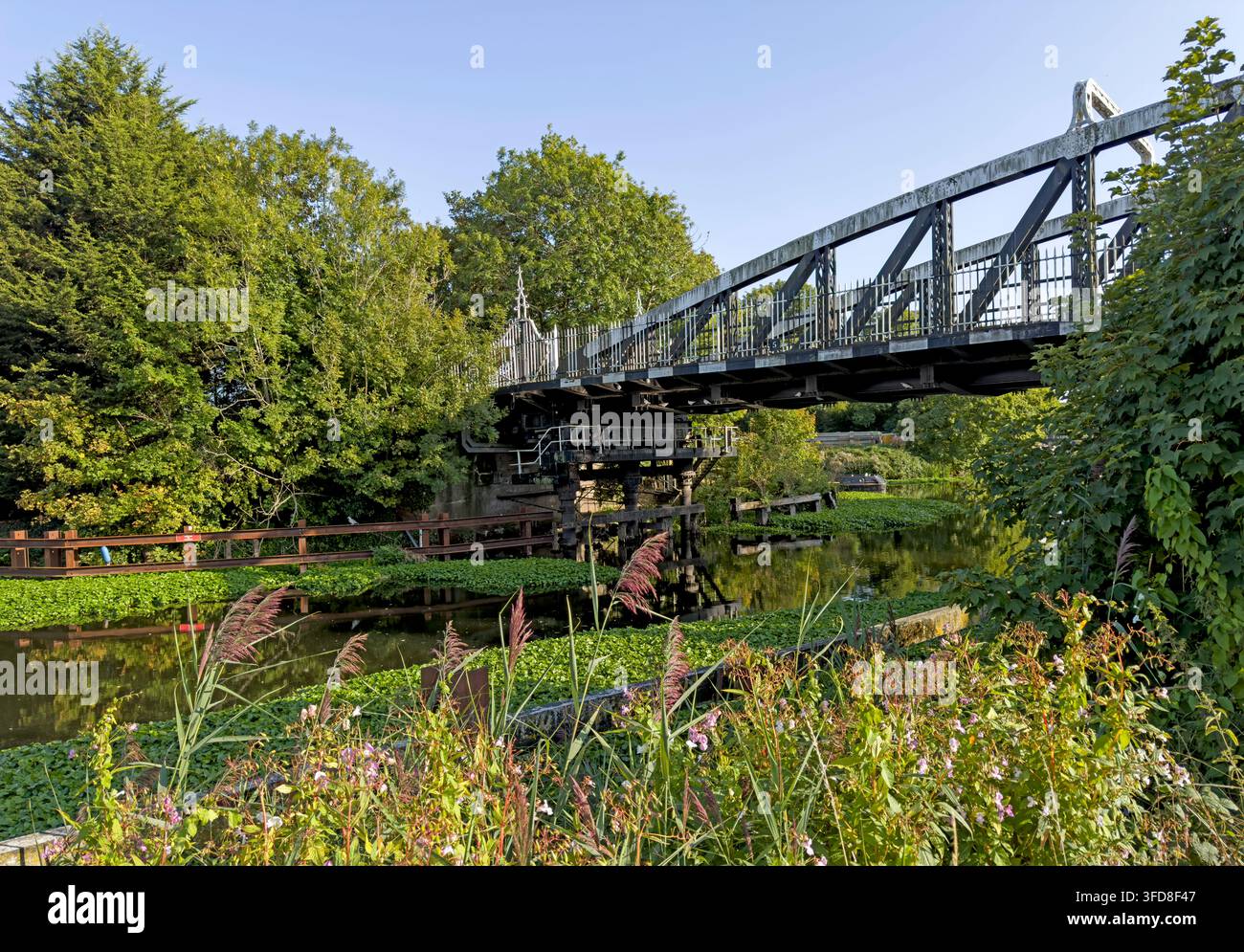
Image details
Contributor:
Tony SmithImage ID:
3FD8F47File size:
99.4 MB (6 MB Compressed download)Releases:
Model - no | Property - noDo I need a release?Dimensions:
7064 x 4920 px | 59.8 x 41.7 cm | 23.5 x 16.4 inches | 300dpiDate taken:
23 August 2026Location:
Hayhurst Bridge, Chester Way, Northwich, Cheshire, EnglandMore information:
. Hayhurst swing bridge crossing the River Weaver Navigation at Northwich in summer. The steel bridge is seen among lush summer vegetation beside the river, combining Northwich’s heavy engineering heritage with the greener modern landscape of the Weaver corridor. Northwich grew around the River Weaver and the salt trade, and its movable bridges are among the town’s most distinctive pieces of industrial infrastructure. Town Bridge and Hayhurst Bridge were built in 1899 for the Weaver Navigation Trustees to designs associated with engineer J. A. Saner and metalwork contractor A. Handyside & Co. Historic England records both as Grade II listed and notes that they are believed to be among the earliest electrically powered swing bridges in Britain. Their unusual engineering also reflects the problem of ground movement caused by historic salt extraction in Northwich. The location is Hayhurst Bridge, Chester Way, Northwich, Cheshire, England. This geographical detail helps distinguish the subject from similar businesses, buildings or scenes elsewhere and gives the photograph stronger value for local, regional and comparative editorial use. Details that might seem mundane at the moment of photography can later help date a streetscape or explain how a service was delivered, which is one reason straightforward editorial documentation remains useful to archives and publishers. As an editorial stock image, it also records the typography, branding, materials and street-level visual language of its period, details that can become historically valuable as shops, products and public infrastructure are altered or replaced. The photograph is particularly useful where a story needs an identifiable real-world example rather than an abstract illustration, because the surrounding details place the subject in an ordinary British or European setting. This makes the photograph a useful piece of contemporary editorial documentation.

