
Crowded Manchester Piccadilly platforms 13 and 14 with passengers waiting for trains.
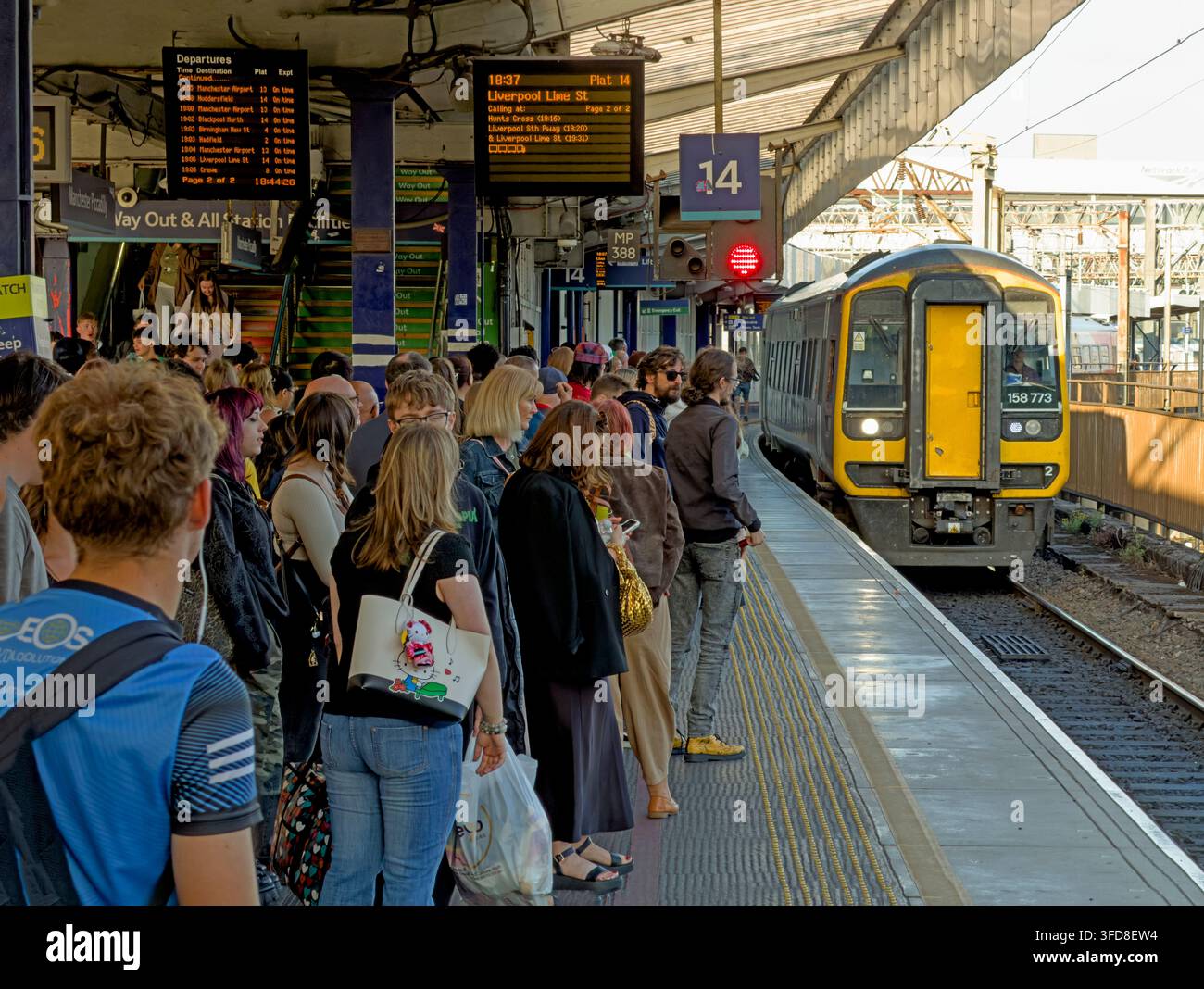
Image details
Contributor:
Tony SmithImage ID:
3FD8EW4File size:
107.4 MB (3.5 MB Compressed download)Releases:
Model - no | Property - noDo I need a release?Dimensions:
7063 x 5315 px | 59.8 x 45 cm | 23.5 x 17.7 inches | 300dpiDate taken:
22 August 2026Location:
Manchester Piccadilly station, Manchester, M1 2PB, EnglandMore information:
. Crowded Manchester Piccadilly platforms 13 and 14 with passengers waiting for trains. Passengers are packed along the narrow through-platform environment as a train approaches, giving a strong visual representation of the crowding problem for which platforms 13 and 14 are well known. Manchester Piccadilly’s present platforms 13 and 14 evolved from the island platform opened in 1882 for the South Junction route. They are the station’s only through platforms and form part of the Castlefield Corridor, the intensively used two-track railway between Piccadilly and Deansgate. Network Rail has described the corridor as a major pinch-point, with local, regional and inter-city services sharing constrained infrastructure. The platforms are particularly useful editorially for illustrating rail capacity, passenger crowding, timetable resilience, airport connectivity and long-running arguments over investment in Manchester’s railway network. The location is Manchester Piccadilly station, Manchester, M1 2PB, England. This geographical detail helps distinguish the subject from similar businesses, buildings or scenes elsewhere and gives the photograph stronger value for local, regional and comparative editorial use. The photograph is particularly useful where a story needs an identifiable real-world example rather than an abstract illustration, because the surrounding details place the subject in an ordinary British or European setting. Commercial and civic landscapes can change quickly, so apparently routine photographs of signs, shopfronts, machines and transport infrastructure often acquire additional documentary value when companies rebrand, premises close or policies change. The scene can be read at several levels: as a record of the immediate subject, as evidence of changing consumer or public behaviour, and as a small piece of the wider social and economic history visible in everyday places.

