
Selection of vintage Soviet USSR wristwatches including Moscow-factory designs.
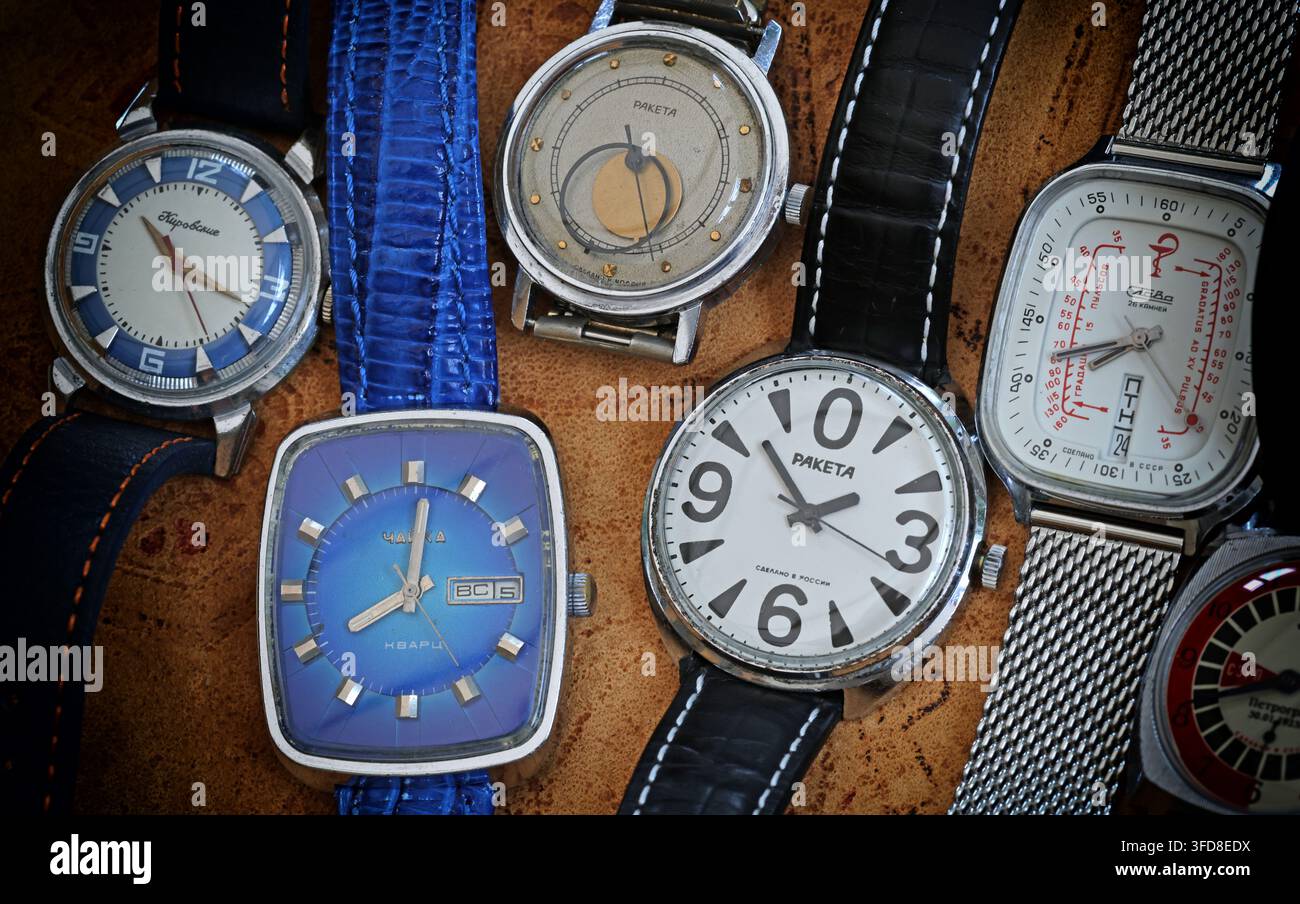
Image details
Contributor:
Tony SmithImage ID:
3FD8EDXFile size:
84.4 MB (2.9 MB Compressed download)Releases:
Model - no | Property - noDo I need a release?Dimensions:
6861 x 4300 px | 58.1 x 36.4 cm | 22.9 x 14.3 inches | 300dpiDate taken:
29 August 2026Location:
United KingdomMore information:
. Selection of vintage Soviet USSR wristwatches including Moscow-factory designs. The watches are arranged together as a collector’s group, allowing differences in dial typography, cases, straps and Soviet-era styling to be compared at a glance. Mechanical wristwatches made in the Soviet Union are now collected for their industrial design, unusual movements, military and scientific associations and distinctly Cold War-era branding. Factories around Moscow, Leningrad and other Soviet cities produced large volumes under names including Raketa, Slava and other state-controlled marques. Many watches were designed for a domestic mass market rather than luxury consumption, yet surviving examples have become historical objects in their own right. A mixed display can illustrate horology, Soviet manufacturing, design history, collecting, vintage fashion and the material culture of the USSR. The photograph is particularly useful where a story needs an identifiable real-world example rather than an abstract illustration, because the surrounding details place the subject in an ordinary British or European setting. Commercial and civic landscapes can change quickly, so apparently routine photographs of signs, shopfronts, machines and transport infrastructure often acquire additional documentary value when companies rebrand, premises close or policies change. The scene can be read at several levels: as a record of the immediate subject, as evidence of changing consumer or public behaviour, and as a small piece of the wider social and economic history visible in everyday places. For picture researchers, the combination of legible wording and clear environmental context broadens the potential use beyond a simple location shot, allowing the image to support business, heritage, lifestyle and public-policy coverage. This makes the photograph a useful piece of contemporary editorial documentation.

