
Driver filling a car with diesel at a Sainsbury’s petrol station.
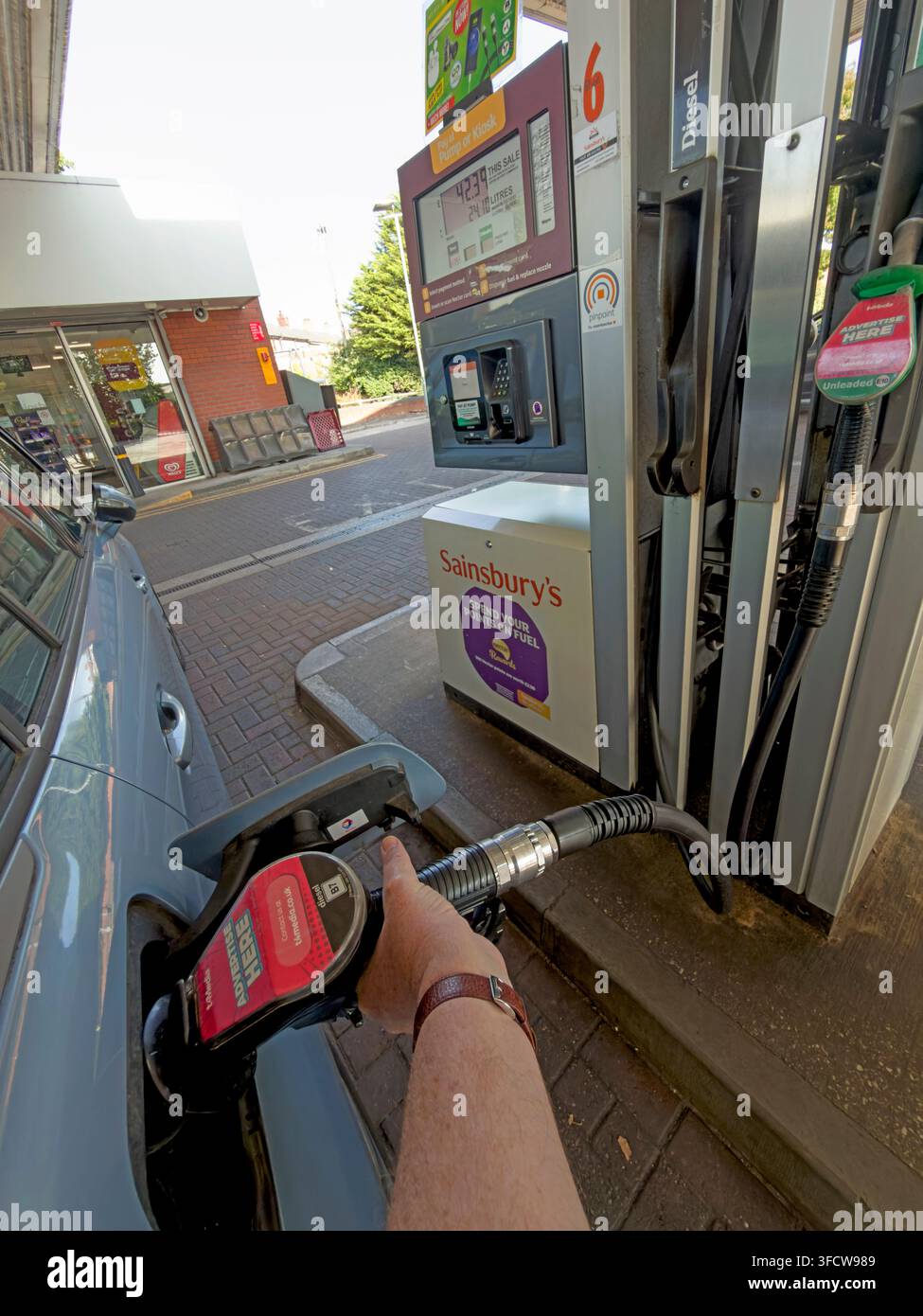
Image details
Contributor:
Tony SmithImage ID:
3FCW989File size:
89.7 MB (2.2 MB Compressed download)Releases:
Model - no | Property - noDo I need a release?Dimensions:
4848 x 6464 px | 41 x 54.7 cm | 16.2 x 21.5 inches | 300dpiDate taken:
23 August 2026Location:
Sainsbury’s petrol filling station, United KingdomMore information:
. Driver filling a car with diesel at a Sainsbury’s petrol station. Seen from the driver’s point of view, a hand holds the black fuel nozzle in the car while the supermarket forecourt equipment fills the background. A driver refuelling at a supermarket forecourt is an everyday image with broad editorial value. Diesel remains important to the UK vehicle fleet even as policy and manufacturer investment shift towards electric cars and lower-emission transport. Supermarket fuel stations have long competed on convenience and price, while pump displays, card payments and loyalty schemes have made the forecourt increasingly automated. The photograph can illustrate motoring costs, fuel duty, diesel prices, emissions policy, household budgets, transport decarbonisation and the continuing dependence of many drivers on liquid fuels. The location is Sainsbury’s petrol filling station, United Kingdom. This geographical detail helps distinguish the subject from similar businesses, buildings or scenes elsewhere and gives the photograph stronger value for local, regional and comparative editorial use. There is also a strong sense of contemporary place: practical objects, signage and architecture are shown as they actually appear in use, without removing the clutter that makes a documentary photograph informative. The image therefore has value not only for current news features but also for retrospective comparisons of how streets, services, brands and public expectations evolve over time. Details that might seem mundane at the moment of photography can later help date a streetscape or explain how a service was delivered, which is one reason straightforward editorial documentation remains useful to archives and publishers. As an editorial stock image, it also records the typography, branding, materials and street-level visual language of its period, details that can become historically valuable as shops, products and public infrastructure are altered or replaced.

