
Panoramic display of Soviet-era statues and monuments at Maarjamäe Palace in Tallinn, Estonia.
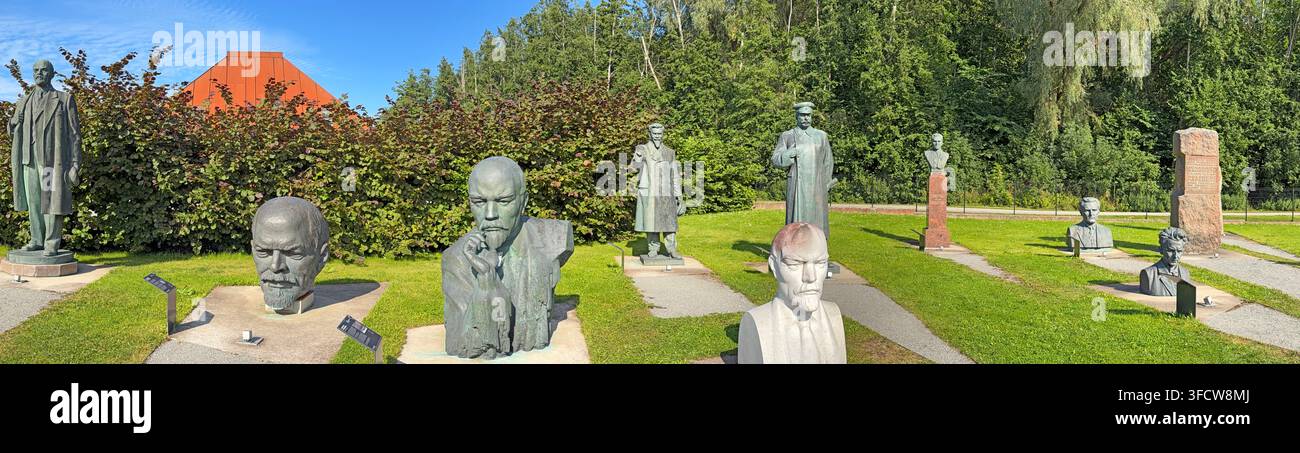
Image details
Contributor:
Tony SmithImage ID:
3FCW8MJFile size:
128.6 MB (8.8 MB Compressed download)Releases:
Model - no | Property - noDo I need a release?Dimensions:
12680 x 3546 px | 107.4 x 30 cm | 42.3 x 11.8 inches | 300dpiDate taken:
4 August 2026Location:
Maarjamäe Palace, Pirita tee 56, Tallinn, 12011, EstoniaMore information:
. Panoramic display of Soviet-era statues and monuments at Maarjamäe Palace in Tallinn, Estonia. A line of monumental heads and standing figures is arranged outdoors against grass and trees, presenting the statues as relocated historical objects rather than active civic monuments. Estonia was incorporated into the Soviet Union during the Second World War and restored its independence in 1991. Soviet-era monuments and statues therefore carry complex historical and political meanings, particularly after Russia’s full-scale invasion of Ukraine sharpened debate across the Baltic states about occupation symbols, memorials and public space. Collections of removed or relocated Soviet sculpture in Tallinn can be photographed both as historical artefacts and as evidence of changing attitudes to twentieth-century power, propaganda and memory in an independent EU and NATO member state. The location is Maarjamäe Palace, Pirita tee 56, Tallinn, 12011, Estonia. This geographical detail helps distinguish the subject from similar businesses, buildings or scenes elsewhere and gives the photograph stronger value for local, regional and comparative editorial use. For picture researchers, the combination of legible wording and clear environmental context broadens the potential use beyond a simple location shot, allowing the image to support business, heritage, lifestyle and public-policy coverage. There is also a strong sense of contemporary place: practical objects, signage and architecture are shown as they actually appear in use, without removing the clutter that makes a documentary photograph informative. The image therefore has value not only for current news features but also for retrospective comparisons of how streets, services, brands and public expectations evolve over time. This makes the photograph a useful piece of contemporary editorial documentation. It preserves a clear, searchable record of the subject and its setting for future editorial comparison.

