
Historic horse-drawn funeral trap or carriage displayed in Ashton-under-Lyne.
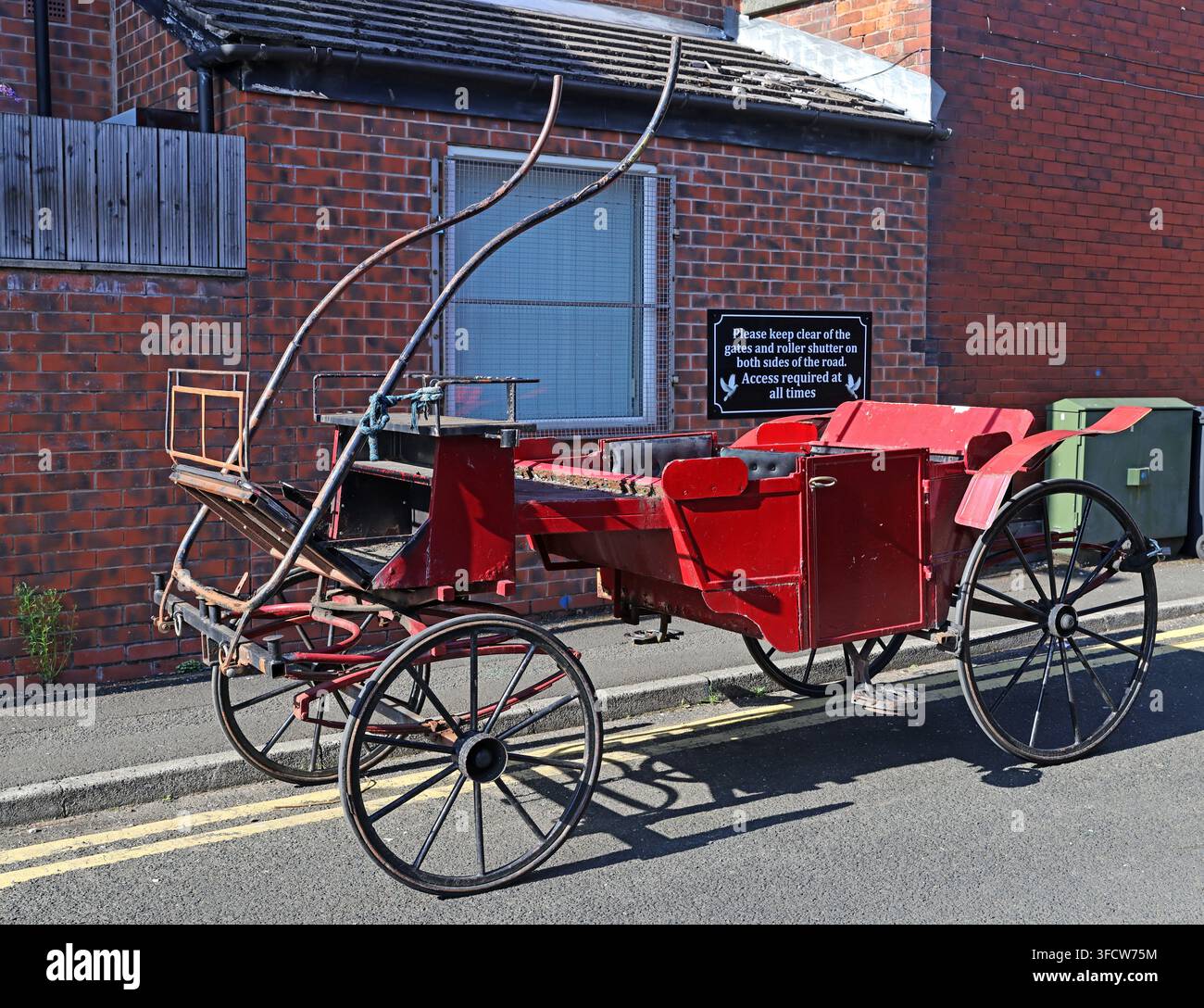
Image details
Contributor:
Tony SmithImage ID:
3FCW75MFile size:
99.8 MB (5.4 MB Compressed download)Releases:
Model - no | Property - noDo I need a release?Dimensions:
6741 x 5176 px | 57.1 x 43.8 cm | 22.5 x 17.3 inches | 300dpiDate taken:
22 August 2026Location:
Ashton-under-Lyne, Tameside, Greater Manchester, EnglandMore information:
. Historic horse-drawn funeral trap or carriage displayed in Ashton-under-Lyne. The black-and-red wheeled carriage has the tall frame and formal appearance associated with older funeral transport, providing a striking contrast with modern motor hearses. Ashton-under-Lyne is one of the principal town centres of Tameside in eastern Greater Manchester. Its streets retain a dense mix of Victorian and twentieth-century commercial buildings, banks, markets, small independents and vacant or altered shopfronts. Like many traditional English centres it has faced competition from out-of-town retail, online shopping and changing leisure patterns. Photographs of individual premises and tired streetscapes provide useful evidence for stories about regeneration, vacancy, adaptive reuse, local enterprise, business rates and the uneven fortunes of post-industrial town centres. The location is Ashton-under-Lyne, Tameside, Greater Manchester, England. This geographical detail helps distinguish the subject from similar businesses, buildings or scenes elsewhere and gives the photograph stronger value for local, regional and comparative editorial use. Commercial and civic landscapes can change quickly, so apparently routine photographs of signs, shopfronts, machines and transport infrastructure often acquire additional documentary value when companies rebrand, premises close or policies change. The scene can be read at several levels: as a record of the immediate subject, as evidence of changing consumer or public behaviour, and as a small piece of the wider social and economic history visible in everyday places. For picture researchers, the combination of legible wording and clear environmental context broadens the potential use beyond a simple location shot, allowing the image to support business, heritage, lifestyle and public-policy coverage. This makes the photograph a useful piece of contemporary editorial documentation.

