
Greater Manchester Police van parked outside Peter House on Oxford Street, Manchester.
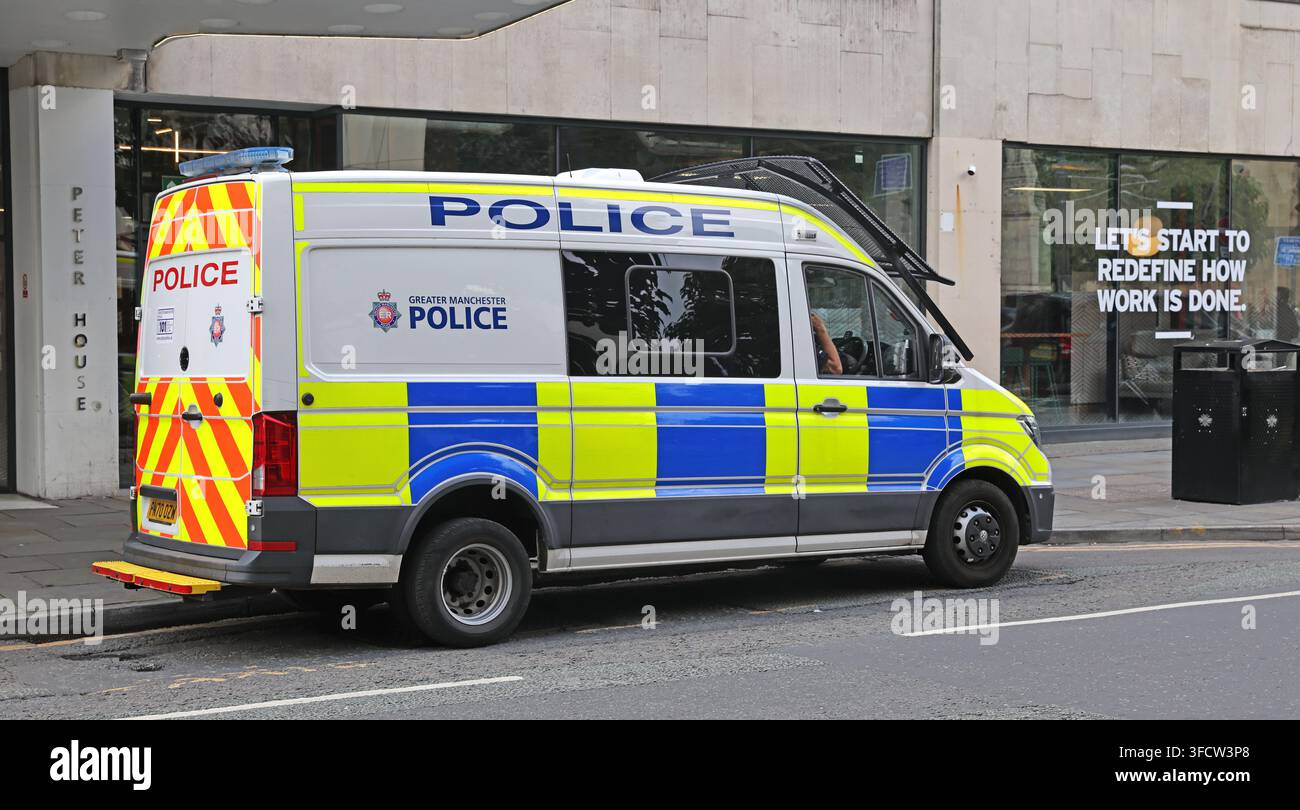
Image details
Contributor:
Tony SmithImage ID:
3FCW3P8File size:
106.4 MB (3.2 MB Compressed download)Releases:
Model - no | Property - noDo I need a release?Dimensions:
8192 x 4540 px | 69.4 x 38.4 cm | 27.3 x 15.1 inches | 300dpiDate taken:
22 August 2026Location:
Peter House, Oxford Street, Manchester, M1, EnglandMore information:
. Greater Manchester Police van parked outside Peter House on Oxford Street, Manchester. The marked van is parked against the modern office frontage, its fluorescent rear chevrons and blue-yellow body markings making the emergency-service presence immediately clear. Greater Manchester Police serves the metropolitan county of Greater Manchester, including Manchester city centre. A marked police van with high-visibility Battenburg markings is a familiar piece of operational street infrastructure, used for patrol, transport and a wide range of policing duties. Peter House stands on Oxford Street in central Manchester, an area of offices, shops, hotels and heavy pedestrian traffic. The image can support editorial coverage of policing, city-centre security, public order, emergency services, crime prevention and the everyday visible presence of police vehicles in urban Britain. The location is Peter House, Oxford Street, Manchester, M1, England. This geographical detail helps distinguish the subject from similar businesses, buildings or scenes elsewhere and gives the photograph stronger value for local, regional and comparative editorial use. For picture researchers, the combination of legible wording and clear environmental context broadens the potential use beyond a simple location shot, allowing the image to support business, heritage, lifestyle and public-policy coverage. There is also a strong sense of contemporary place: practical objects, signage and architecture are shown as they actually appear in use, without removing the clutter that makes a documentary photograph informative. The image therefore has value not only for current news features but also for retrospective comparisons of how streets, services, brands and public expectations evolve over time. This makes the photograph a useful piece of contemporary editorial documentation. It preserves a clear, searchable record of the subject and its setting for future editorial comparison.

