
St Matthew's Church, Stretton, red sandstone Gothic Revival parish church near Warrington, Cheshire
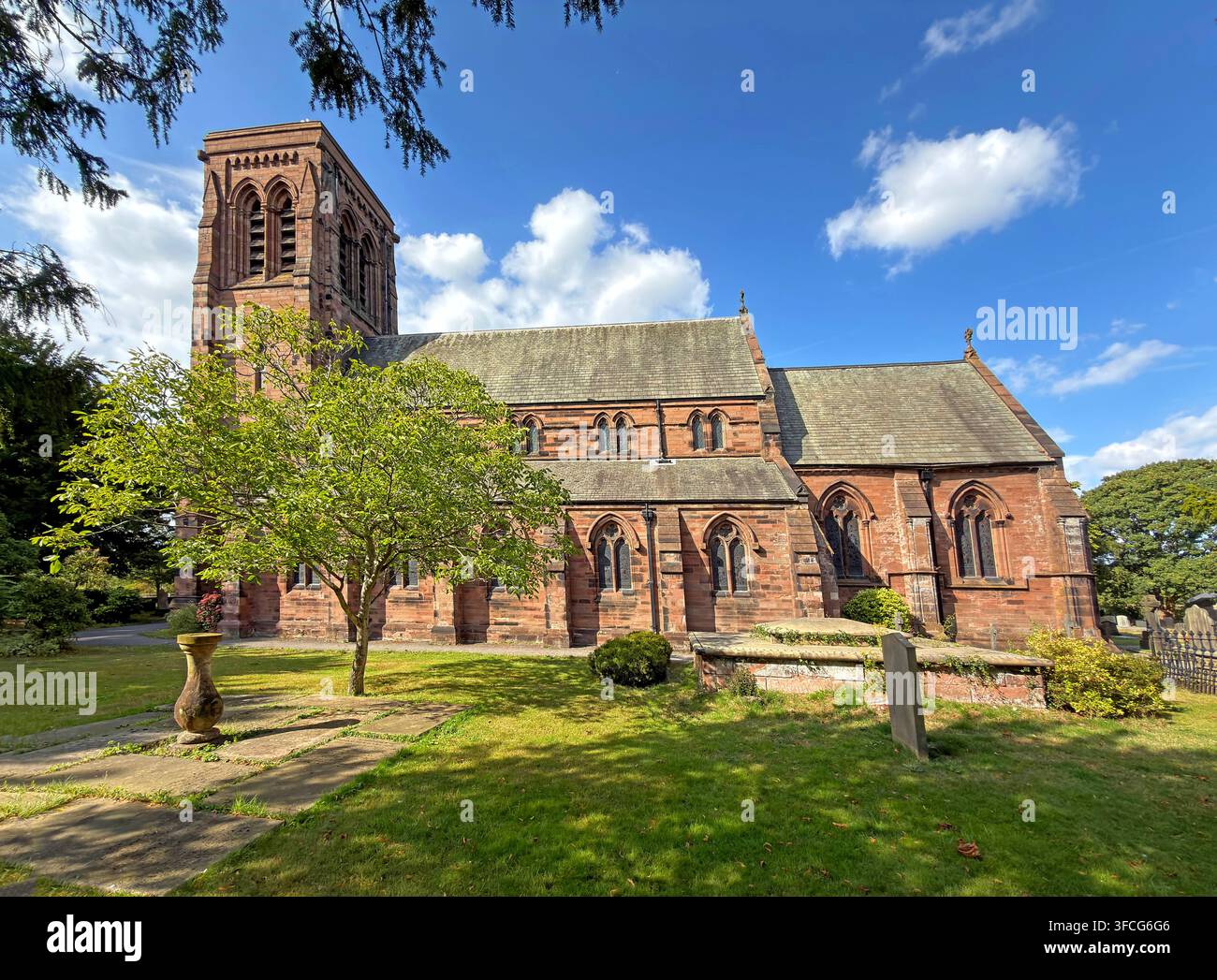
Image details
Contributor:
Tony SmithImage ID:
3FCG6G6File size:
89.7 MB (4.9 MB Compressed download)Releases:
Model - no | Property - noDo I need a release?Dimensions:
6524 x 4807 px | 55.2 x 40.7 cm | 21.7 x 16 inches | 300dpiDate taken:
25 August 2026Location:
St Matthew's Church, Stretton Road, Stretton, Warrington, Cheshire, England, UKMore information:
. St Matthew's Church at Stretton is a Grade II listed Anglican parish church built in red sandstone and strongly associated with the Victorian Gothic Revival. Stretton had much older Christian worship: local church history records a medieval chapel connected with the Starkey family and a later Commissioners' Church of 1826-27 designed by Philip Hardwick. In 1859 Archdeacon Richard Greenall commissioned George Gilbert Scott to build a new chancel, and after Greenall's death the remainder of the church was rebuilt in 1870 as a memorial to him. Historic England describes the present building as a red-sandstone church with Westmorland slate roofs, an aisled nave and a substantial west tower. The photograph is useful as an architectural record of one of the surviving village landmarks around south Warrington, an area where historic settlements now sit close to motorways, commuter housing and modern development. Its masonry, tracery and proportions are characteristic of the nineteenth-century return to medieval-inspired church design. Placed in a 2026 archive, this view becomes a useful before-and-after reference for future changes to the street, service or organisation. Relevant search and editorial concepts include Warrington, Cheshire, North West England, local community, urban fringe, village heritage, transport links, development pressure, public realm, local services. Useful descriptive vocabulary for archive discovery includes St, Matthew, Stretton, Warrington, Cheshire, church, Anglican, parish, Gothic, Revival, George, Gilbert, Scott, red, sandstone, Grade, II, architecture, Victorian, heritage, Westmorland, slate. As a visual record it preserves ordinary details that formal reports often omit, including the condition, presentation and day-to-day setting of the subject at the time of photography. Its value is strongest when used with precise place and date information, making it relevant to archives, newspapers, magazines, books,

