
The Penny Black Wetherspoon pub in Northwich, a 1914 former post office and liftable building
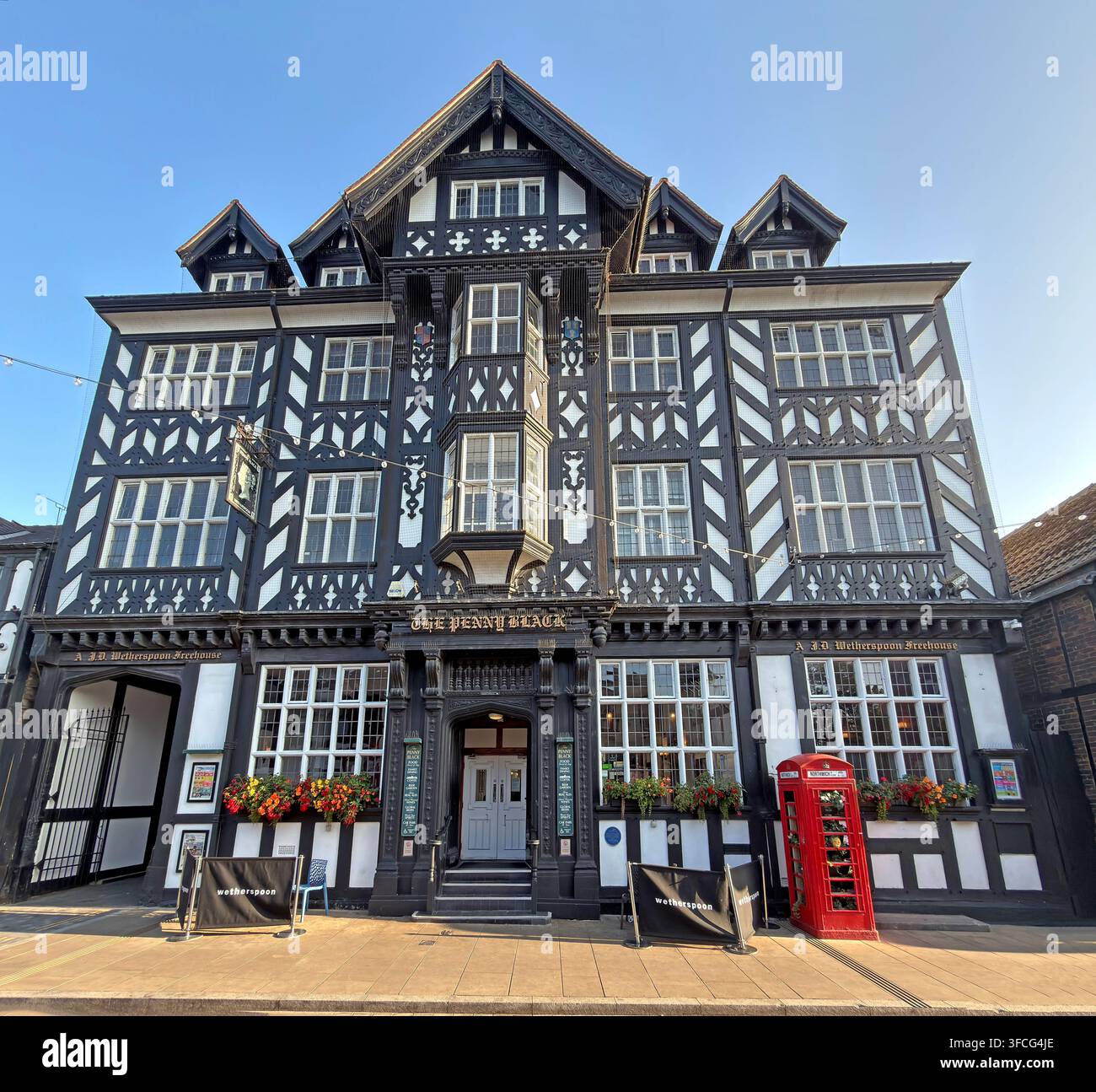
Image details
Contributor:
Tony SmithImage ID:
3FCG4JEFile size:
79.1 MB (3.5 MB Compressed download)Releases:
Model - no | Property - noDo I need a release?Dimensions:
5460 x 5063 px | 46.2 x 42.9 cm | 18.2 x 16.9 inches | 300dpiDate taken:
23 August 2026Location:
The Penny Black, 110 Witton Street, Northwich, Cheshire, CW9 5AB, England, UKMore information:
. The Penny Black at 110 Witton Street is one of Northwich's most distinctive surviving commercial buildings. It was purpose-built in 1914 as the town's main post office and later converted into a J D Wetherspoon pub. Wetherspoon's own history describes it as the town's 'largest liftable building', a timber-framed form deliberately suited to Northwich's notorious ground movement: brine extraction and salt mining caused subsidence, so important structures could be jacked back towards level. The pub name references the Penny Black, the world's first adhesive postage stamp, neatly preserving the building's postal past. CAMRA records that renovation of the Grade II listed former post office was completed in 1999. The exterior's black-and-white timber treatment, gables and strong civic scale make it a landmark on Witton Street. As well as pub, architecture and postal-history searches, the scene can illustrate adaptive reuse, heritage conservation, Britain's salt-industry legacy and the survival of large hospitality venues in changing town centres. Researchers may also find value in the precise visual record of how the premises and its immediate surroundings appeared at the time. Relevant search and editorial concepts include Northwich, Mid Cheshire, Cheshire West and Chester, town centre, Witton Street, River Weaver, salt town, regeneration, local history, public realm, high street, community, Cheshire. Useful descriptive vocabulary for archive discovery includes Penny, Black, Wetherspoon, Northwich, Witton, Street, former, post, office, liftable, building, timber, frame, subsidence, salt, Cheshire, pub, Grade, II, heritage. As a visual record it preserves ordinary details that formal reports often omit, including the condition, presentation and day-to-day setting of the subject at the time of photography. Its value is strongest when used with precise place and date information, making it relevant to archives, newspapers, magazines, books,

