
Panoramic view at Hunt’s Lock on the River Weaver Navigation near Northwich, Cheshire, with lock structures and waterway.
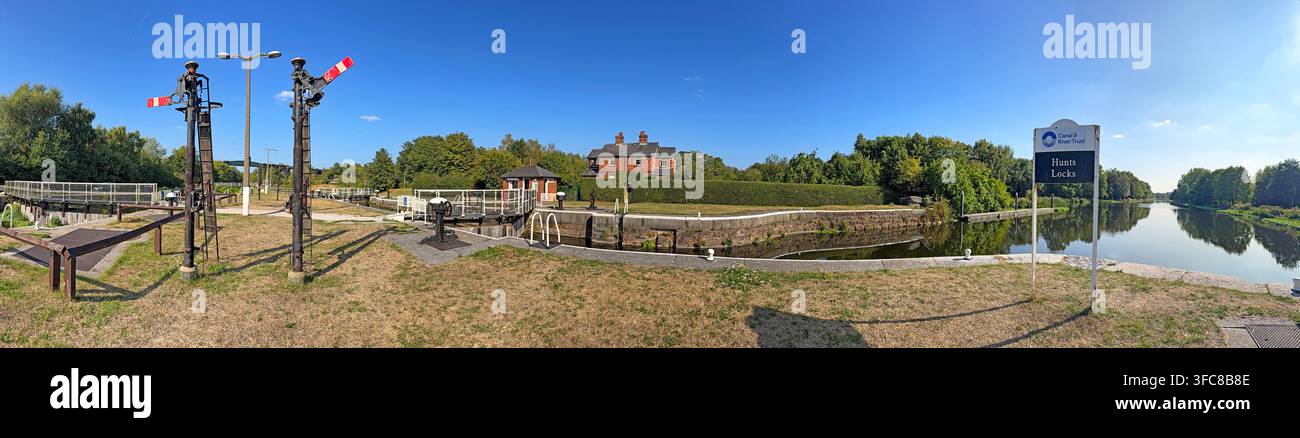
Image details
Contributor:
Tony SmithImage ID:
3FC8B8EFile size:
120.4 MB (7.4 MB Compressed download)Releases:
Model - no | Property - noDo I need a release?Dimensions:
12532 x 3358 px | 106.1 x 28.4 cm | 41.8 x 11.2 inches | 300dpiDate taken:
23 August 2026Location:
Hunt’s Lock, Northwich, Cheshire, England, UKMore information:
. Panorama of hunt’s lock and the river weaver navigation records one of the historic navigation points on the River Weaver near Northwich. The Weaver was improved for navigation from the eighteenth century to serve Cheshire’s salt and chemical industries, allowing large quantities of raw materials and finished products to move between inland works and the Mersey system. Hunt’s Lock developed as part of that commercial waterway and the surrounding engineering landscape includes lock chambers, weirs, bridges and railway infrastructure from different periods. Northwich itself grew around salt: brine extraction, mining and chemical manufacture shaped its economy, architecture and even its ground conditions, with subsidence becoming a defining local issue. Today the Weaver Navigation combines industrial heritage, boating, flood control, wildlife and recreation, so a broad panorama can support stories ranging from canals and river engineering to regeneration and the reuse of former industrial landscapes. The visible lock equipment also reminds viewers that this is managed infrastructure rather than simply a scenic river. The photograph also fixes the appearance of the place in the mid-2020s, preserving details that may later disappear through redevelopment, rebranding or changes in regulation. It is suitable for editorial use on social history, local identity, consumer behaviour and the way everyday streets respond to wider economic forces. Because the photograph is tied to a specific date, it can later be compared with subsequent changes in signage, ownership, regulation, public use or the surrounding streetscape. It additionally captures ordinary material culture of 2026, including the graphic design, technology, clothing or infrastructure through which broader trends become visible at street level. Its small visible details add extra value for researchers comparing change over time. Useful for dated UK editorial coverage.

