
Welsh-language Ofgem energy price cap information on a tablet, explaining household gas and electricity charges in Wales.
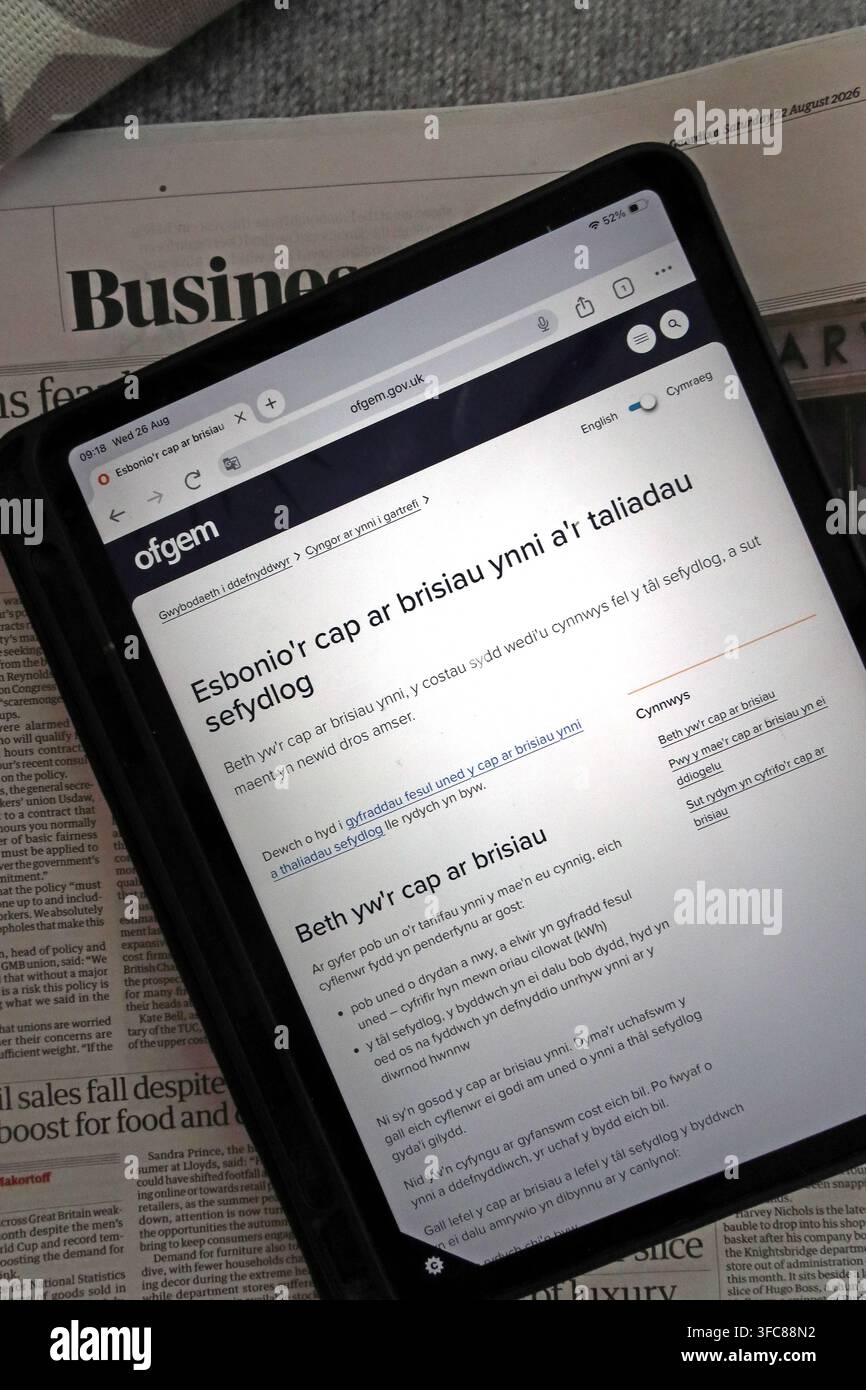
Image details
Contributor:
Tony SmithImage ID:
3FC88N2File size:
57.1 MB (1.9 MB Compressed download)Releases:
Model - no | Property - noDo I need a release?Dimensions:
3648 x 5472 px | 30.9 x 46.3 cm | 12.2 x 18.2 inches | 300dpiDate taken:
26 August 2026Location:
Wales, UKMore information:
. Welsh ofgem price-cap page displayed on a tablet provides a direct contemporary illustration of household energy regulation and billing in Great Britain. The October 2026 cap contains an unusual policy change as well as a price rise. Government removal of VAT from domestic electricity bills from 1 October 2026 to 31 March 2027 is built into Ofgem’s calculation. Electricity costs therefore remain broadly stable for many customers, while gas bills rise more sharply; Ofgem said the typical gas element rises by about 8%. Even with that relief, the overall dual-fuel cap goes up 4% to £1, 723 for the representative direct-debit household. The figures apply across England, Scotland and Wales, with local unit rates and standing charges differing between energy regions. In Wales, Ofgem’s consumer information is also available in Welsh, reflecting bilingual public-service obligations and giving publishers a useful visual for stories specifically about Welsh households. The wider context remains the cost-of-living squeeze, fuel poverty, smart meters, energy debt, standing charges, tariff choice and the transition toward lower-carbon heating and electricity. The composition is also useful as a time capsule: the branding, materials and small practical details visible here are exactly the features most likely to change. That makes the photograph relevant to later stories about continuity, closure, investment, regulation or shifts in public behaviour. The subject provides a concrete visual reference for editors needing a real location rather than a generic illustration of ofgem. Because the photograph is tied to a specific date, it can later be compared with subsequent changes in signage, ownership, regulation, public use or the surrounding streetscape. It additionally captures ordinary material culture of 2026, including the graphic design, technology, clothing or infrastructure through which broader trends become visible at street level.

