
Traditional Cable Street E1 enamel-style street sign for the London Borough of Tower Hamlets, East London, England, UK.
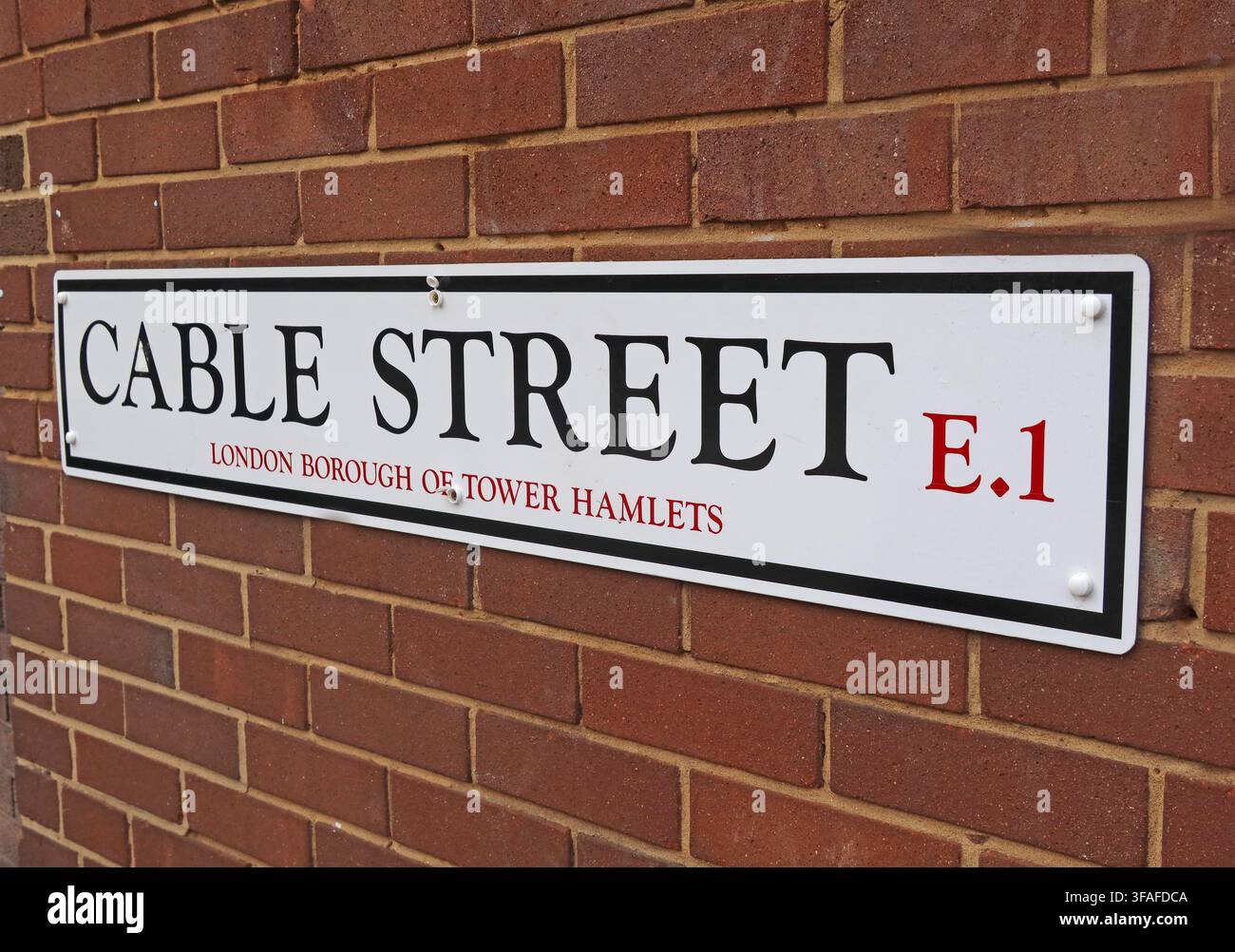
Image details
Contributor:
Tony SmithImage ID:
3FAFDCAFile size:
54.2 MB (2.1 MB Compressed download)Releases:
Model - no | Property - noDo I need a release?Dimensions:
5196 x 3648 px | 44 x 30.9 cm | 17.3 x 12.2 inches | 300dpiDate taken:
23 June 2024Location:
Cable Street, Tower Hamlets, London E1, England, UKMore information:
Close view of a traditional Cable Street E1 street name sign mounted on brickwork in the London Borough of Tower Hamlets. Cable Street runs through the historic East End and is internationally associated with the Battle of Cable Street of 4 October 1936, when local residents and anti-fascist demonstrators opposed a planned march by Oswald Mosley's British Union of Fascists. The simple sign therefore carries strong geographical and historical associations beyond its everyday function as street furniture. This image is suitable for editorial use about Tower Hamlets, Shadwell, East London, postcode geography, London street signs, local identity, urban history, political history, anti-fascism, tourism and the changing East End. The white sign with black lettering and E1 postcode district provides a clear location image, while the surrounding brick wall reinforces the dense urban character of the area. It can also illustrate stories about wayfinding, local authority street furniture and neighbourhood identity. The photograph also provides a contemporary documentary record of surviving East London heritage at a time when property values, redevelopment and changing commercial uses continue to alter the character of inner-city neighbourhoods. Details in the fabric, signage and surrounding streetscape help locate the subject in its real urban setting rather than presenting it as an isolated landmark. It can therefore support features comparing historic London with twenty-first-century development, tourism and conservation policy, as well as archive-style coverage of places whose appearance may change through restoration, conversion or redevelopment.

