
Welcome to Oban railway station sign , ferry terminal, at dusk in Argyll, Scotland
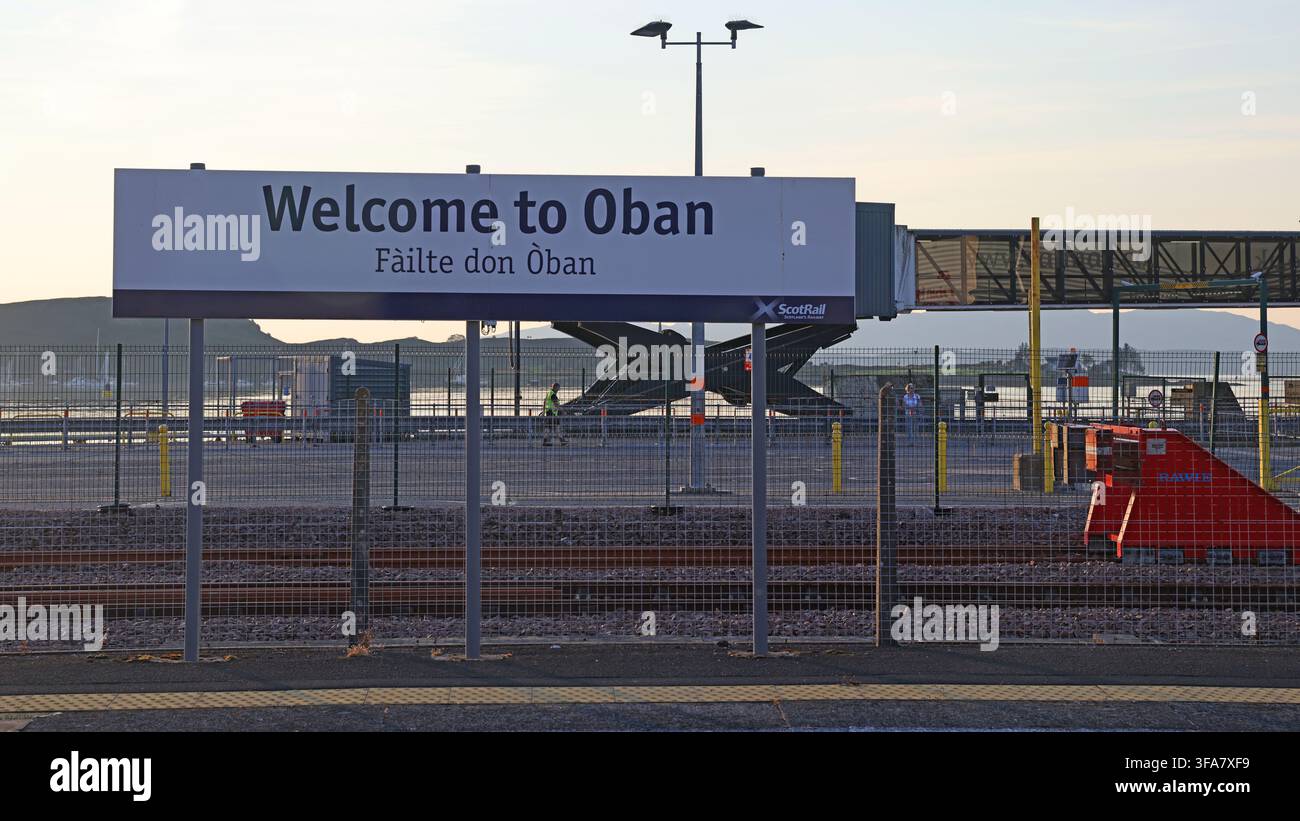
Image details
Contributor:
Tony SmithImage ID:
3FA7XF9File size:
83.3 MB (3.1 MB Compressed download)Releases:
Model - no | Property - noDo I need a release?Dimensions:
7192 x 4049 px | 60.9 x 34.3 cm | 24 x 13.5 inches | 300dpiDate taken:
17 August 2025Location:
Oban, Argyll and Bute, Scotland, UKMore information:
. Welcome to Oban railway station sign , ferry terminal, at dusk in Argyll, Scotland. Photographed on 17 August 2025. The recorded location is Oban, Argyll and Bute, Scotland, UK. Large Welcome to Oban sign at the railway station and transport interchange in the west-coast town of Oban, Scotland, seen in soft evening light. The bilingual welcome message reflects the town's role as a gateway to Argyll and the Inner Hebrides, connecting rail passengers with ferries, buses and local services. The scene provides editorial context for Scottish rail travel, regional connectivity, tourism, public transport, Gaelic identity and arrival in one of the principal transport hubs on Scotland's west coast. Oban grew around a sheltered bay on Scotland's west coast and expanded in the nineteenth century with steamship traffic and the arrival of the railway in 1880. It remains a major gateway to the Inner Hebrides, with CalMac ferries, rail and road connections concentrated around the waterfront. Tourism, seafood, island travel and maritime services all contribute to the town's modern economy. In relation to rolling stock, historical context shows that rail transport links engineering history with everyday mobility; The network evolved through private railway companies, grouping, nationalisation, British Rail and later privatisation, leaving successive layers of architecture, liveries, ticketing equipment and operating practice. For the story of typography, it is useful to note that temporary and permanent notices are valuable social-history evidence because they capture the rules and assumptions of a particular moment, from parking and access to opening times, safety and public-service instructions. The historical setting for harbour town is that harbours and ferry ports have shaped coastal communities for centuries, providing sheltered water for fishing, trade and passenger travel; Quays, piers, slipways and terminal buildings record evolving vessel sizes and the.

