
Repair Cafe Stockton Heath event banner promoting community repair and reuse in Warrington, Cheshire, England, UK.
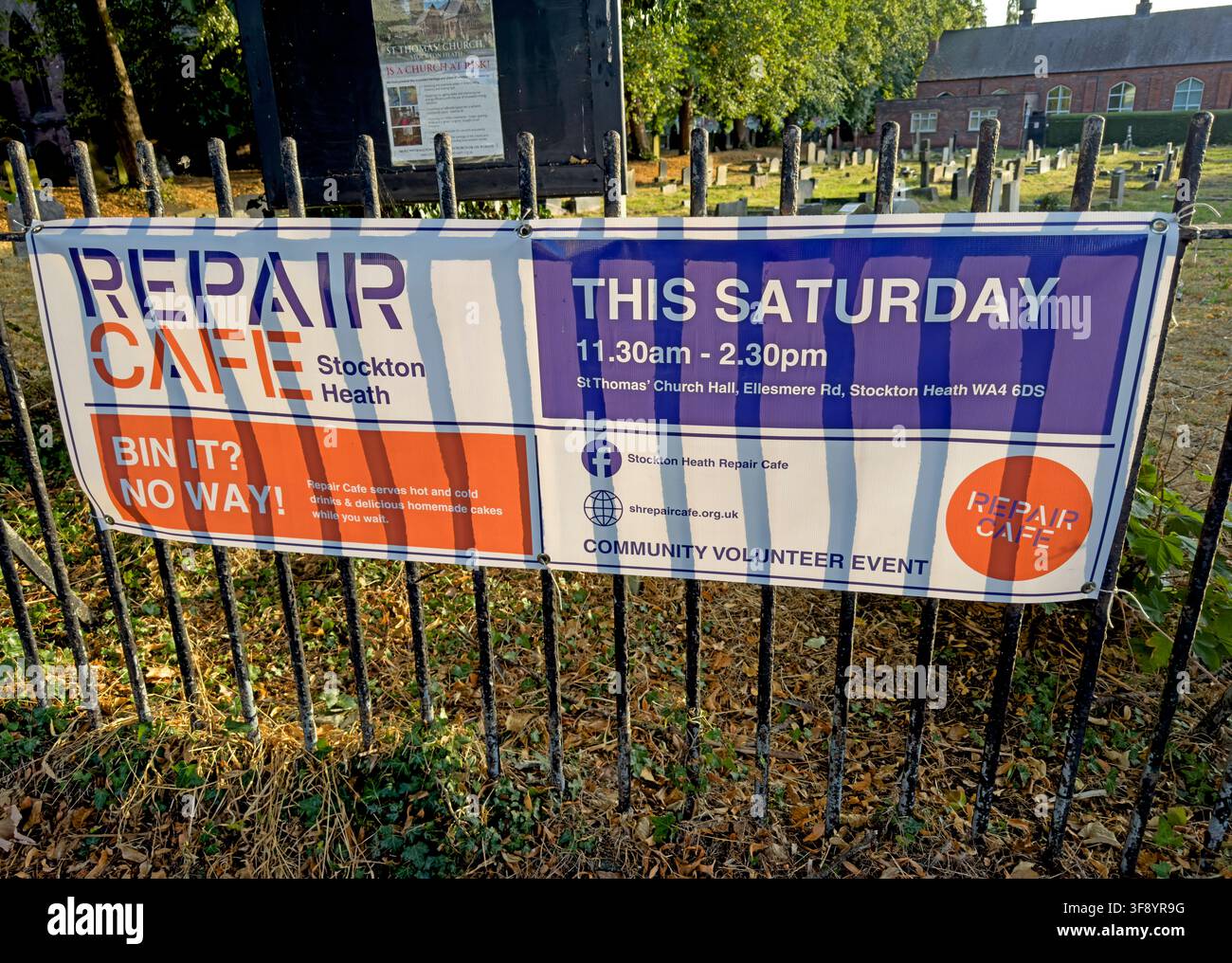
Image details
Contributor:
Tony SmithImage ID:
3F8YR9GFile size:
101.8 MB (4.5 MB Compressed download)Releases:
Model - no | Property - noDo I need a release?Dimensions:
7064 x 5035 px | 59.8 x 42.6 cm | 23.5 x 16.8 inches | 300dpiDate taken:
11 August 2026Location:
Stockton Heath, Warrington, Cheshire, England, UKMore information:
. Repair Cafe Stockton Heath event banner promoting community repair and reuse in Warrington, Cheshire, England, UK. Photographed on 11 August 2026. The recorded location is Stockton Heath, Warrington, Cheshire, England, UK. The sign promotes a community repair session and encourages people to bring broken household items for repair rather than throwing them away. Repair cafes support reuse, waste reduction, practical skills, community volunteering and the circular economy by helping extend the life of everyday products. Looking at dry recycling, the longer history is that recycling systems developed in response to landfill pressure, resource use and environmental targets, but different local collection schemes often created confusion about what belonged in each container. The background to ingredients is that packaging and utensils also matter: corks, bottles and branded labels preserve evidence of production and trade alongside the food or drink itself. Within the history of urban commerce, local businesses provide unusually precise social-history evidence because names, branding and uses change more quickly than the buildings they occupy; A shop, café, pub or service company can disappear while the façade survives, leaving photographs as a record of the previous commercial life of the street. In 2026, dry recycling remains relevant because recycling policy in England is undergoing its biggest standardisation for years; Older photographs of multiple bins or difficult packaging help illustrate why government sought clearer, more consistent collection systems. Current 2026 context around ingredients is that food affordability, provenance, nutrition and environmental impact remain prominent issues, while consumers increasingly balance convenience with interest in local ingredients, international cuisines and lower-waste packaging. Other strongly related concepts include household waste, waste collection, kerbside collection, and food waste.

