
Vintage LMS and LNER railway poster promoting family holidays at sunny Southend-on-Sea, Essex, with Cliff Gardens and the pier.
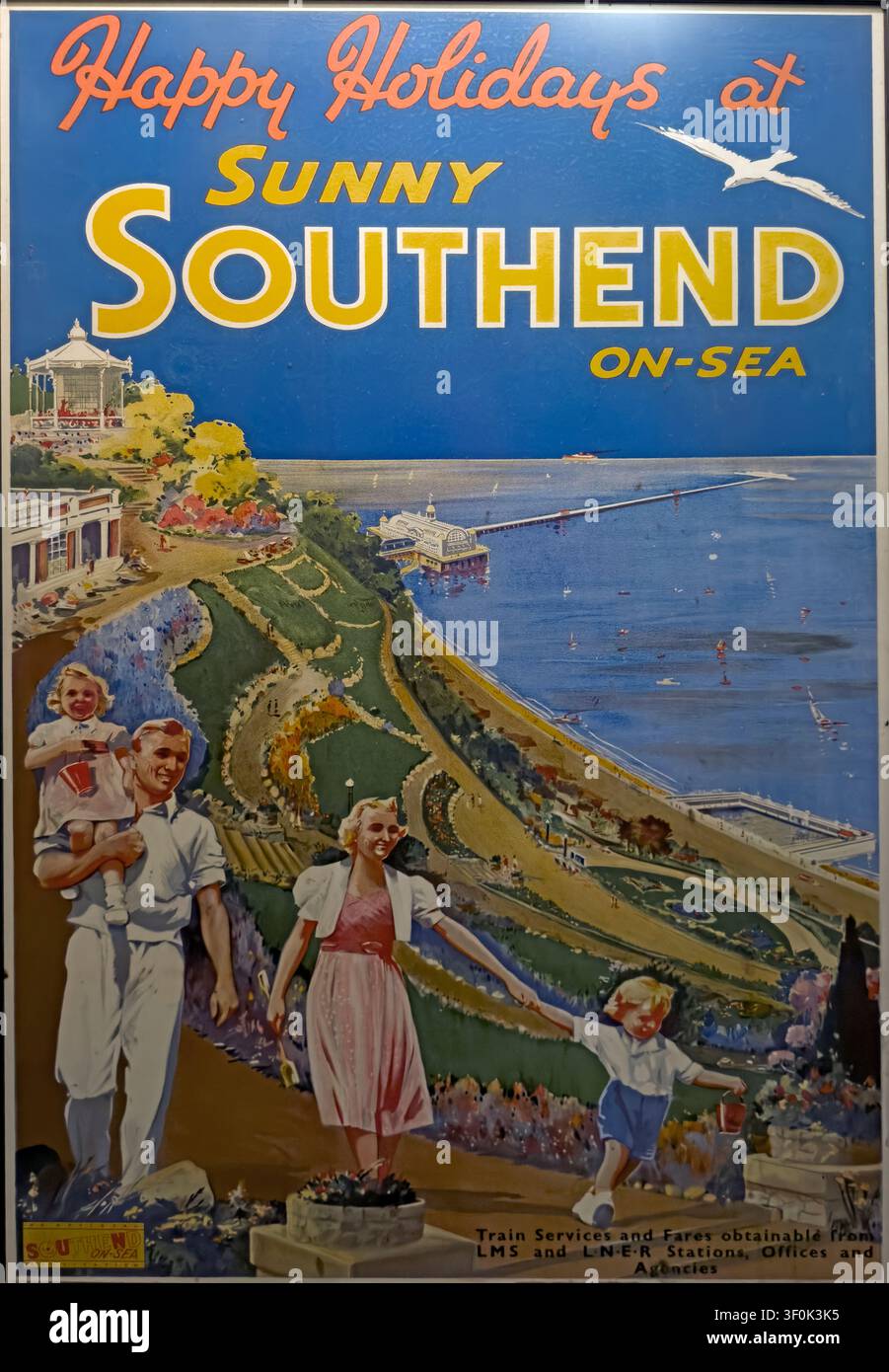
Image details
Contributor:
Tony SmithImage ID:
3F0K3K5File size:
72.1 MB (2.3 MB Compressed download)Releases:
Model - no | Property - noDo I need a release?Dimensions:
4181 x 6028 px | 35.4 x 51 cm | 13.9 x 20.1 inches | 300dpiDate taken:
22 November 2023Location:
Westcliff Parade, Westcliff-on-Sea, Southend-on-Sea, Essex, England, UK, SS0 7QHMore information:
Colourful vintage railway poster promotes “Happy Holidays at Sunny Southend-on-Sea”, presenting the Essex resort as an inviting destination for family leisure and rail tourism. Produced jointly for the London Midland and Scottish Railway and the London and North Eastern Railway, the design dates from around 1945–1947 and belongs to the golden age of British transport advertising. The illustration shows a cheerful family walking through landscaped clifftop gardens above the Thames Estuary. Below them are the seafront, pleasure grounds, beach, promenade and Southend Pier stretching dramatically into the water. A white seabird flies beside the bold yellow and orange lettering, reinforcing the optimistic coastal holiday imagery. The scene combines a panoramic bird’s-eye view with idealised figures, flowers and bright summer colours intended to encourage day trips and longer stays by train. Southend developed rapidly as a seaside resort after railway connections arrived in the nineteenth century. The London, Tilbury and Southend Railway reached the town in 1856, while the Great Eastern Railway opened another route in 1889. Easy access from London helped Southend become one of southern England’s best-known destinations for working families and excursion traffic. Its pier, projecting far into the shallow Thames Estuary, became the defining feature of the resort. The prominent curved sun shelter and Cliff Gardens represented in railway publicity formed part of Southend’s interwar investment in its seafront. The shelter was completed in 1928 and survives on Westcliff Parade as a Grade II listed structure. Posters such as this are important examples of commercial graphic art, showing how railway companies sold not merely transport but an idealised experience of sunshine, fresh air, family recreation and modern mobility. The surviving design is held in the Science Museum Group collection under object number 1978-9514; the artist is not identified in the official catalogue.

