
Verdant Works Museum entrance in Dundee, Scotland, UK.
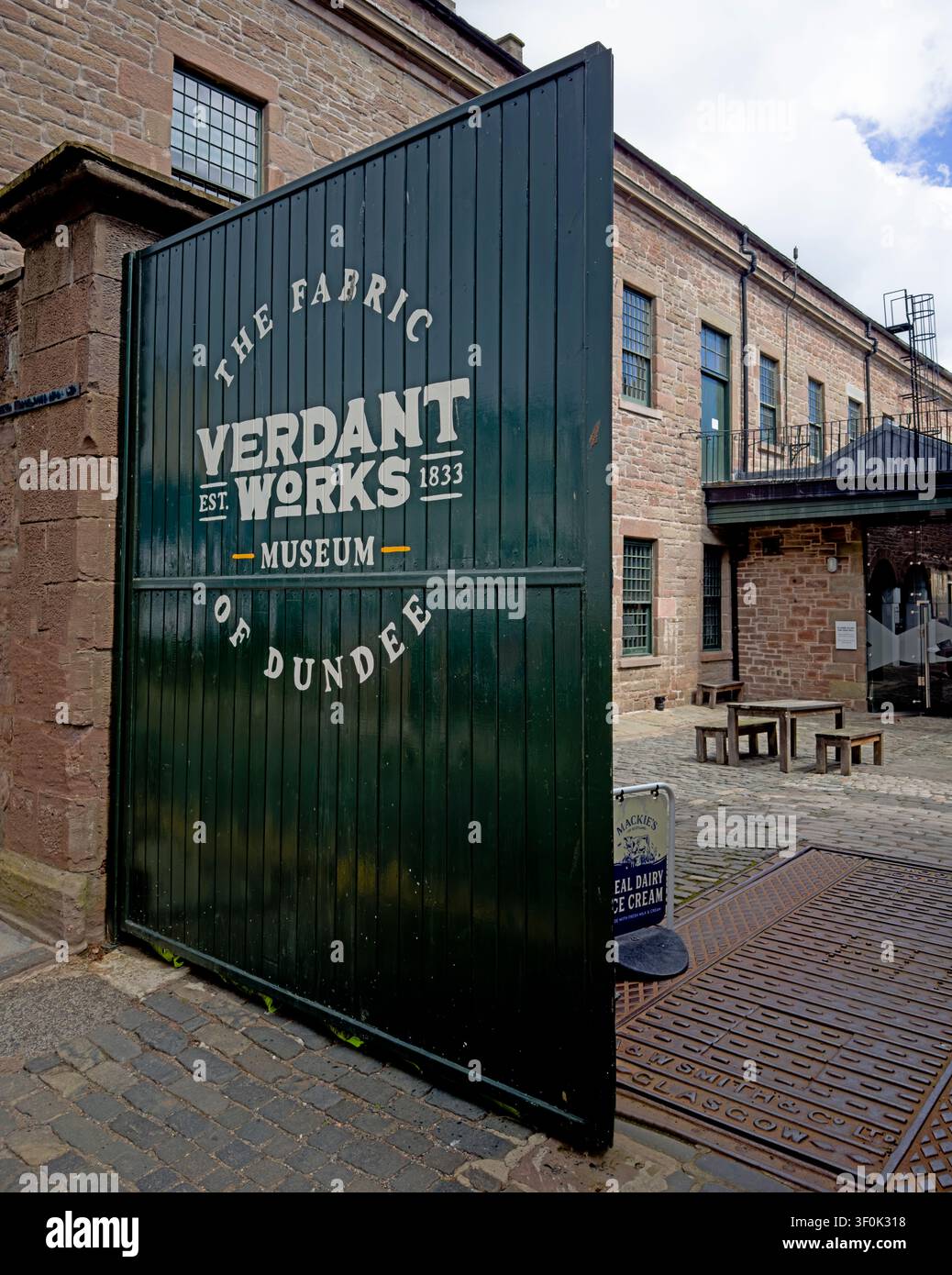
Image details
Contributor:
Tony SmithImage ID:
3F0K318File size:
114.2 MB (4 MB Compressed download)Releases:
Model - no | Property - noDo I need a release?Dimensions:
5648 x 7068 px | 47.8 x 59.8 cm | 18.8 x 23.6 inches | 300dpiDate taken:
9 June 2026Location:
Verdant Works, West Henderson's Wynd, Dundee DD1 5BT, Scotland, UKMore information:
. Verdant Works Museum entrance in Dundee, Scotland, UK. Photographed on 9 June 2026. The recorded location is Verdant Works, West Henderson's Wynd, Dundee DD1 5BT, Scotland, UK. The green industrial-style gate carries prominent VERDANT WORKS MUSEUM lettering with historic brick mill buildings visible behind it. Verdant Works is an industrial heritage museum telling the story of Dundee's jute industry, mill workers and the city's manufacturing past. The entrance design reinforces the site's identity as both a preserved factory complex and a modern visitor attraction. For adaptive reuse, the historical context is that industrial heritage links architecture and machinery with the people who worked in mines, potteries, foundries and factories; As production declined or modernised, many sites were demolished, adapted or preserved as museums and regeneration projects. Looking at digital access, the longer history is that libraries, museums and archives developed as civic institutions for preserving knowledge, objects and local records; Reading rooms, catalogues and display cases reveal how public access to information changed before digitisation transformed research. The background to labour history is that british labour history is closely tied to ports, factories, mines and transport, where collective organisation sought to improve pay, safety and job security. For adaptive reuse, the 2026 context is that industrial heritage is increasingly tied to regeneration, tourism, conservation and skills education, particularly in former manufacturing towns seeking new uses for historic sites. In 2026, digital access remains relevant because digitisation has changed research but has not removed the need for physical archives and collections. institutions increasingly combine online access with conservation of original material and renewed interest in local history. Useful related concepts include industrial archaeology, engineering history, and historic machinery.

