
Traffic cone placed on Edinburgh’s Duke of Wellington statue outside General Register House, echoing a familiar Scottish urban prank
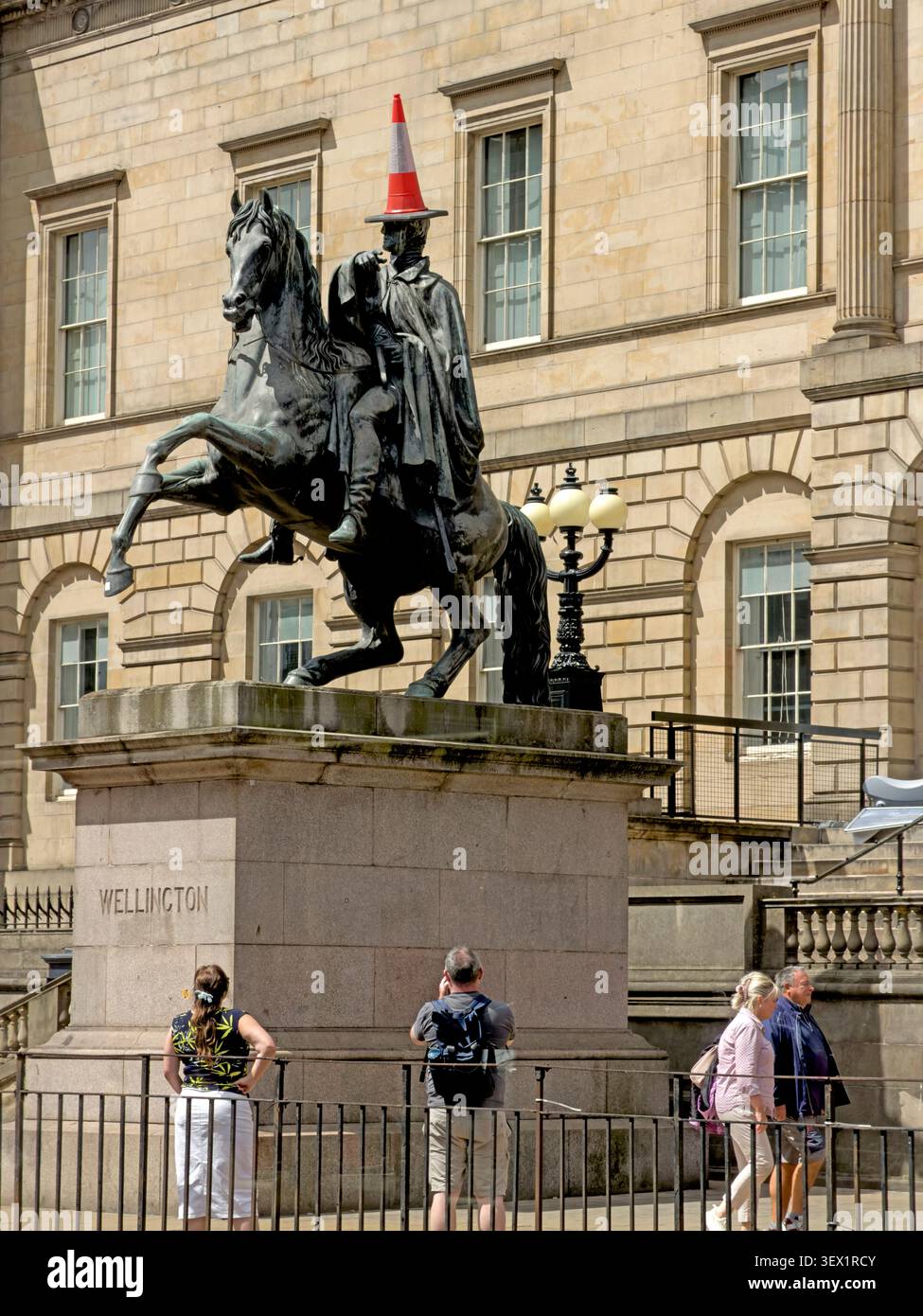
Image details
Contributor:
Tony SmithImage ID:
3EX1RCYFile size:
116.4 MB (3.7 MB Compressed download)Releases:
Model - no | Property - noDo I need a release?Dimensions:
5523 x 7364 px | 46.8 x 62.3 cm | 18.4 x 24.5 inches | 300dpiDate taken:
28 June 2026Location:
General Register House, Princes Street, Edinburgh, EH1 3YY, Scotland, United KingdomMore information:
Equestrian monument to Arthur Wellesley, 1st Duke of Wellington, stands outside General Register House at the east end of Princes Street in central Edinburgh. In this humorous contemporary scene, an orange-and-white road cone has been placed on the military leader’s head, creating a striking contrast between the formal bronze sculpture, its rearing horse and the everyday object balanced above the figure. Sir John Steell’s monument depicts Wellington mounted on Copenhagen, his celebrated war horse. Commissioned in 1842, the bronze work was created during the 1840s and unveiled on 18 June 1852, the thirty-seventh anniversary of the Battle of Waterloo. The sculpture is mounted on a substantial red Aberdeen granite pedestal and forms part of the historic setting of Register House. It is protected as a Category A listed monument. Traffic cones placed on statues have become a familiar feature of Scottish urban humour, most famously associated with the Duke of Wellington outside Glasgow’s Gallery of Modern Art. The appearance of a cone on Edinburgh’s Wellington creates an obvious visual echo of that better-known tradition, combining public art, irreverence and playful street culture. The intervention also prompts debate about civic identity, imitation, harmless mischief, vandalism, public safety and the treatment of historic monuments. Pedestrians gather around the base while the classical stone façade of General Register House fills the background. Bright daylight reveals the bronze surface, architectural masonry, sash windows and decorative street lighting. The photograph is suitable for editorial coverage of Edinburgh tourism, Scottish humour, public sculpture, heritage conservation, city-centre culture, traffic-cone pranks and changing attitudes towards monuments in public space

