
The ornate medieval tower and south side of St Giles Parish Church rise above the leafy churchyard in central Wrexham / Wrecsam city centre
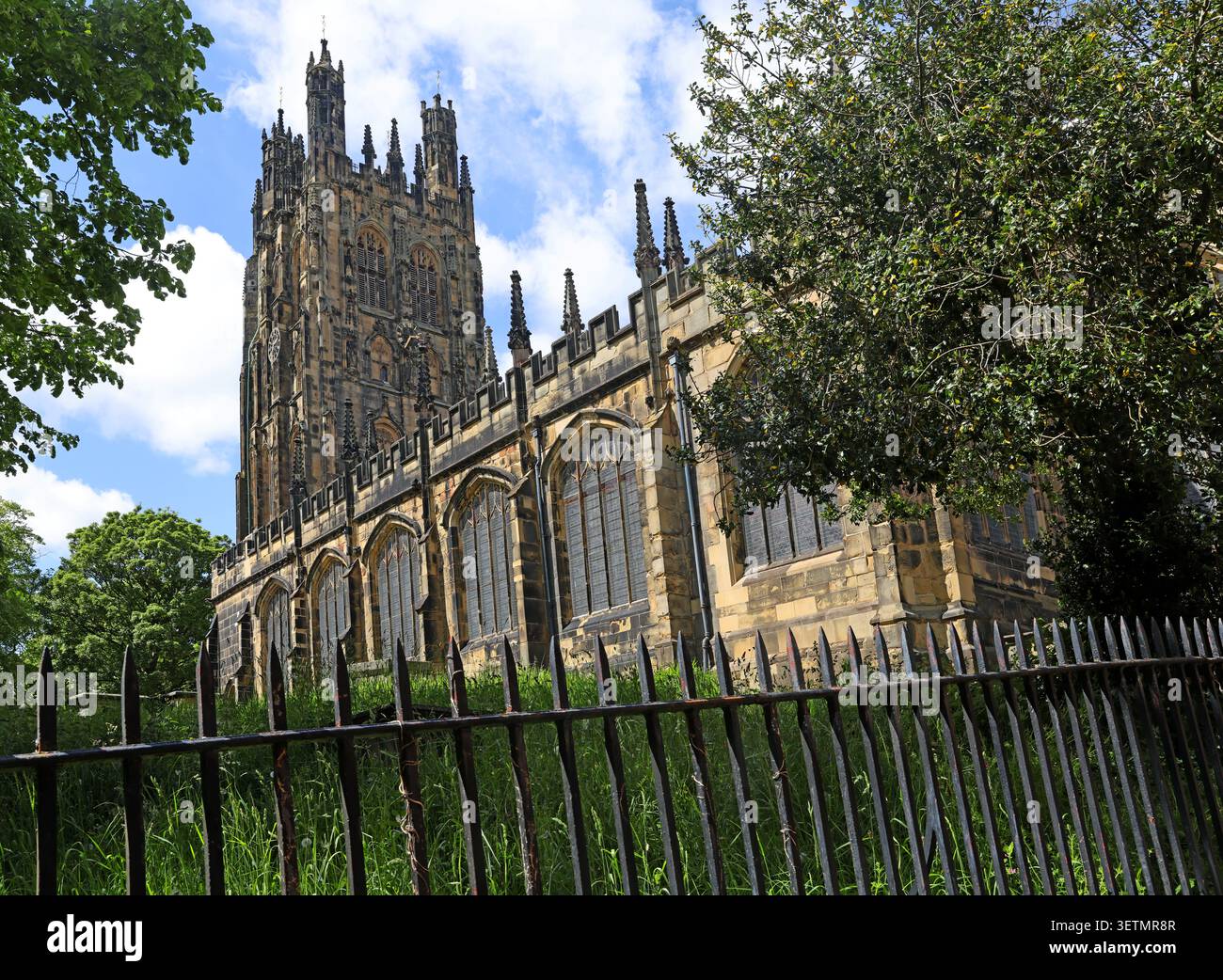
Image details
Contributor:
Tony SmithImage ID:
3ETMR8RFile size:
116.6 MB (7.2 MB Compressed download)Releases:
Model - no | Property - noDo I need a release?Dimensions:
7460 x 5464 px | 63.2 x 46.3 cm | 24.9 x 18.2 inches | 300dpiDate taken:
17 May 2026Location:
St Giles Parish Church, Church Street, Wrexham, Wales, United Kingdom, LL13 7LUMore information:
A low-angle exterior view of St Giles Parish Church, known in Welsh as Eglwys Sant Silyn, in the historic centre of Wrexham, North Wales. Black wrought iron railings cross the foreground, while mature trees and dense summer greenery frame the medieval stone building. Strong sunlight falls across the south wall and its tall traceried windows, with white clouds and patches of blue sky visible behind the richly ornamented tower. The present church was constructed mainly during the late fifteenth and early sixteenth centuries following a major fire in 1463. Earlier Christian worship on the site is documented from the thirteenth century, while local tradition suggests that a still earlier church may have been dedicated to the Celtic saint Silyn. The surviving building is recognised as one of the finest medieval parish churches in Wales and is protected as a Grade I listed structure. Its elaborate tower, completed during the early sixteenth century, rises approximately 41 metres above Wrexham and is decorated with niches, carved figures, battlements and numerous pinnacles. The tower is traditionally celebrated as one of the Seven Wonders of Wales and has long formed the dominant landmark on the city skyline. The church’s long elevations display the strong vertical lines, large windows, buttresses and decorative parapets associated with the Perpendicular Gothic style. Inside are medieval and later monuments, carved stonework, a sixteenth-century wooden roof decorated with musical angels, a rare Doom painting and a brass eagle lectern dated 1524. The churchyard contains the grave of Elihu Yale, the merchant and benefactor after whom Yale University in the United States was named. Historic wrought iron entrance gates were produced by the Davies brothers of Bersham during the early eighteenth century. The photograph emphasises the scale and intricate craftsmanship of the tower when viewed from the surrounding churchyard. Trees, vegetation and railings create a layer

